

Appendix G
Life Cycle Assessment and the Impact Categories
Life Cycle Assessment (LCA) is a methodology developed for the comparison, for
their environmental impact, of different processes that may exist in the same
product. It implies the computation, on the basis of process data (or of
best-simulated process data), of energy input-output, in-out mass balance,
by-product, and waste production. The impact on a number (13) of categories is
evaluated. The expression through a single value of the environmental impact of a
given process has also been attempted with alternate fortune as it is not simple to
find and “equivalence” among the various “impact categories” and to “weigh” them
correctly.
It is a quite complex methodology that requires a careful assessment of data:
wrong fed data produce highly erroneous conclusions. The evaluation of the
uncertainty of data is of fundamental importance.
The absolute assessment of a process has also been attempted with a high
uncertainty about the meaning of conclusions.
Studies carried out by third parties may be considered more reliable than in
house carried studies. The latter, on the other hand, can protect the sensitive process
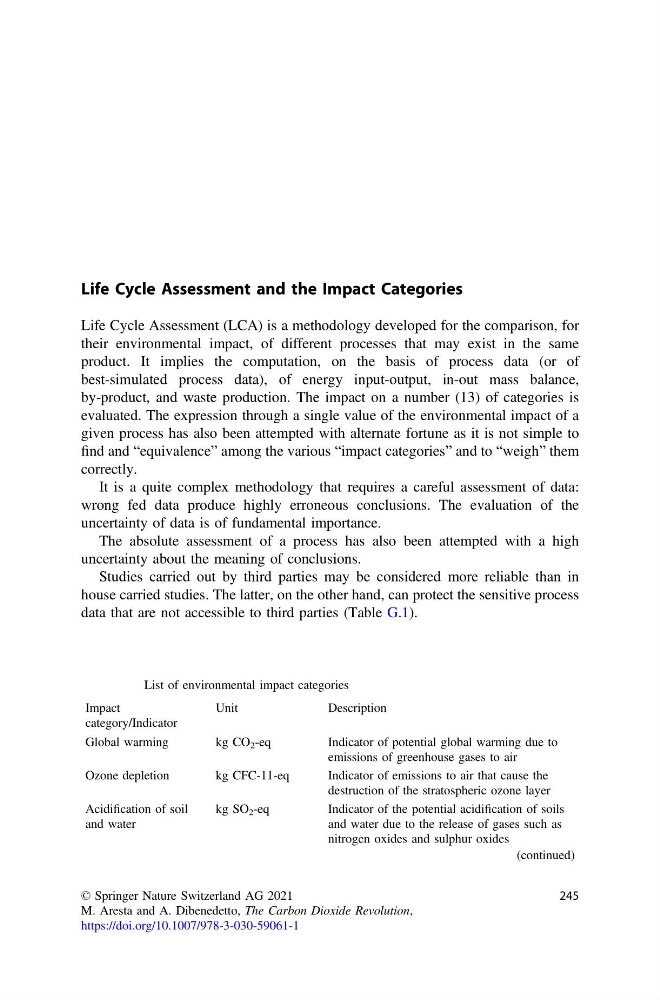
data that are not accessible to third parties (Table G.1).
Table G.1 List of environmental impact categories
Impact
category/Indicator
Unit
Description
Global warming
kg CO 2 -eq
Indicator of potential global warming due to
emissions of greenhouse gases to air
Ozone depletion
kg CFC-11-eq
Indicator of emissions to air that cause the
destruction of the stratospheric ozone layer
Acidification of soil
and water
kg SO 2 -eq
Indicator of the potential acidification of soils
and water due to the release of gases such as
nitrogen oxides and sulphur oxides
(continued)
© Springer Nature Switzerland AG 2021
M. Aresta and A. Dibenedetto, The Carbon Dioxide Revolution,
https://doi.org/10.1007/978-3-030-59061-1
245
Life Cycle Assessment and the Impact Categories
Life Cycle Assessment (LCA) is a methodology developed for the comparison, for
their environmental impact, of different processes that may exist in the same
product. It implies the computation, on the basis of process data (or of
best-simulated process data), of energy input-output, in-out mass balance,
by-product, and waste production. The impact on a number (13) of categories is
evaluated. The expression through a single value of the environmental impact of a
given process has also been attempted with alternate fortune as it is not simple to
find and “equivalence” among the various “impact categories” and to “weigh” them
correctly.
It is a quite complex methodology that requires a careful assessment of data:
wrong fed data produce highly erroneous conclusions. The evaluation of the
uncertainty of data is of fundamental importance.
The absolute assessment of a process has also been attempted with a high
uncertainty about the meaning of conclusions.
Studies carried out by third parties may be considered more reliable than in
house carried studies. The latter, on the other hand, can protect the sensitive process
data that are not accessible to third parties (Table G.1).
Table G.1 List of environmental impact categories
Impact
category/Indicator
Unit
Description
Global warming
kg CO 2 -eq
Indicator of potential global warming due to
emissions of greenhouse gases to air
Ozone depletion
kg CFC-11-eq
Indicator of emissions to air that cause the
destruction of the stratospheric ozone layer
Acidification of soil
and water
kg SO 2 -eq
Indicator of the potential acidification of soils
and water due to the release of gases such as
nitrogen oxides and sulphur oxides
(continued)
© Springer Nature Switzerland AG 2021
M. Aresta and A. Dibenedetto, The Carbon Dioxide Revolution,
https://doi.org/10.1007/978-3-030-59061-1
245