

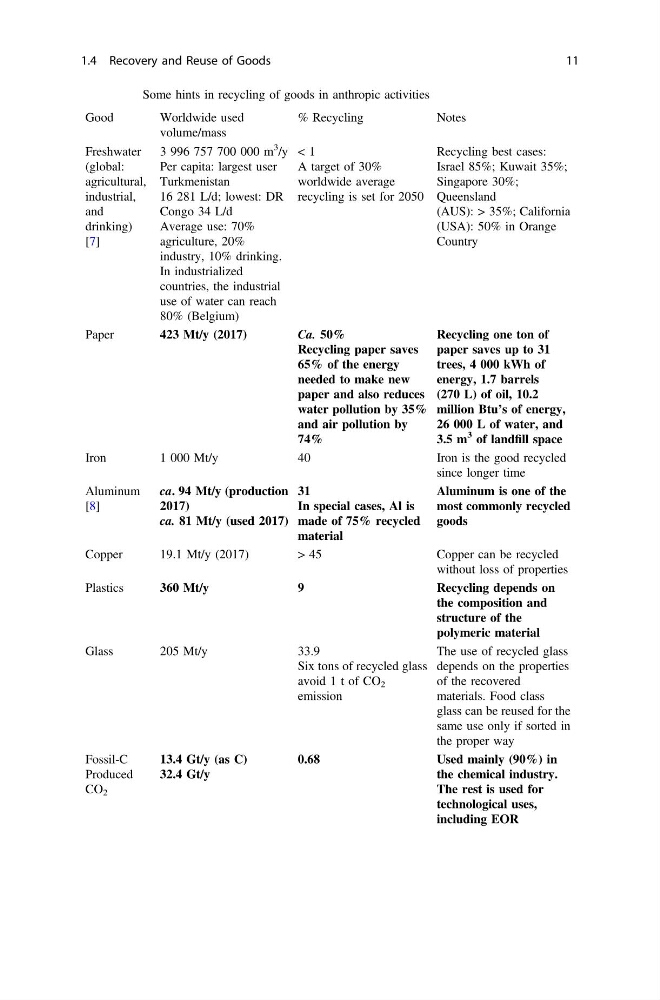
Table 1.9 Some hints in recycling of goods in anthropic activities
Good
Worldwide used
volume/mass
% Recycling
Notes
Freshwater
(global:
agricultural,
industrial,
and
drinking)
[7]
3 996 757 700 000 m
3
/y
Per capita: largest user
Turkmenistan
16 281 L/d; lowest: DR
Congo 34 L/d
Average use: 70%
agriculture, 20%
industry, 10% drinking.
In industrialized
countries, the industrial
use of water can reach
80% (Belgium)
< 1
A target of 30%
worldwide average
recycling is set for 2050
Recycling best cases:
Israel 85%; Kuwait 35%;
Singapore 30%;
Queensland
(AUS): > 35%; California
(USA): 50% in Orange
Country
Paper
423 Mt/y (2017)
Ca. 50%
Recycling paper saves
65% of the energy
needed to make new
paper and also reduces
water pollution by 35%
and air pollution by
74%
Recycling one ton of
paper saves up to 31
trees, 4 000 kWh of
energy, 1.7 barrels
(270 L) of oil, 10.2
million Btu’s of energy,
26 000 L of water, and
3.5 m
3 of landfill space
Iron
1 000 Mt/y
40
Iron is the good recycled
since longer time
Aluminum
[8]
ca. 94 Mt/y (production
2017)
ca. 81 Mt/y (used 2017)
31
In special cases, Al is
made of 75% recycled
material
Aluminum is one of the
most commonly recycled
goods
Copper
19.1 Mt/y (2017)
> 45
Copper can be recycled
without loss of properties
Plastics
360 Mt/y
9
Recycling depends on
the composition and
structure of the
polymeric material
Glass
205 Mt/y
33.9
Six tons of recycled glass
avoid 1 t of CO 2
emission
The use of recycled glass
depends on the properties
of the recovered
materials. Food class
glass can be reused for the
same use only if sorted in
the proper way
Fossil-C
Produced
CO 2
13.4 Gt/y (as C)
32.4 Gt/y
0.68
Used mainly (90%) in
the chemical industry.
The rest is used for
technological uses,
including EOR
1.4 Recovery and Reuse of Goods
11
Good
Worldwide used
volume/mass
% Recycling
Notes
Freshwater
(global:
agricultural,
industrial,
and
drinking)
[7]
3 996 757 700 000 m
3
/y
Per capita: largest user
Turkmenistan
16 281 L/d; lowest: DR
Congo 34 L/d
Average use: 70%
agriculture, 20%
industry, 10% drinking.
In industrialized
countries, the industrial
use of water can reach
80% (Belgium)
< 1
A target of 30%
worldwide average
recycling is set for 2050
Recycling best cases:
Israel 85%; Kuwait 35%;
Singapore 30%;
Queensland
(AUS): > 35%; California
(USA): 50% in Orange
Country
Paper
423 Mt/y (2017)
Ca. 50%
Recycling paper saves
65% of the energy
needed to make new
paper and also reduces
water pollution by 35%
and air pollution by
74%
Recycling one ton of
paper saves up to 31
trees, 4 000 kWh of
energy, 1.7 barrels
(270 L) of oil, 10.2
million Btu’s of energy,
26 000 L of water, and
3.5 m
3 of landfill space
Iron
1 000 Mt/y
40
Iron is the good recycled
since longer time
Aluminum
[8]
ca. 94 Mt/y (production
2017)
ca. 81 Mt/y (used 2017)
31
In special cases, Al is
made of 75% recycled
material
Aluminum is one of the
most commonly recycled
goods
Copper
19.1 Mt/y (2017)
> 45
Copper can be recycled
without loss of properties
Plastics
360 Mt/y
9
Recycling depends on
the composition and
structure of the
polymeric material
Glass
205 Mt/y
33.9
Six tons of recycled glass
avoid 1 t of CO 2
emission
The use of recycled glass
depends on the properties
of the recovered
materials. Food class
glass can be reused for the
same use only if sorted in
the proper way
Fossil-C
Produced
CO 2
13.4 Gt/y (as C)
32.4 Gt/y
0.68
Used mainly (90%) in
the chemical industry.
The rest is used for
technological uses,
including EOR
1.4 Recovery and Reuse of Goods
11