

3
2 = 18) (see the Periodic Table in the Appendix J for the symbols and
electronic structures).
iv. The “valence electrons” are those of the uncomplete level. H has one electron in the level K (or 1) and thus has one valence electron. Its electronic
structure is indicated as Ks
1 or 1s
1 . He, the second element of the first Period
has an electronic structure 1s
2 : the level is complete: the two electrons of He
are not considered as valence electrons, He has a scarce reactivity, it is
labeled “noble gas.” C has six electrons in total, two belonging to the K (or
1) level and four to the L (or 2) level: the latter are “valence electrons”. Its
electronic structure is K2s
2 2p
2 . N has an electronic structure K2s
2 2p
3 . O has
an electronic structure K2s
2 2p
4 . Ne ha an electronic structure K2s
2 2p
6 or KL:
both are completed and Ne again has no electrons suitable for the formation
of bonds at low energy, it is said to be a non-reactive or noble gas, as He. The
notation K in C, N, O means that the K level is full, or 1s
2 : such electrons are
not valence electrons and will not be implied in bond formation.
v. By convention, all elemental species have oxidation state, n ox equal to zero.
So, Fe, Ni, H 2 , N 2 , O 3 , P 4 , S 8 , have all n ox equal to zero, even if some of
them are molecules and not atoms.
Orbitals s
Orbitals p
Orbitals d
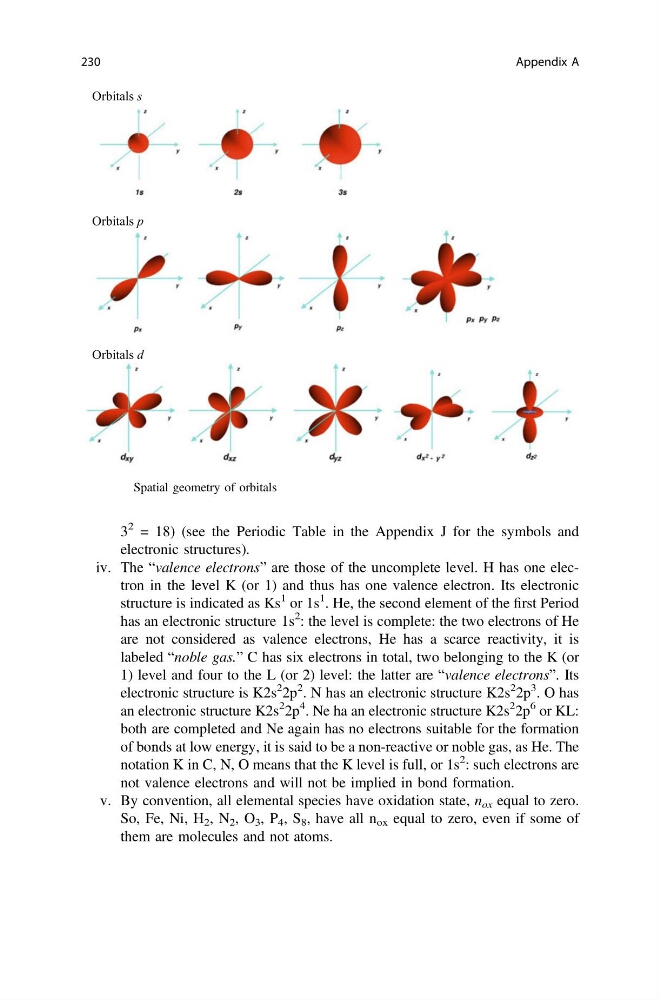
Fig. A.1 Spatial geometry of orbitals
230
Appendix A
2 = 18) (see the Periodic Table in the Appendix J for the symbols and
electronic structures).
iv. The “valence electrons” are those of the uncomplete level. H has one electron in the level K (or 1) and thus has one valence electron. Its electronic
structure is indicated as Ks
1 or 1s
1 . He, the second element of the first Period
has an electronic structure 1s
2 : the level is complete: the two electrons of He
are not considered as valence electrons, He has a scarce reactivity, it is
labeled “noble gas.” C has six electrons in total, two belonging to the K (or
1) level and four to the L (or 2) level: the latter are “valence electrons”. Its
electronic structure is K2s
2 2p
2 . N has an electronic structure K2s
2 2p
3 . O has
an electronic structure K2s
2 2p
4 . Ne ha an electronic structure K2s
2 2p
6 or KL:
both are completed and Ne again has no electrons suitable for the formation
of bonds at low energy, it is said to be a non-reactive or noble gas, as He. The
notation K in C, N, O means that the K level is full, or 1s
2 : such electrons are
not valence electrons and will not be implied in bond formation.
v. By convention, all elemental species have oxidation state, n ox equal to zero.
So, Fe, Ni, H 2 , N 2 , O 3 , P 4 , S 8 , have all n ox equal to zero, even if some of
them are molecules and not atoms.
Orbitals s
Orbitals p
Orbitals d
Fig. A.1 Spatial geometry of orbitals
230
Appendix A