

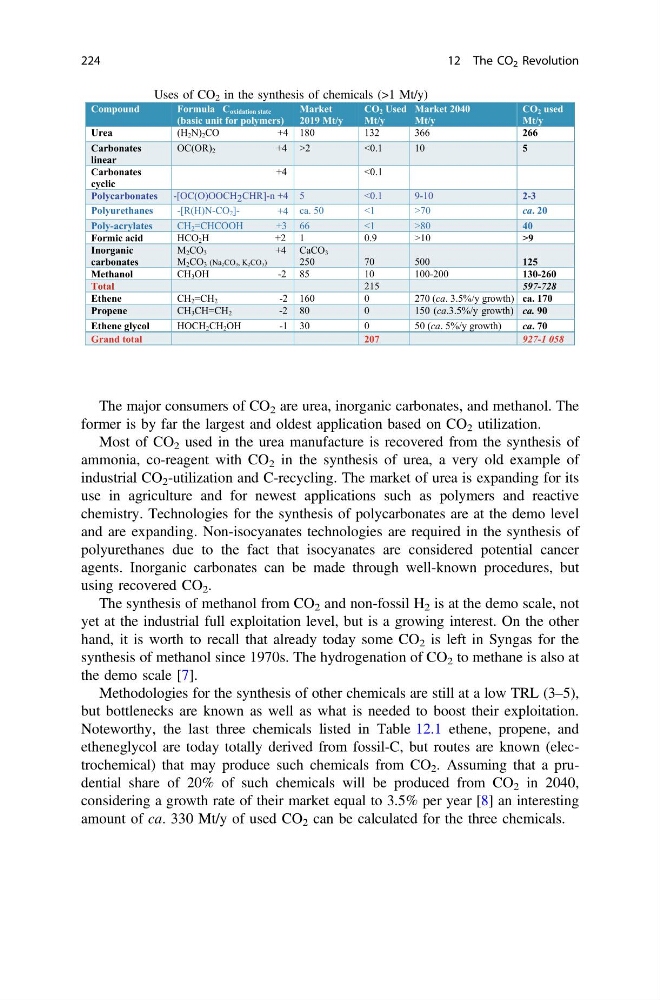
The major consumers of CO 2 are urea, inorganic carbonates, and methanol. The
former is by far the largest and oldest application based on CO 2 utilization.
Most of CO 2 used in the urea manufacture is recovered from the synthesis of
ammonia, co-reagent with CO 2 in the synthesis of urea, a very old example of
industrial CO 2 -utilization and C-recycling. The market of urea is expanding for its
use in agriculture and for newest applications such as polymers and reactive
chemistry. Technologies for the synthesis of polycarbonates are at the demo level
and are expanding. Non-isocyanates technologies are required in the synthesis of
polyurethanes due to the fact that isocyanates are considered potential cancer
agents. Inorganic carbonates can be made through well-known procedures, but
using recovered CO 2 .
The synthesis of methanol from CO 2 and non-fossil H 2 is at the demo scale, not
yet at the industrial full exploitation level, but is a growing interest. On the other
hand, it is worth to recall that already today some CO 2 is left in Syngas for the
synthesis of methanol since 1970s. The hydrogenation of CO 2 to methane is also at
the demo scale [7].
Methodologies for the synthesis of other chemicals are still at a low TRL (3–5),
but bottlenecks are known as well as what is needed to boost their exploitation.
Noteworthy, the last three chemicals listed in Table 12.1 ethene, propene, and
etheneglycol are today totally derived from fossil-C, but routes are known (electrochemical) that may produce such chemicals from CO 2 . Assuming that a prudential share of 20% of such chemicals will be produced from CO 2 in 2040,
considering a growth rate of their market equal to 3.5% per year [8] an interesting
amount of ca. 330 Mt/y of used CO 2 can be calculated for the three chemicals.
Table 12.1 Uses of CO 2 in the synthesis of chemicals (>1 Mt/y)
Compound
Formula C oxidation state
(basic unit for polymers)
Market
2019 Mt/y
CO 2 Used
Mt/y
Market 2040
Mt/y
CO 2 used
Mt/y
Urea
(H 2 N) 2 CO
+4 180
132
366
266
Carbonates
linear
OC(OR) 2
+4 >2
<0.1
10
5
Carbonates
cyclic
+4
<0.1
Polycarbonates
-[OC(O)OOCH 2 CHR]-n +4 5
<0.1
9-10
2-3
Polyurethanes
-[R(H)N-CO 2 ]+4 ca. 50
<1
>70
ca. 20
Poly-acrylates
CH 2 =CHCOOH
+3 66
<1
>80
40
Formic acid
HCO 2 H
+2 1
0.9
>10
>9
Inorganic
carbonates
M 2 CO 3
+4
M CO 3 (Na2CO3, K2CO3)
CaCO 3
250
70
500
125
Methanol
CH 3 OH
-2 85
10
100-200
130-260
Total
215
597-728
Ethene
CH 2 =CH 2
-2 160
0
270 (ca. 3.5%/y growth) ca. 170
Propene
CH 3 CH=CH 2
-2 80
0
150 (ca.3.5%/y growth) ca. 90
Ethene glycol
HOCH 2 CH 2 OH
-1 30
0
50 (ca. 5%/y growth)
ca. 70
Grand total
207
927-1 058
2
224
12 The CO 2 Revolution
former is by far the largest and oldest application based on CO 2 utilization.
Most of CO 2 used in the urea manufacture is recovered from the synthesis of
ammonia, co-reagent with CO 2 in the synthesis of urea, a very old example of
industrial CO 2 -utilization and C-recycling. The market of urea is expanding for its
use in agriculture and for newest applications such as polymers and reactive
chemistry. Technologies for the synthesis of polycarbonates are at the demo level
and are expanding. Non-isocyanates technologies are required in the synthesis of
polyurethanes due to the fact that isocyanates are considered potential cancer
agents. Inorganic carbonates can be made through well-known procedures, but
using recovered CO 2 .
The synthesis of methanol from CO 2 and non-fossil H 2 is at the demo scale, not
yet at the industrial full exploitation level, but is a growing interest. On the other
hand, it is worth to recall that already today some CO 2 is left in Syngas for the
synthesis of methanol since 1970s. The hydrogenation of CO 2 to methane is also at
the demo scale [7].
Methodologies for the synthesis of other chemicals are still at a low TRL (3–5),
but bottlenecks are known as well as what is needed to boost their exploitation.
Noteworthy, the last three chemicals listed in Table 12.1 ethene, propene, and
etheneglycol are today totally derived from fossil-C, but routes are known (electrochemical) that may produce such chemicals from CO 2 . Assuming that a prudential share of 20% of such chemicals will be produced from CO 2 in 2040,
considering a growth rate of their market equal to 3.5% per year [8] an interesting
amount of ca. 330 Mt/y of used CO 2 can be calculated for the three chemicals.
Table 12.1 Uses of CO 2 in the synthesis of chemicals (>1 Mt/y)
Compound
Formula C oxidation state
(basic unit for polymers)
Market
2019 Mt/y
CO 2 Used
Mt/y
Market 2040
Mt/y
CO 2 used
Mt/y
Urea
(H 2 N) 2 CO
+4 180
132
366
266
Carbonates
linear
OC(OR) 2
+4 >2
<0.1
10
5
Carbonates
cyclic
+4
<0.1
Polycarbonates
-[OC(O)OOCH 2 CHR]-n +4 5
<0.1
9-10
2-3
Polyurethanes
-[R(H)N-CO 2 ]+4 ca. 50
<1
>70
ca. 20
Poly-acrylates
CH 2 =CHCOOH
+3 66
<1
>80
40
Formic acid
HCO 2 H
+2 1
0.9
>10
>9
Inorganic
carbonates
M 2 CO 3
+4
M CO 3 (Na2CO3, K2CO3)
CaCO 3
250
70
500
125
Methanol
CH 3 OH
-2 85
10
100-200
130-260
Total
215
597-728
Ethene
CH 2 =CH 2
-2 160
0
270 (ca. 3.5%/y growth) ca. 170
Propene
CH 3 CH=CH 2
-2 80
0
150 (ca.3.5%/y growth) ca. 90
Ethene glycol
HOCH 2 CH 2 OH
-1 30
0
50 (ca. 5%/y growth)
ca. 70
Grand total
207
927-1 058
2
224
12 The CO 2 Revolution