

States, India, and western China. In each case, this was associated with an increase
in: temperature, low clouds, and specific humidity. It looks like atmospheric water
vapor level is increasing even at a higher rate than that of CO 2 . Therefore, the
increase of the concentration of both H 2 O and CO 2 is causing trapping IR radiations
that cannot escape the atmosphere, increasing the average temperature of the planet.
The higher concentration of water vapor causes heavy rains, which we see these
days, even in geographical areas which were not used to such phenomena, causing
serious disasters, and the reinforcing of such phenomena in equatorial areas.
Extreme events are the evidence of climate change that is usually ascribed to the
increase of the CO 2 level in the atmosphere, but in our opinion should be more
correctly ascribed to the overall inefficient use of fossil-C, which is the real origin of
all problems. A question rises quite spontaneous: if we would be able to capture all
emitted CO 2 and would continue to warm up the atmosphere at the actual rate by
emitting heat, would climate change stop or would we most likely continue to
observe an increase of the average temperature of our planet as today, due to the
release of heat to the atmosphere and the greenhouse effect of water vapor that is
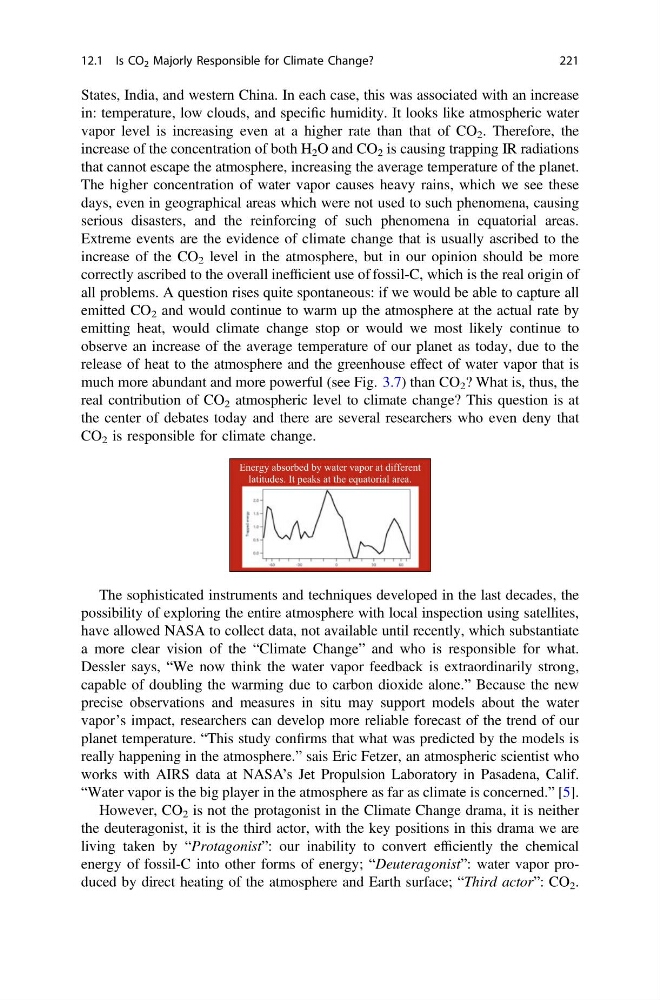
much more abundant and more powerful (see Fig. 3.7) than CO 2 ? What is, thus, the
real contribution of CO 2 atmospheric level to climate change? This question is at
the center of debates today and there are several researchers who even deny that
CO 2 is responsible for climate change.
Energy absorbed by water vapor at different
latitudes. It peaks at the equatorial area.
The sophisticated instruments and techniques developed in the last decades, the
possibility of exploring the entire atmosphere with local inspection using satellites,
have allowed NASA to collect data, not available until recently, which substantiate
a more clear vision of the “Climate Change” and who is responsible for what.
Dessler says, “We now think the water vapor feedback is extraordinarily strong,
capable of doubling the warming due to carbon dioxide alone.” Because the new
precise observations and measures in situ may support models about the water
vapor’s impact, researchers can develop more reliable forecast of the trend of our
planet temperature. “This study confirms that what was predicted by the models is
really happening in the atmosphere.” sais Eric Fetzer, an atmospheric scientist who
works with AIRS data at NASA’s Jet Propulsion Laboratory in Pasadena, Calif.
“Water vapor is the big player in the atmosphere as far as climate is concerned.” [5].
However, CO 2 is not the protagonist in the Climate Change drama, it is neither
the deuteragonist, it is the third actor, with the key positions in this drama we are
living taken by “Protagonist”: our inability to convert efficiently the chemical
energy of fossil-C into other forms of energy; “Deuteragonist”: water vapor produced by direct heating of the atmosphere and Earth surface; “Third actor”: CO 2 .
12.1 Is CO 2 Majorly Responsible for Climate Change?
221
in: temperature, low clouds, and specific humidity. It looks like atmospheric water
vapor level is increasing even at a higher rate than that of CO 2 . Therefore, the
increase of the concentration of both H 2 O and CO 2 is causing trapping IR radiations
that cannot escape the atmosphere, increasing the average temperature of the planet.
The higher concentration of water vapor causes heavy rains, which we see these
days, even in geographical areas which were not used to such phenomena, causing
serious disasters, and the reinforcing of such phenomena in equatorial areas.
Extreme events are the evidence of climate change that is usually ascribed to the
increase of the CO 2 level in the atmosphere, but in our opinion should be more
correctly ascribed to the overall inefficient use of fossil-C, which is the real origin of
all problems. A question rises quite spontaneous: if we would be able to capture all
emitted CO 2 and would continue to warm up the atmosphere at the actual rate by
emitting heat, would climate change stop or would we most likely continue to
observe an increase of the average temperature of our planet as today, due to the
release of heat to the atmosphere and the greenhouse effect of water vapor that is
much more abundant and more powerful (see Fig. 3.7) than CO 2 ? What is, thus, the
real contribution of CO 2 atmospheric level to climate change? This question is at
the center of debates today and there are several researchers who even deny that
CO 2 is responsible for climate change.
Energy absorbed by water vapor at different
latitudes. It peaks at the equatorial area.
The sophisticated instruments and techniques developed in the last decades, the
possibility of exploring the entire atmosphere with local inspection using satellites,
have allowed NASA to collect data, not available until recently, which substantiate
a more clear vision of the “Climate Change” and who is responsible for what.
Dessler says, “We now think the water vapor feedback is extraordinarily strong,
capable of doubling the warming due to carbon dioxide alone.” Because the new
precise observations and measures in situ may support models about the water
vapor’s impact, researchers can develop more reliable forecast of the trend of our
planet temperature. “This study confirms that what was predicted by the models is
really happening in the atmosphere.” sais Eric Fetzer, an atmospheric scientist who
works with AIRS data at NASA’s Jet Propulsion Laboratory in Pasadena, Calif.
“Water vapor is the big player in the atmosphere as far as climate is concerned.” [5].
However, CO 2 is not the protagonist in the Climate Change drama, it is neither
the deuteragonist, it is the third actor, with the key positions in this drama we are
living taken by “Protagonist”: our inability to convert efficiently the chemical
energy of fossil-C into other forms of energy; “Deuteragonist”: water vapor produced by direct heating of the atmosphere and Earth surface; “Third actor”: CO 2 .
12.1 Is CO 2 Majorly Responsible for Climate Change?
221