

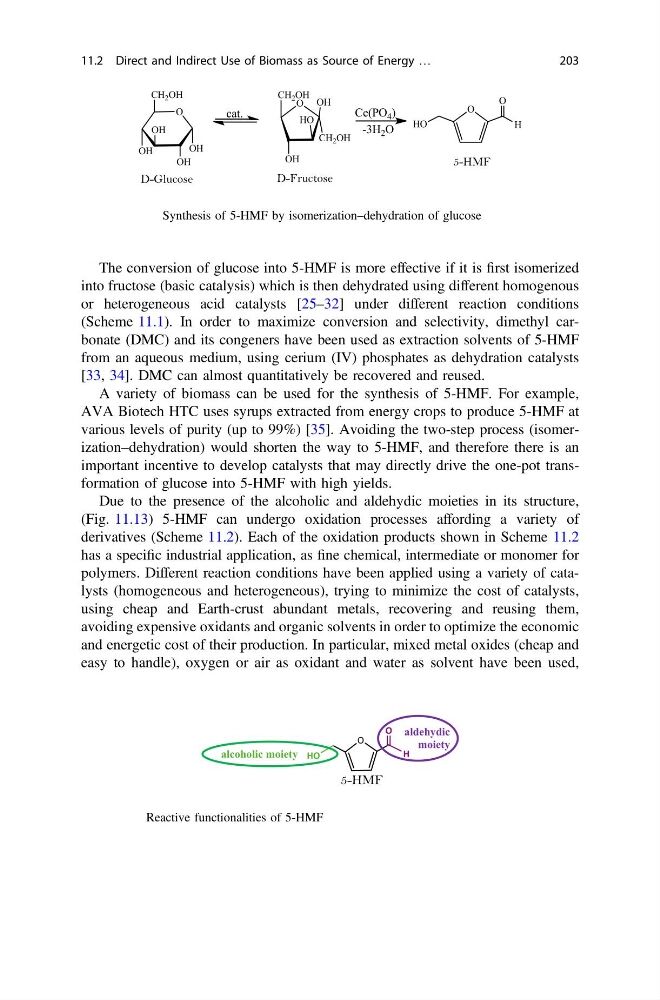
The conversion of glucose into 5-HMF is more effective if it is first isomerized
into fructose (basic catalysis) which is then dehydrated using different homogenous
or heterogeneous acid catalysts [25–32] under different reaction conditions
(Scheme 11.1). In order to maximize conversion and selectivity, dimethyl carbonate (DMC) and its congeners have been used as extraction solvents of 5-HMF
from an aqueous medium, using cerium (IV) phosphates as dehydration catalysts
[33, 34]. DMC can almost quantitatively be recovered and reused.
A variety of biomass can be used for the synthesis of 5-HMF. For example,
AVA Biotech HTC uses syrups extracted from energy crops to produce 5-HMF at
various levels of purity (up to 99%) [35]. Avoiding the two-step process (isomerization–dehydration) would shorten the way to 5-HMF, and therefore there is an
important incentive to develop catalysts that may directly drive the one-pot transformation of glucose into 5-HMF with high yields.
Due to the presence of the alcoholic and aldehydic moieties in its structure,
(Fig. 11.13) 5-HMF can undergo oxidation processes affording a variety of
derivatives (Scheme 11.2). Each of the oxidation products shown in Scheme 11.2
has a specific industrial application, as fine chemical, intermediate or monomer for
polymers. Different reaction conditions have been applied using a variety of catalysts (homogeneous and heterogeneous), trying to minimize the cost of catalysts,
using cheap and Earth-crust abundant metals, recovering and reusing them,
avoiding expensive oxidants and organic solvents in order to optimize the economic
and energetic cost of their production. In particular, mixed metal oxides (cheap and
easy to handle), oxygen or air as oxidant and water as solvent have been used,
O
CH 2 OH
OH
OH
OH
OH
O
CH 2 OH
OH
HO
OH
CH 2 OH
O
O
H
HO
Ce(PO 4 )
-3H 2 O
cat.
D-Glucose
D-Fructose
5-HMF
Scheme 11.1 Synthesis of 5-HMF by isomerization–dehydration of glucose
O
HO
H
O
5-HMF
alcoholic moiety
aldehydic
moiety
Fig. 11.13 Reactive functionalities of 5-HMF
11.2 Direct and Indirect Use of Biomass as Source of Energy …
203
into fructose (basic catalysis) which is then dehydrated using different homogenous
or heterogeneous acid catalysts [25–32] under different reaction conditions
(Scheme 11.1). In order to maximize conversion and selectivity, dimethyl carbonate (DMC) and its congeners have been used as extraction solvents of 5-HMF
from an aqueous medium, using cerium (IV) phosphates as dehydration catalysts
[33, 34]. DMC can almost quantitatively be recovered and reused.
A variety of biomass can be used for the synthesis of 5-HMF. For example,
AVA Biotech HTC uses syrups extracted from energy crops to produce 5-HMF at
various levels of purity (up to 99%) [35]. Avoiding the two-step process (isomerization–dehydration) would shorten the way to 5-HMF, and therefore there is an
important incentive to develop catalysts that may directly drive the one-pot transformation of glucose into 5-HMF with high yields.
Due to the presence of the alcoholic and aldehydic moieties in its structure,
(Fig. 11.13) 5-HMF can undergo oxidation processes affording a variety of
derivatives (Scheme 11.2). Each of the oxidation products shown in Scheme 11.2
has a specific industrial application, as fine chemical, intermediate or monomer for
polymers. Different reaction conditions have been applied using a variety of catalysts (homogeneous and heterogeneous), trying to minimize the cost of catalysts,
using cheap and Earth-crust abundant metals, recovering and reusing them,
avoiding expensive oxidants and organic solvents in order to optimize the economic
and energetic cost of their production. In particular, mixed metal oxides (cheap and
easy to handle), oxygen or air as oxidant and water as solvent have been used,
O
CH 2 OH
OH
OH
OH
OH
O
CH 2 OH
OH
HO
OH
CH 2 OH
O
O
H
HO
Ce(PO 4 )
-3H 2 O
cat.
D-Glucose
D-Fructose
5-HMF
Scheme 11.1 Synthesis of 5-HMF by isomerization–dehydration of glucose
O
HO
H
O
5-HMF
alcoholic moiety
aldehydic
moiety
Fig. 11.13 Reactive functionalities of 5-HMF
11.2 Direct and Indirect Use of Biomass as Source of Energy …
203