

Such concept will be a driving force in future and process integration within the
chemical industry and of the chemical industries with other sectors (utilization of
biomass, biotechnology) will be the winning option (see Chap. 11). Carbon-circular
economy and Bio-economy are strongly complementary and, if integrated, can
multiply the positive effects, balancing some externalities [57]. On the other hand,
CO 2 is at the basis of both and the integration can reinforce weak points of one with
strong points of the other. Notably, Nature has not maximized energy efficiency
(there is plenty of solar energy) toward a single product but toward the production
of useful chemicals to support life; while the chemical industry has the attitude to
maximize selectivity and energy efficiency (of fossil-C, a not infinite resource)
toward a single product. Science and Technology will be able to merge these two
powers for finding the solution to the needs of our society? We believe they can.
9.4 Conclusions
In this chapter, we have shown that our future lays on stepping away from fossil-C
and developing an ability to use CO 2 and water, in other words developing “An
economy based on CO 2 and water” [58]. Key questions are: at what extent and
when will this be possible?
The use of CO 2 as building block for added value products, does not need
hydrogen. Such products have short- (order of months, such as fuels), medium(order of year, chemicals), long-(order of decades, organic polymers) life. The TRL
level varies from 4 to 9 with the process considered, in all cases bottlenecks are
well-known, as well as remedies, opening to a good perspective in the exploitation
of discussed technologies in the short–medium term (5–10 years). Nevertheless, the
market of such products is limited, ranging from actual 200 Mt/y CO 2 to over 350–
400 Mt/y within 2030. Apparently, such use of CO 2 will not contribute significantly
to controlling the CO 2 atmospheric level. Nevertheless, if we consider not the used
but the avoided CO 2, assuming an average avoided/used ratio of 2.8 as discussed
before, even considering the potential technology innovation, then we can conclude
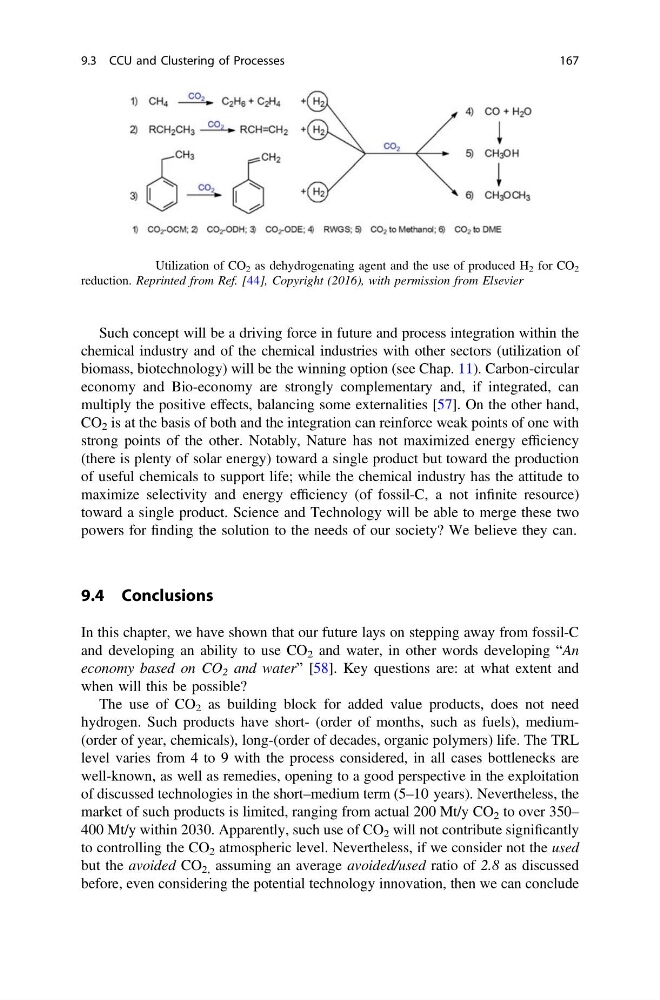
Scheme 9.3 Utilization of CO 2 as dehydrogenating agent and the use of produced H 2 for CO 2
reduction. Reprinted from Ref. [44], Copyright (2016), with permission from Elsevier
9.3 CCU and Clustering of Processes
167
chemical industry and of the chemical industries with other sectors (utilization of
biomass, biotechnology) will be the winning option (see Chap. 11). Carbon-circular
economy and Bio-economy are strongly complementary and, if integrated, can
multiply the positive effects, balancing some externalities [57]. On the other hand,
CO 2 is at the basis of both and the integration can reinforce weak points of one with
strong points of the other. Notably, Nature has not maximized energy efficiency
(there is plenty of solar energy) toward a single product but toward the production
of useful chemicals to support life; while the chemical industry has the attitude to
maximize selectivity and energy efficiency (of fossil-C, a not infinite resource)
toward a single product. Science and Technology will be able to merge these two
powers for finding the solution to the needs of our society? We believe they can.
9.4 Conclusions
In this chapter, we have shown that our future lays on stepping away from fossil-C
and developing an ability to use CO 2 and water, in other words developing “An
economy based on CO 2 and water” [58]. Key questions are: at what extent and
when will this be possible?
The use of CO 2 as building block for added value products, does not need
hydrogen. Such products have short- (order of months, such as fuels), medium(order of year, chemicals), long-(order of decades, organic polymers) life. The TRL
level varies from 4 to 9 with the process considered, in all cases bottlenecks are
well-known, as well as remedies, opening to a good perspective in the exploitation
of discussed technologies in the short–medium term (5–10 years). Nevertheless, the
market of such products is limited, ranging from actual 200 Mt/y CO 2 to over 350–
400 Mt/y within 2030. Apparently, such use of CO 2 will not contribute significantly
to controlling the CO 2 atmospheric level. Nevertheless, if we consider not the used
but the avoided CO 2, assuming an average avoided/used ratio of 2.8 as discussed
before, even considering the potential technology innovation, then we can conclude
Scheme 9.3 Utilization of CO 2 as dehydrogenating agent and the use of produced H 2 for CO 2
reduction. Reprinted from Ref. [44], Copyright (2016), with permission from Elsevier
9.3 CCU and Clustering of Processes
167