

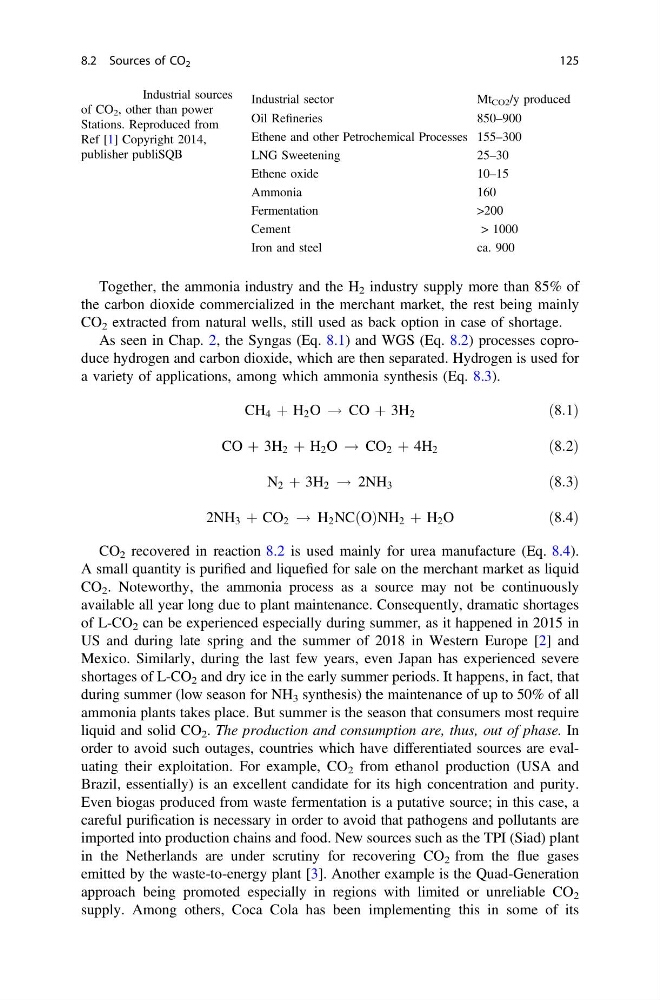
Table 8.1 Industrial sources
of CO 2 , other than power
Stations. Reproduced from
Ref [1] Copyright 2014,
publisher publiSQB
Industrial sector
Mt CO2 /y produced
Oil Refineries
850–900
Ethene and other Petrochemical Processes 155–300
LNG Sweetening
25–30
Ethene oxide
10–15
Ammonia
160
Fermentation
>200
Cement
> 1000
Iron and steel
ca. 900
Together, the ammonia industry and the H 2 industry supply more than 85% of
the carbon dioxide commercialized in the merchant market, the rest being mainly
CO 2 extracted from natural wells, still used as back option in case of shortage.
As seen in Chap. 2, the Syngas (Eq. 8.1) and WGS (Eq. 8.2) processes coproduce hydrogen and carbon dioxide, which are then separated. Hydrogen is used for
a variety of applications, among which ammonia synthesis (Eq. 8.3).
CH 4 þ H 2 O ! CO þ 3H 2
ð8:1Þ
CO þ 3H 2 þ H 2 O ! CO 2 þ 4H 2
ð8:2Þ
N 2 þ 3H 2 ! 2NH 3
ð8:3Þ
2NH 3 þ CO 2 ! H 2 NCðOÞNH 2 þ H 2 O
ð8:4Þ
CO 2 recovered in reaction 8.2 is used mainly for urea manufacture (Eq. 8.4).
A small quantity is purified and liquefied for sale on the merchant market as liquid
CO 2 . Noteworthy, the ammonia process as a source may not be continuously
available all year long due to plant maintenance. Consequently, dramatic shortages
of L-CO 2 can be experienced especially during summer, as it happened in 2015 in
US and during late spring and the summer of 2018 in Western Europe [2] and
Mexico. Similarly, during the last few years, even Japan has experienced severe
shortages of L-CO 2 and dry ice in the early summer periods. It happens, in fact, that
during summer (low season for NH 3 synthesis) the maintenance of up to 50% of all
ammonia plants takes place. But summer is the season that consumers most require
liquid and solid CO 2 . The production and consumption are, thus, out of phase. In
order to avoid such outages, countries which have differentiated sources are evaluating their exploitation. For example, CO 2 from ethanol production (USA and
Brazil, essentially) is an excellent candidate for its high concentration and purity.
Even biogas produced from waste fermentation is a putative source; in this case, a
careful purification is necessary in order to avoid that pathogens and pollutants are
imported into production chains and food. New sources such as the TPI (Siad) plant
in the Netherlands are under scrutiny for recovering CO 2 from the flue gases
emitted by the waste-to-energy plant [3]. Another example is the Quad-Generation
approach being promoted especially in regions with limited or unreliable CO 2
supply. Among others, Coca Cola has been implementing this in some of its
8.2 Sources of CO 2
125
of CO 2 , other than power
Stations. Reproduced from
Ref [1] Copyright 2014,
publisher publiSQB
Industrial sector
Mt CO2 /y produced
Oil Refineries
850–900
Ethene and other Petrochemical Processes 155–300
LNG Sweetening
25–30
Ethene oxide
10–15
Ammonia
160
Fermentation
>200
Cement
> 1000
Iron and steel
ca. 900
Together, the ammonia industry and the H 2 industry supply more than 85% of
the carbon dioxide commercialized in the merchant market, the rest being mainly
CO 2 extracted from natural wells, still used as back option in case of shortage.
As seen in Chap. 2, the Syngas (Eq. 8.1) and WGS (Eq. 8.2) processes coproduce hydrogen and carbon dioxide, which are then separated. Hydrogen is used for
a variety of applications, among which ammonia synthesis (Eq. 8.3).
CH 4 þ H 2 O ! CO þ 3H 2
ð8:1Þ
CO þ 3H 2 þ H 2 O ! CO 2 þ 4H 2
ð8:2Þ
N 2 þ 3H 2 ! 2NH 3
ð8:3Þ
2NH 3 þ CO 2 ! H 2 NCðOÞNH 2 þ H 2 O
ð8:4Þ
CO 2 recovered in reaction 8.2 is used mainly for urea manufacture (Eq. 8.4).
A small quantity is purified and liquefied for sale on the merchant market as liquid
CO 2 . Noteworthy, the ammonia process as a source may not be continuously
available all year long due to plant maintenance. Consequently, dramatic shortages
of L-CO 2 can be experienced especially during summer, as it happened in 2015 in
US and during late spring and the summer of 2018 in Western Europe [2] and
Mexico. Similarly, during the last few years, even Japan has experienced severe
shortages of L-CO 2 and dry ice in the early summer periods. It happens, in fact, that
during summer (low season for NH 3 synthesis) the maintenance of up to 50% of all
ammonia plants takes place. But summer is the season that consumers most require
liquid and solid CO 2 . The production and consumption are, thus, out of phase. In
order to avoid such outages, countries which have differentiated sources are evaluating their exploitation. For example, CO 2 from ethanol production (USA and
Brazil, essentially) is an excellent candidate for its high concentration and purity.
Even biogas produced from waste fermentation is a putative source; in this case, a
careful purification is necessary in order to avoid that pathogens and pollutants are
imported into production chains and food. New sources such as the TPI (Siad) plant
in the Netherlands are under scrutiny for recovering CO 2 from the flue gases
emitted by the waste-to-energy plant [3]. Another example is the Quad-Generation
approach being promoted especially in regions with limited or unreliable CO 2
supply. Among others, Coca Cola has been implementing this in some of its
8.2 Sources of CO 2
125