

1.8 and 3.1 cm
−1 , respectively, showing Davydov splitting due to a high-ordered
dry-ice structure [30b]. Because carbon dioxide molecule has a center of symmetry,
the antisymmetric stretching (m 3 ) and the bending (m 2 ) modes are Raman inactive.
A Fermi dyad is observed in the Raman spectrum of gaseous CO 2 at 1285.40 and
1388.15 cm
−1 [30a], which originates from the resonance between the unperturbed
energy levels associated with the fundamental transition of the m 1 totally symmetric
stretching mode (m 1 = 1333 cm
−1 ) and the harmonic transition 2m 2 of the m 2
bending mode.
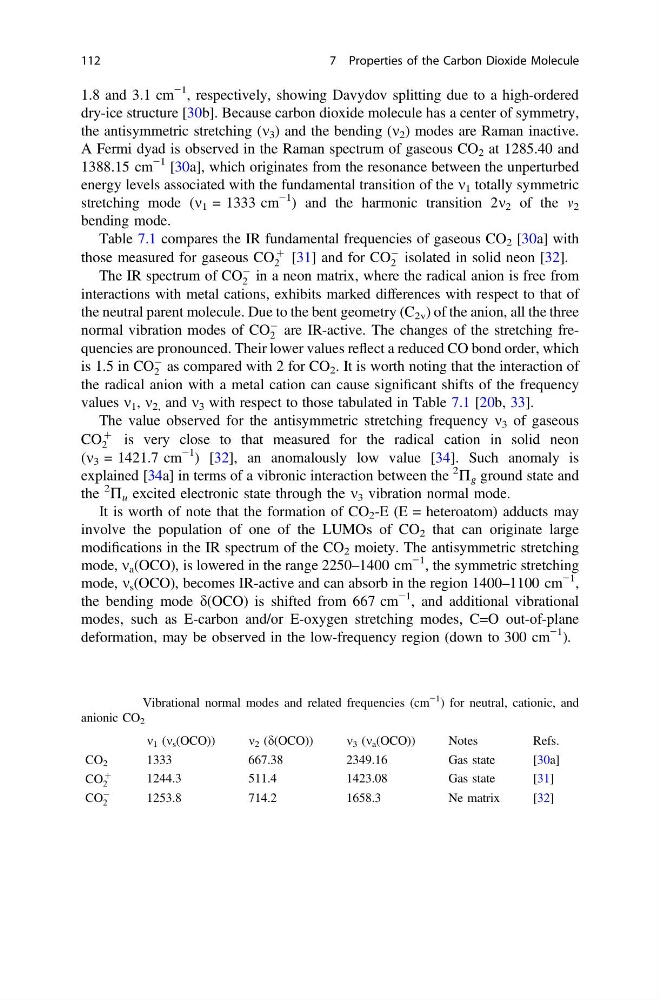
Table 7.1 compares the IR fundamental frequencies of gaseous CO 2 [30a] with
those measured for gaseous CO
þ
2 [31] and for CO
À
2 isolated in solid neon [32].
The IR spectrum of CO
À
2 in a neon matrix, where the radical anion is free from
interactions with metal cations, exhibits marked differences with respect to that of
the neutral parent molecule. Due to the bent geometry (C 2v ) of the anion, all the three
normal vibration modes of CO
À
2 are IR-active. The changes of the stretching frequencies are pronounced. Their lower values reflect a reduced CO bond order, which
is 1.5 in CO
À
2 as compared with 2 for CO 2 . It is worth noting that the interaction of
the radical anion with a metal cation can cause significant shifts of the frequency
values m 1 , m 2, and m 3 with respect to those tabulated in Table 7.1 [20b, 33].
The value observed for the antisymmetric stretching frequency m 3 of gaseous
CO
þ
2
is very close to that measured for the radical cation in solid neon
(m 3 = 1421.7 cm
−1 ) [32], an anomalously low value [34]. Such anomaly is
explained [34a] in terms of a vibronic interaction between the
2
P g ground state and
the
2
P u excited electronic state through the m 3 vibration normal mode.
It is worth of note that the formation of CO 2 -E (E = heteroatom) adducts may
involve the population of one of the LUMOs of CO 2 that can originate large
modifications in the IR spectrum of the CO 2 moiety. The antisymmetric stretching
mode, m a (OCO), is lowered in the range 2250–1400 cm
−1 , the symmetric stretching
mode, m s (OCO), becomes IR-active and can absorb in the region 1400–1100 cm
−1 ,
the bending mode d(OCO) is shifted from 667 cm
−1 , and additional vibrational
modes, such as E-carbon and/or E-oxygen stretching modes, C=O out-of-plane
deformation, may be observed in the low-frequency region (down to 300 cm
−1 ).
Table 7.1 Vibrational normal modes and related frequencies (cm
−1
) for neutral, cationic, and
anionic CO 2
m 1 (m s (OCO))
m 2 (d(OCO))
m 3 (m a (OCO))
Notes
Refs.
CO 2
1333
667.38
2349.16
Gas state
[30a]
CO
þ
2
1244.3
511.4
1423.08
Gas state
[31]
CO
À
2
1253.8
714.2
1658.3
Ne matrix
[32]
112
7 Properties of the Carbon Dioxide Molecule
−1 , respectively, showing Davydov splitting due to a high-ordered
dry-ice structure [30b]. Because carbon dioxide molecule has a center of symmetry,
the antisymmetric stretching (m 3 ) and the bending (m 2 ) modes are Raman inactive.
A Fermi dyad is observed in the Raman spectrum of gaseous CO 2 at 1285.40 and
1388.15 cm
−1 [30a], which originates from the resonance between the unperturbed
energy levels associated with the fundamental transition of the m 1 totally symmetric
stretching mode (m 1 = 1333 cm
−1 ) and the harmonic transition 2m 2 of the m 2
bending mode.
Table 7.1 compares the IR fundamental frequencies of gaseous CO 2 [30a] with
those measured for gaseous CO
þ
2 [31] and for CO
À
2 isolated in solid neon [32].
The IR spectrum of CO
À
2 in a neon matrix, where the radical anion is free from
interactions with metal cations, exhibits marked differences with respect to that of
the neutral parent molecule. Due to the bent geometry (C 2v ) of the anion, all the three
normal vibration modes of CO
À
2 are IR-active. The changes of the stretching frequencies are pronounced. Their lower values reflect a reduced CO bond order, which
is 1.5 in CO
À
2 as compared with 2 for CO 2 . It is worth noting that the interaction of
the radical anion with a metal cation can cause significant shifts of the frequency
values m 1 , m 2, and m 3 with respect to those tabulated in Table 7.1 [20b, 33].
The value observed for the antisymmetric stretching frequency m 3 of gaseous
CO
þ
2
is very close to that measured for the radical cation in solid neon
(m 3 = 1421.7 cm
−1 ) [32], an anomalously low value [34]. Such anomaly is
explained [34a] in terms of a vibronic interaction between the
2
P g ground state and
the
2
P u excited electronic state through the m 3 vibration normal mode.
It is worth of note that the formation of CO 2 -E (E = heteroatom) adducts may
involve the population of one of the LUMOs of CO 2 that can originate large
modifications in the IR spectrum of the CO 2 moiety. The antisymmetric stretching
mode, m a (OCO), is lowered in the range 2250–1400 cm
−1 , the symmetric stretching
mode, m s (OCO), becomes IR-active and can absorb in the region 1400–1100 cm
−1 ,
the bending mode d(OCO) is shifted from 667 cm
−1 , and additional vibrational
modes, such as E-carbon and/or E-oxygen stretching modes, C=O out-of-plane
deformation, may be observed in the low-frequency region (down to 300 cm
−1 ).
Table 7.1 Vibrational normal modes and related frequencies (cm
−1
) for neutral, cationic, and
anionic CO 2
m 1 (m s (OCO))
m 2 (d(OCO))
m 3 (m a (OCO))
Notes
Refs.
CO 2
1333
667.38
2349.16
Gas state
[30a]
CO
þ
2
1244.3
511.4
1423.08
Gas state
[31]
CO
À
2
1253.8
714.2
1658.3
Ne matrix
[32]
112
7 Properties of the Carbon Dioxide Molecule