

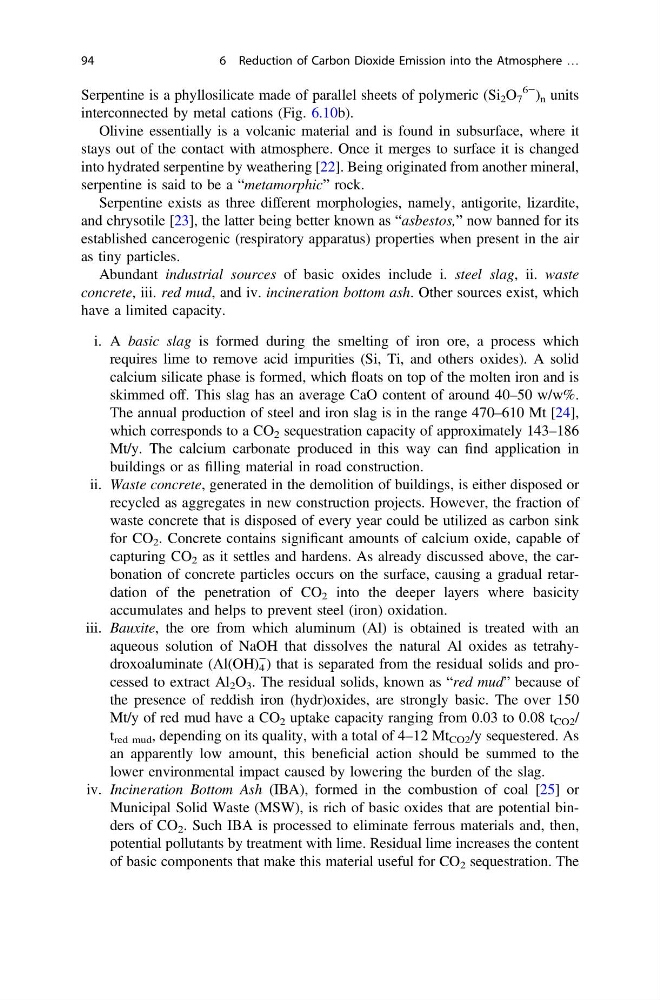
Serpentine is a phyllosilicate made of parallel sheets of polymeric (Si 2 O 7
6− ) n units
interconnected by metal cations (Fig. 6.10b).
Olivine essentially is a volcanic material and is found in subsurface, where it
stays out of the contact with atmosphere. Once it merges to surface it is changed
into hydrated serpentine by weathering [22]. Being originated from another mineral,
serpentine is said to be a “metamorphic” rock.
Serpentine exists as three different morphologies, namely, antigorite, lizardite,
and chrysotile [23], the latter being better known as “asbestos,” now banned for its
established cancerogenic (respiratory apparatus) properties when present in the air
as tiny particles.
Abundant industrial sources of basic oxides include i. steel slag, ii. waste
concrete, iii. red mud, and iv. incineration bottom ash. Other sources exist, which
have a limited capacity.
i. A basic slag is formed during the smelting of iron ore, a process which
requires lime to remove acid impurities (Si, Ti, and others oxides). A solid
calcium silicate phase is formed, which floats on top of the molten iron and is
skimmed off. This slag has an average CaO content of around 40–50 w/w%.
The annual production of steel and iron slag is in the range 470–610 Mt [24],
which corresponds to a CO 2 sequestration capacity of approximately 143–186
Mt/y. The calcium carbonate produced in this way can find application in
buildings or as filling material in road construction.
ii. Waste concrete, generated in the demolition of buildings, is either disposed or
recycled as aggregates in new construction projects. However, the fraction of
waste concrete that is disposed of every year could be utilized as carbon sink
for CO 2 . Concrete contains significant amounts of calcium oxide, capable of
capturing CO 2 as it settles and hardens. As already discussed above, the carbonation of concrete particles occurs on the surface, causing a gradual retardation of the penetration of CO 2 into the deeper layers where basicity
accumulates and helps to prevent steel (iron) oxidation.
iii. Bauxite, the ore from which aluminum (Al) is obtained is treated with an
aqueous solution of NaOH that dissolves the natural Al oxides as tetrahydroxoaluminate (Al(OH) 4
− ) that is separated from the residual solids and processed to extract Al 2 O 3 . The residual solids, known as “red mud” because of
the presence of reddish iron (hydr)oxides, are strongly basic. The over 150
Mt/y of red mud have a CO 2 uptake capacity ranging from 0.03 to 0.08 t CO2 /
t red mud , depending on its quality, with a total of 4–12 Mt CO2 /y sequestered. As
an apparently low amount, this beneficial action should be summed to the
lower environmental impact caused by lowering the burden of the slag.
iv. Incineration Bottom Ash (IBA), formed in the combustion of coal [25] or
Municipal Solid Waste (MSW), is rich of basic oxides that are potential binders of CO 2 . Such IBA is processed to eliminate ferrous materials and, then,
potential pollutants by treatment with lime. Residual lime increases the content
of basic components that make this material useful for CO 2 sequestration. The
94
6 Reduction of Carbon Dioxide Emission into the Atmosphere …
6− ) n units
interconnected by metal cations (Fig. 6.10b).
Olivine essentially is a volcanic material and is found in subsurface, where it
stays out of the contact with atmosphere. Once it merges to surface it is changed
into hydrated serpentine by weathering [22]. Being originated from another mineral,
serpentine is said to be a “metamorphic” rock.
Serpentine exists as three different morphologies, namely, antigorite, lizardite,
and chrysotile [23], the latter being better known as “asbestos,” now banned for its
established cancerogenic (respiratory apparatus) properties when present in the air
as tiny particles.
Abundant industrial sources of basic oxides include i. steel slag, ii. waste
concrete, iii. red mud, and iv. incineration bottom ash. Other sources exist, which
have a limited capacity.
i. A basic slag is formed during the smelting of iron ore, a process which
requires lime to remove acid impurities (Si, Ti, and others oxides). A solid
calcium silicate phase is formed, which floats on top of the molten iron and is
skimmed off. This slag has an average CaO content of around 40–50 w/w%.
The annual production of steel and iron slag is in the range 470–610 Mt [24],
which corresponds to a CO 2 sequestration capacity of approximately 143–186
Mt/y. The calcium carbonate produced in this way can find application in
buildings or as filling material in road construction.
ii. Waste concrete, generated in the demolition of buildings, is either disposed or
recycled as aggregates in new construction projects. However, the fraction of
waste concrete that is disposed of every year could be utilized as carbon sink
for CO 2 . Concrete contains significant amounts of calcium oxide, capable of
capturing CO 2 as it settles and hardens. As already discussed above, the carbonation of concrete particles occurs on the surface, causing a gradual retardation of the penetration of CO 2 into the deeper layers where basicity
accumulates and helps to prevent steel (iron) oxidation.
iii. Bauxite, the ore from which aluminum (Al) is obtained is treated with an
aqueous solution of NaOH that dissolves the natural Al oxides as tetrahydroxoaluminate (Al(OH) 4
− ) that is separated from the residual solids and processed to extract Al 2 O 3 . The residual solids, known as “red mud” because of
the presence of reddish iron (hydr)oxides, are strongly basic. The over 150
Mt/y of red mud have a CO 2 uptake capacity ranging from 0.03 to 0.08 t CO2 /
t red mud , depending on its quality, with a total of 4–12 Mt CO2 /y sequestered. As
an apparently low amount, this beneficial action should be summed to the
lower environmental impact caused by lowering the burden of the slag.
iv. Incineration Bottom Ash (IBA), formed in the combustion of coal [25] or
Municipal Solid Waste (MSW), is rich of basic oxides that are potential binders of CO 2 . Such IBA is processed to eliminate ferrous materials and, then,
potential pollutants by treatment with lime. Residual lime increases the content
of basic components that make this material useful for CO 2 sequestration. The
94
6 Reduction of Carbon Dioxide Emission into the Atmosphere …