

7.6 Contaminated Area and Infrastructure
69
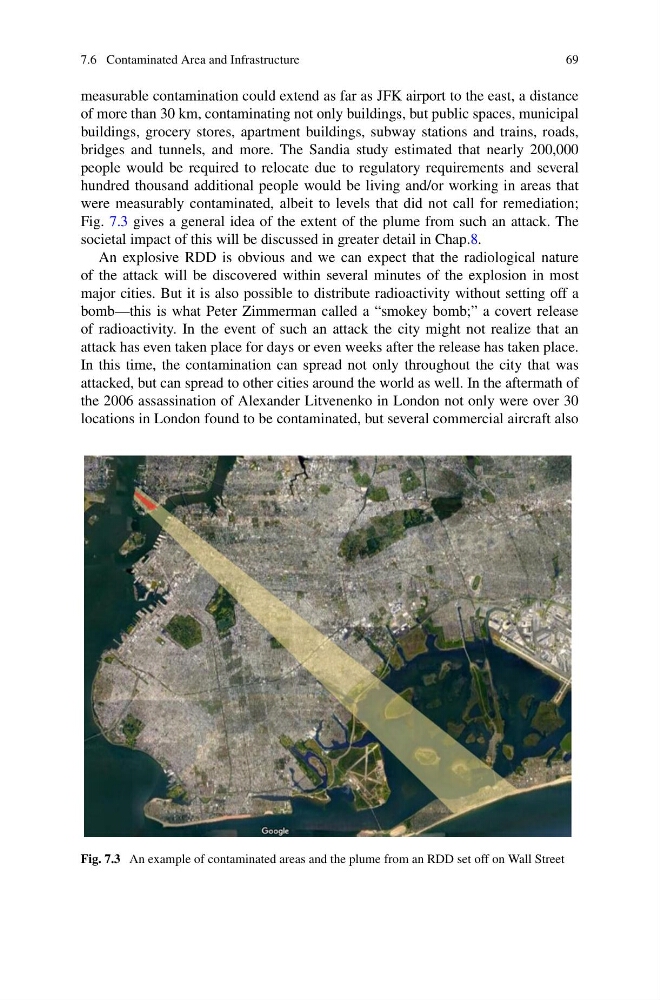
measurable contamination could extend as far as JFK airport to the east, a distance
of more than 30 km, contaminating not only buildings, but public spaces, municipal
buildings, grocery stores, apartment buildings, subway stations and trains, roads,
bridges and tunnels, and more. The Sandia study estimated that nearly 200,000
people would be required to relocate due to regulatory requirements and several
hundred thousand additional people would be living and/or working in areas that
were measurably contaminated, albeit to levels that did not call for remediation;
Fig. 7.3 gives a general idea of the extent of the plume from such an attack. The
societal impact of this will be discussed in greater detail in Chap.8.
An explosive RDD is obvious and we can expect that the radiological nature
of the attack will be discovered within several minutes of the explosion in most
major cities. But it is also possible to distribute radioactivity without setting off a
bomb—this is what Peter Zimmerman called a “smokey bomb;” a covert release
of radioactivity. In the event of such an attack the city might not realize that an
attack has even taken place for days or even weeks after the release has taken place.
In this time, the contamination can spread not only throughout the city that was
attacked, but can spread to other cities around the world as well. In the aftermath of
the 2006 assassination of Alexander Litvenenko in London not only were over 30
locations in London found to be contaminated, but several commercial aircraft also
Fig. 7.3 An example of contaminated areas and the plume from an RDD set off on Wall Street
69
measurable contamination could extend as far as JFK airport to the east, a distance
of more than 30 km, contaminating not only buildings, but public spaces, municipal
buildings, grocery stores, apartment buildings, subway stations and trains, roads,
bridges and tunnels, and more. The Sandia study estimated that nearly 200,000
people would be required to relocate due to regulatory requirements and several
hundred thousand additional people would be living and/or working in areas that
were measurably contaminated, albeit to levels that did not call for remediation;
Fig. 7.3 gives a general idea of the extent of the plume from such an attack. The
societal impact of this will be discussed in greater detail in Chap.8.
An explosive RDD is obvious and we can expect that the radiological nature
of the attack will be discovered within several minutes of the explosion in most
major cities. But it is also possible to distribute radioactivity without setting off a
bomb—this is what Peter Zimmerman called a “smokey bomb;” a covert release
of radioactivity. In the event of such an attack the city might not realize that an
attack has even taken place for days or even weeks after the release has taken place.
In this time, the contamination can spread not only throughout the city that was
attacked, but can spread to other cities around the world as well. In the aftermath of
the 2006 assassination of Alexander Litvenenko in London not only were over 30
locations in London found to be contaminated, but several commercial aircraft also
Fig. 7.3 An example of contaminated areas and the plume from an RDD set off on Wall Street