

5.2 Types of Radiological Weapons
41
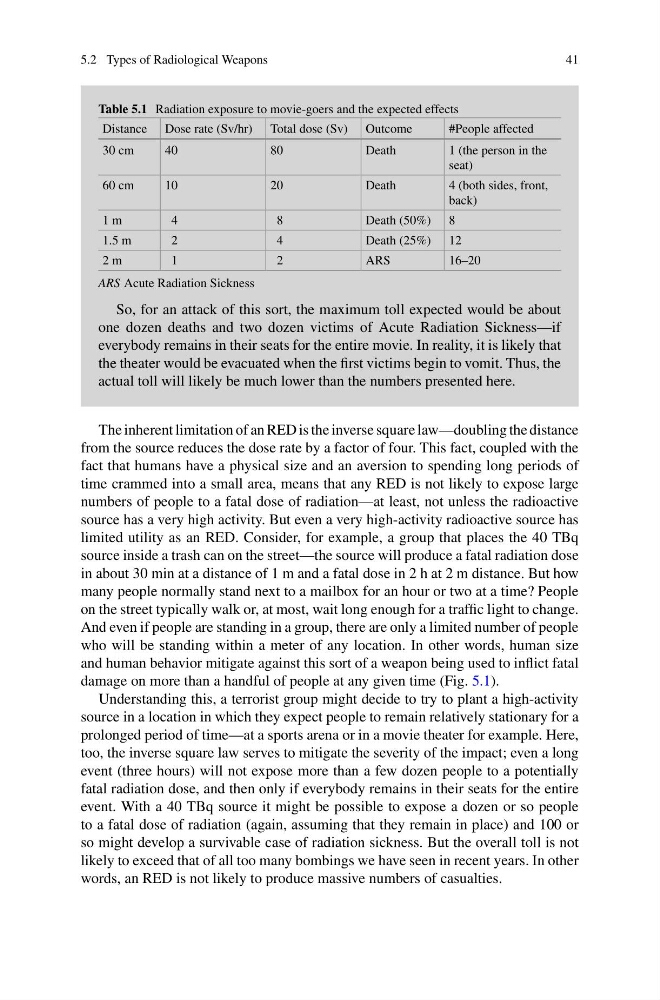
Table 5.1 Radiation exposure to movie-goers and the expected effects
Distance Dose rate (Sv/hr) Total dose (Sv) Outcome
#People affected
30 cm
40
80
Death
1 (the person in the
seat)
60 cm
10
20
Death
4 (both sides, front,
back)
1 m
4
8
Death (50%) 8
1.5 m
2
4
Death (25%) 12
2 m
1
2
ARS
16–20
ARS Acute Radiation Sickness
So, for an attack of this sort, the maximum toll expected would be about
one dozen deaths and two dozen victims of Acute Radiation Sickness—if
everybody remains in their seats for the entire movie. In reality, it is likely that
the theater would be evacuated when the first victims begin to vomit. Thus, the
actual toll will likely be much lower than the numbers presented here.
The inherent limitation of an RED is the inverse square law—doubling the distance
from the source reduces the dose rate by a factor of four. This fact, coupled with the
fact that humans have a physical size and an aversion to spending long periods of
time crammed into a small area, means that any RED is not likely to expose large
numbers of people to a fatal dose of radiation—at least, not unless the radioactive
source has a very high activity. But even a very high-activity radioactive source has
limited utility as an RED. Consider, for example, a group that places the 40 TBq
source inside a trash can on the street—the source will produce a fatal radiation dose
in about 30 min at a distance of 1 m and a fatal dose in 2 h at 2 m distance. But how
many people normally stand next to a mailbox for an hour or two at a time? People
on the street typically walk or, at most, wait long enough for a traffic light to change.
And even if people are standing in a group, there are only a limited number of people
who will be standing within a meter of any location. In other words, human size
and human behavior mitigate against this sort of a weapon being used to inflict fatal
damage on more than a handful of people at any given time (Fig. 5.1).
Understanding this, a terrorist group might decide to try to plant a high-activity
source in a location in which they expect people to remain relatively stationary for a
prolonged period of time—at a sports arena or in a movie theater for example. Here,
too, the inverse square law serves to mitigate the severity of the impact; even a long
event (three hours) will not expose more than a few dozen people to a potentially
fatal radiation dose, and then only if everybody remains in their seats for the entire
event. With a 40 TBq source it might be possible to expose a dozen or so people
to a fatal dose of radiation (again, assuming that they remain in place) and 100 or
so might develop a survivable case of radiation sickness. But the overall toll is not
likely to exceed that of all too many bombings we have seen in recent years. In other
words, an RED is not likely to produce massive numbers of casualties.
41
Table 5.1 Radiation exposure to movie-goers and the expected effects
Distance Dose rate (Sv/hr) Total dose (Sv) Outcome
#People affected
30 cm
40
80
Death
1 (the person in the
seat)
60 cm
10
20
Death
4 (both sides, front,
back)
1 m
4
8
Death (50%) 8
1.5 m
2
4
Death (25%) 12
2 m
1
2
ARS
16–20
ARS Acute Radiation Sickness
So, for an attack of this sort, the maximum toll expected would be about
one dozen deaths and two dozen victims of Acute Radiation Sickness—if
everybody remains in their seats for the entire movie. In reality, it is likely that
the theater would be evacuated when the first victims begin to vomit. Thus, the
actual toll will likely be much lower than the numbers presented here.
The inherent limitation of an RED is the inverse square law—doubling the distance
from the source reduces the dose rate by a factor of four. This fact, coupled with the
fact that humans have a physical size and an aversion to spending long periods of
time crammed into a small area, means that any RED is not likely to expose large
numbers of people to a fatal dose of radiation—at least, not unless the radioactive
source has a very high activity. But even a very high-activity radioactive source has
limited utility as an RED. Consider, for example, a group that places the 40 TBq
source inside a trash can on the street—the source will produce a fatal radiation dose
in about 30 min at a distance of 1 m and a fatal dose in 2 h at 2 m distance. But how
many people normally stand next to a mailbox for an hour or two at a time? People
on the street typically walk or, at most, wait long enough for a traffic light to change.
And even if people are standing in a group, there are only a limited number of people
who will be standing within a meter of any location. In other words, human size
and human behavior mitigate against this sort of a weapon being used to inflict fatal
damage on more than a handful of people at any given time (Fig. 5.1).
Understanding this, a terrorist group might decide to try to plant a high-activity
source in a location in which they expect people to remain relatively stationary for a
prolonged period of time—at a sports arena or in a movie theater for example. Here,
too, the inverse square law serves to mitigate the severity of the impact; even a long
event (three hours) will not expose more than a few dozen people to a potentially
fatal radiation dose, and then only if everybody remains in their seats for the entire
event. With a 40 TBq source it might be possible to expose a dozen or so people
to a fatal dose of radiation (again, assuming that they remain in place) and 100 or
so might develop a survivable case of radiation sickness. But the overall toll is not
likely to exceed that of all too many bombings we have seen in recent years. In other
words, an RED is not likely to produce massive numbers of casualties.