

38
4 Radiation Detection Technology
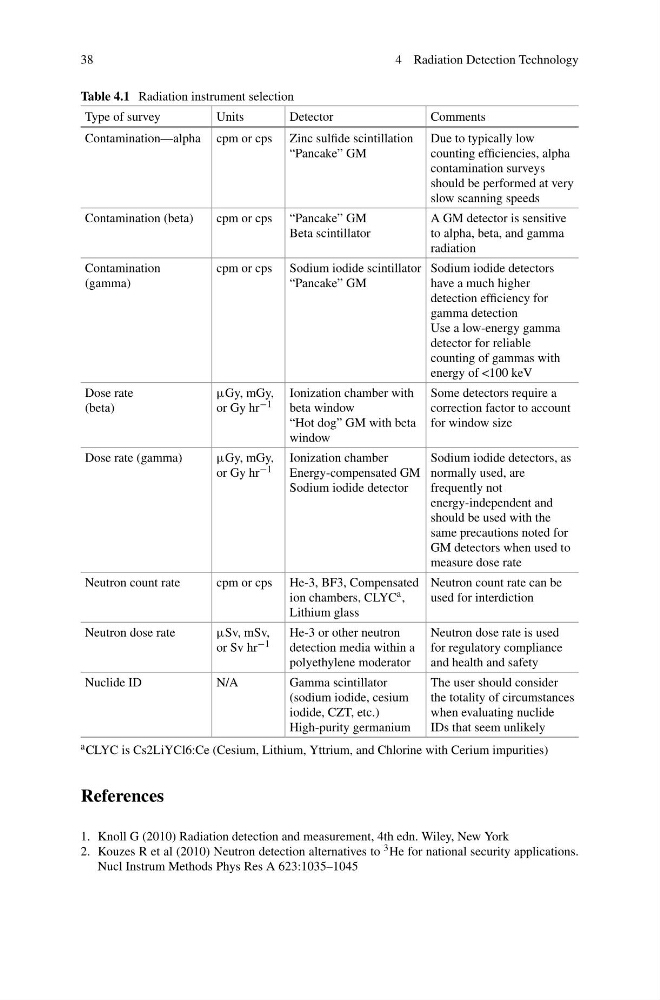
Table 4.1 Radiation instrument selection
Type of survey
Units
Detector
Comments
Contamination—alpha cpm or cps Zinc sulfide scintillation
“Pancake” GM
Due to typically low
counting efficiencies, alpha
contamination surveys
should be performed at very
slow scanning speeds
Contamination (beta)
cpm or cps “Pancake” GM
Beta scintillator
A GM detector is sensitive
to alpha, beta, and gamma
radiation
Contamination
(gamma)
cpm or cps Sodium iodide scintillator
“Pancake” GM
Sodium iodide detectors
have a much higher
detection efficiency for
gamma detection
Use a low-energy gamma
detector for reliable
counting of gammas with
energy of <100 keV
Dose rate
(beta)
µGy, mGy,
or Gy hr −1
Ionization chamber with
beta window
“Hot dog” GM with beta
window
Some detectors require a
correction factor to account
for window size
Dose rate (gamma)
µGy, mGy,
or Gy hr −1
Ionization chamber
Energy-compensated GM
Sodium iodide detector
Sodium iodide detectors, as
normally used, are
frequently not
energy-independent and
should be used with the
same precautions noted for
GM detectors when used to
measure dose rate
Neutron count rate
cpm or cps He-3, BF3, Compensated
ion chambers, CLYC a ,
Lithium glass
Neutron count rate can be
used for interdiction
Neutron dose rate
µSv, mSv,
or Sv hr −1
He-3 or other neutron
detection media within a
polyethylene moderator
Neutron dose rate is used
for regulatory compliance
and health and safety
Nuclide ID
N/A
Gamma scintillator
(sodium iodide, cesium
iodide, CZT, etc.)
High-purity germanium
The user should consider
the totality of circumstances
when evaluating nuclide
IDs that seem unlikely
a CLYC is Cs2LiYCl6:Ce (Cesium, Lithium, Yttrium, and Chlorine with Cerium impurities)
References
1. Knoll G (2010) Radiation detection and measurement, 4th edn. Wiley, New York
2. Kouzes R et al (2010) Neutron detection alternatives to 3 He for national security applications.
Nucl Instrum Methods Phys Res A 623:1035–1045
4 Radiation Detection Technology
Table 4.1 Radiation instrument selection
Type of survey
Units
Detector
Comments
Contamination—alpha cpm or cps Zinc sulfide scintillation
“Pancake” GM
Due to typically low
counting efficiencies, alpha
contamination surveys
should be performed at very
slow scanning speeds
Contamination (beta)
cpm or cps “Pancake” GM
Beta scintillator
A GM detector is sensitive
to alpha, beta, and gamma
radiation
Contamination
(gamma)
cpm or cps Sodium iodide scintillator
“Pancake” GM
Sodium iodide detectors
have a much higher
detection efficiency for
gamma detection
Use a low-energy gamma
detector for reliable
counting of gammas with
energy of <100 keV
Dose rate
(beta)
µGy, mGy,
or Gy hr −1
Ionization chamber with
beta window
“Hot dog” GM with beta
window
Some detectors require a
correction factor to account
for window size
Dose rate (gamma)
µGy, mGy,
or Gy hr −1
Ionization chamber
Energy-compensated GM
Sodium iodide detector
Sodium iodide detectors, as
normally used, are
frequently not
energy-independent and
should be used with the
same precautions noted for
GM detectors when used to
measure dose rate
Neutron count rate
cpm or cps He-3, BF3, Compensated
ion chambers, CLYC a ,
Lithium glass
Neutron count rate can be
used for interdiction
Neutron dose rate
µSv, mSv,
or Sv hr −1
He-3 or other neutron
detection media within a
polyethylene moderator
Neutron dose rate is used
for regulatory compliance
and health and safety
Nuclide ID
N/A
Gamma scintillator
(sodium iodide, cesium
iodide, CZT, etc.)
High-purity germanium
The user should consider
the totality of circumstances
when evaluating nuclide
IDs that seem unlikely
a CLYC is Cs2LiYCl6:Ce (Cesium, Lithium, Yttrium, and Chlorine with Cerium impurities)
References
1. Knoll G (2010) Radiation detection and measurement, 4th edn. Wiley, New York
2. Kouzes R et al (2010) Neutron detection alternatives to 3 He for national security applications.
Nucl Instrum Methods Phys Res A 623:1035–1045