

34
4 Radiation Detection Technology
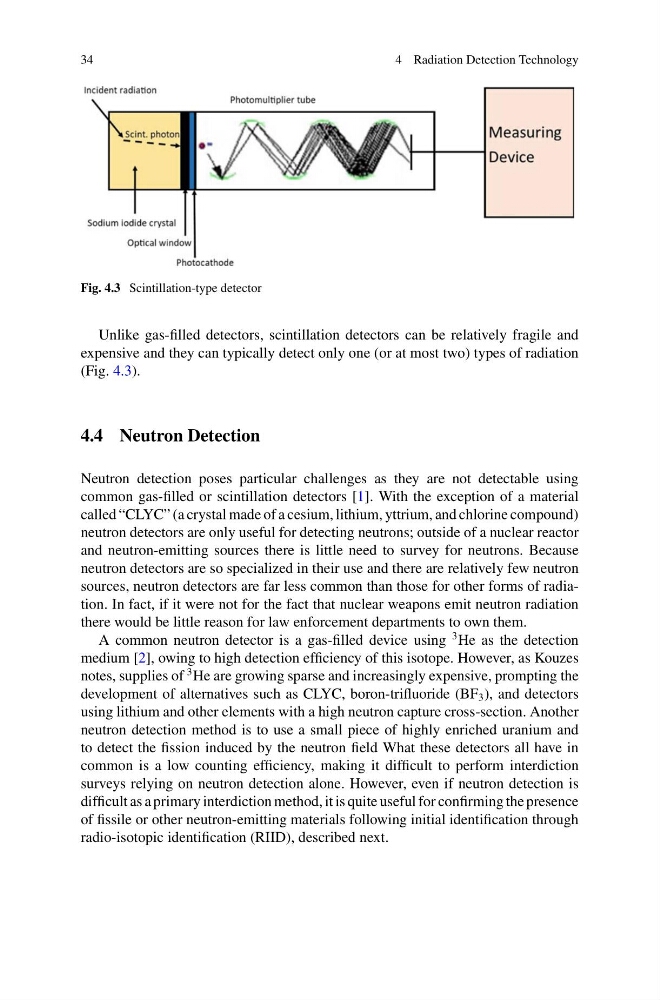
Fig. 4.3 Scintillation-type detector
Unlike gas-filled detectors, scintillation detectors can be relatively fragile and
expensive and they can typically detect only one (or at most two) types of radiation
(Fig. 4.3).
4.4 Neutron Detection
Neutron detection poses particular challenges as they are not detectable using
common gas-filled or scintillation detectors [1]. With the exception of a material
called “CLYC” (a crystal made of a cesium, lithium, yttrium, and chlorine compound)
neutron detectors are only useful for detecting neutrons; outside of a nuclear reactor
and neutron-emitting sources there is little need to survey for neutrons. Because
neutron detectors are so specialized in their use and there are relatively few neutron
sources, neutron detectors are far less common than those for other forms of radiation. In fact, if it were not for the fact that nuclear weapons emit neutron radiation
there would be little reason for law enforcement departments to own them.
A common neutron detector is a gas-filled device using
3 He as the detection
medium [2], owing to high detection efficiency of this isotope. However, as Kouzes
notes, supplies of
3 He are growing sparse and increasingly expensive, prompting the
development of alternatives such as CLYC, boron-trifluoride (BF 3 ), and detectors
using lithium and other elements with a high neutron capture cross-section. Another
neutron detection method is to use a small piece of highly enriched uranium and
to detect the fission induced by the neutron field What these detectors all have in
common is a low counting efficiency, making it difficult to perform interdiction
surveys relying on neutron detection alone. However, even if neutron detection is
difficult as a primary interdiction method, it is quite useful for confirming the presence
of fissile or other neutron-emitting materials following initial identification through
radio-isotopic identification (RIID), described next.
4 Radiation Detection Technology
Fig. 4.3 Scintillation-type detector
Unlike gas-filled detectors, scintillation detectors can be relatively fragile and
expensive and they can typically detect only one (or at most two) types of radiation
(Fig. 4.3).
4.4 Neutron Detection
Neutron detection poses particular challenges as they are not detectable using
common gas-filled or scintillation detectors [1]. With the exception of a material
called “CLYC” (a crystal made of a cesium, lithium, yttrium, and chlorine compound)
neutron detectors are only useful for detecting neutrons; outside of a nuclear reactor
and neutron-emitting sources there is little need to survey for neutrons. Because
neutron detectors are so specialized in their use and there are relatively few neutron
sources, neutron detectors are far less common than those for other forms of radiation. In fact, if it were not for the fact that nuclear weapons emit neutron radiation
there would be little reason for law enforcement departments to own them.
A common neutron detector is a gas-filled device using
3 He as the detection
medium [2], owing to high detection efficiency of this isotope. However, as Kouzes
notes, supplies of
3 He are growing sparse and increasingly expensive, prompting the
development of alternatives such as CLYC, boron-trifluoride (BF 3 ), and detectors
using lithium and other elements with a high neutron capture cross-section. Another
neutron detection method is to use a small piece of highly enriched uranium and
to detect the fission induced by the neutron field What these detectors all have in
common is a low counting efficiency, making it difficult to perform interdiction
surveys relying on neutron detection alone. However, even if neutron detection is
difficult as a primary interdiction method, it is quite useful for confirming the presence
of fissile or other neutron-emitting materials following initial identification through
radio-isotopic identification (RIID), described next.