

3.4 Reproductive Effects of Radiation Exposure
27
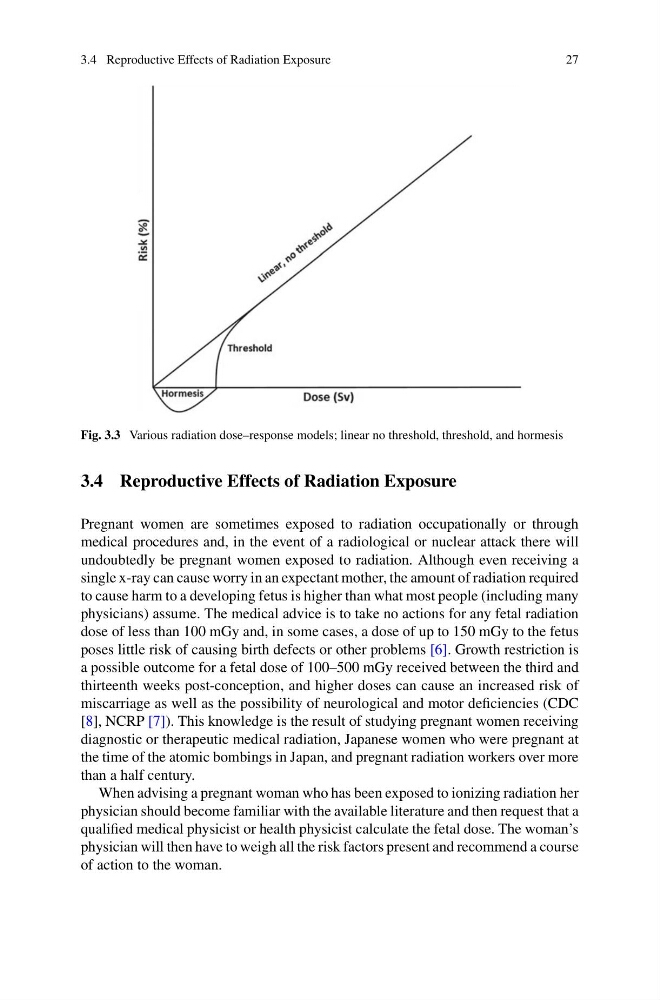
Fig. 3.3 Various radiation dose–response models; linear no threshold, threshold, and hormesis
3.4 Reproductive Effects of Radiation Exposure
Pregnant women are sometimes exposed to radiation occupationally or through
medical procedures and, in the event of a radiological or nuclear attack there will
undoubtedly be pregnant women exposed to radiation. Although even receiving a
single x-ray can cause worry in an expectant mother, the amount of radiation required
to cause harm to a developing fetus is higher than what most people (including many
physicians) assume. The medical advice is to take no actions for any fetal radiation
dose of less than 100 mGy and, in some cases, a dose of up to 150 mGy to the fetus
poses little risk of causing birth defects or other problems [6]. Growth restriction is
a possible outcome for a fetal dose of 100–500 mGy received between the third and
thirteenth weeks post-conception, and higher doses can cause an increased risk of
miscarriage as well as the possibility of neurological and motor deficiencies (CDC
[8], NCRP [7]). This knowledge is the result of studying pregnant women receiving
diagnostic or therapeutic medical radiation, Japanese women who were pregnant at
the time of the atomic bombings in Japan, and pregnant radiation workers over more
than a half century.
When advising a pregnant woman who has been exposed to ionizing radiation her
physician should become familiar with the available literature and then request that a
qualified medical physicist or health physicist calculate the fetal dose. The woman’s
physician will then have to weigh all the risk factors present and recommend a course
of action to the woman.
27
Fig. 3.3 Various radiation dose–response models; linear no threshold, threshold, and hormesis
3.4 Reproductive Effects of Radiation Exposure
Pregnant women are sometimes exposed to radiation occupationally or through
medical procedures and, in the event of a radiological or nuclear attack there will
undoubtedly be pregnant women exposed to radiation. Although even receiving a
single x-ray can cause worry in an expectant mother, the amount of radiation required
to cause harm to a developing fetus is higher than what most people (including many
physicians) assume. The medical advice is to take no actions for any fetal radiation
dose of less than 100 mGy and, in some cases, a dose of up to 150 mGy to the fetus
poses little risk of causing birth defects or other problems [6]. Growth restriction is
a possible outcome for a fetal dose of 100–500 mGy received between the third and
thirteenth weeks post-conception, and higher doses can cause an increased risk of
miscarriage as well as the possibility of neurological and motor deficiencies (CDC
[8], NCRP [7]). This knowledge is the result of studying pregnant women receiving
diagnostic or therapeutic medical radiation, Japanese women who were pregnant at
the time of the atomic bombings in Japan, and pregnant radiation workers over more
than a half century.
When advising a pregnant woman who has been exposed to ionizing radiation her
physician should become familiar with the available literature and then request that a
qualified medical physicist or health physicist calculate the fetal dose. The woman’s
physician will then have to weigh all the risk factors present and recommend a course
of action to the woman.