

226
18 Radiological Assessment and Public Health Response
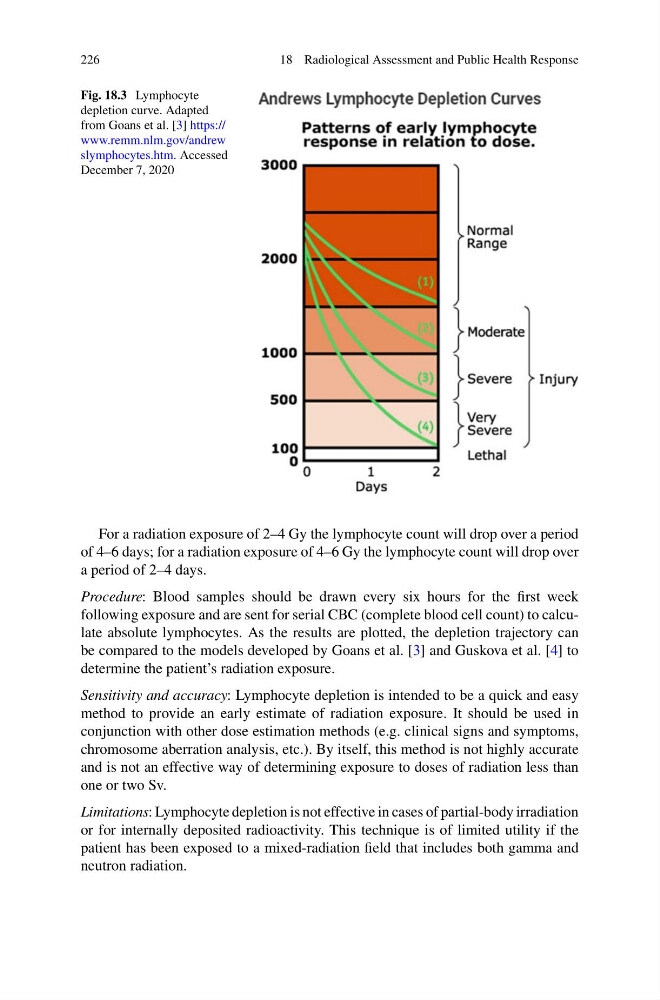
Fig. 18.3 Lymphocyte
depletion curve. Adapted
from Goans et al. [3] https://
www.remm.nlm.gov/andrew
slymphocytes.htm. Accessed
December 7, 2020
For a radiation exposure of 2–4 Gy the lymphocyte count will drop over a period
of 4–6 days; for a radiation exposure of 4–6 Gy the lymphocyte count will drop over
a period of 2–4 days.
Procedure: Blood samples should be drawn every six hours for the first week
following exposure and are sent for serial CBC (complete blood cell count) to calculate absolute lymphocytes. As the results are plotted, the depletion trajectory can
be compared to the models developed by Goans et al. [3] and Guskova et al. [4] to
determine the patient’s radiation exposure.
Sensitivity and accuracy: Lymphocyte depletion is intended to be a quick and easy
method to provide an early estimate of radiation exposure. It should be used in
conjunction with other dose estimation methods (e.g. clinical signs and symptoms,
chromosome aberration analysis, etc.). By itself, this method is not highly accurate
and is not an effective way of determining exposure to doses of radiation less than
one or two Sv.
Limitations: Lymphocyte depletion is not effective in cases of partial-body irradiation
or for internally deposited radioactivity. This technique is of limited utility if the
patient has been exposed to a mixed-radiation field that includes both gamma and
neutron radiation.
18 Radiological Assessment and Public Health Response
Fig. 18.3 Lymphocyte
depletion curve. Adapted
from Goans et al. [3] https://
www.remm.nlm.gov/andrew
slymphocytes.htm. Accessed
December 7, 2020
For a radiation exposure of 2–4 Gy the lymphocyte count will drop over a period
of 4–6 days; for a radiation exposure of 4–6 Gy the lymphocyte count will drop over
a period of 2–4 days.
Procedure: Blood samples should be drawn every six hours for the first week
following exposure and are sent for serial CBC (complete blood cell count) to calculate absolute lymphocytes. As the results are plotted, the depletion trajectory can
be compared to the models developed by Goans et al. [3] and Guskova et al. [4] to
determine the patient’s radiation exposure.
Sensitivity and accuracy: Lymphocyte depletion is intended to be a quick and easy
method to provide an early estimate of radiation exposure. It should be used in
conjunction with other dose estimation methods (e.g. clinical signs and symptoms,
chromosome aberration analysis, etc.). By itself, this method is not highly accurate
and is not an effective way of determining exposure to doses of radiation less than
one or two Sv.
Limitations: Lymphocyte depletion is not effective in cases of partial-body irradiation
or for internally deposited radioactivity. This technique is of limited utility if the
patient has been exposed to a mixed-radiation field that includes both gamma and
neutron radiation.