

17.3 Medical Care in the Emergency Department
201
17.3.2 Assessing the Patient’s Acute Radiation Exposure
and Intake
In particular, medical caregivers must be able to determine if a patient’s radiation
exposure—internal or external—was high enough to cause clinical issues. There are
a variety of symptoms that can indicate exposure to radiation exposures of 1 Gy
or more as an acute exposure: vomiting, diarrhea, headache, and fever. The amount
of time required for the onset of these symptoms can help medical caregivers to
assess the acute radiation exposure; these can be compared to the dose determined
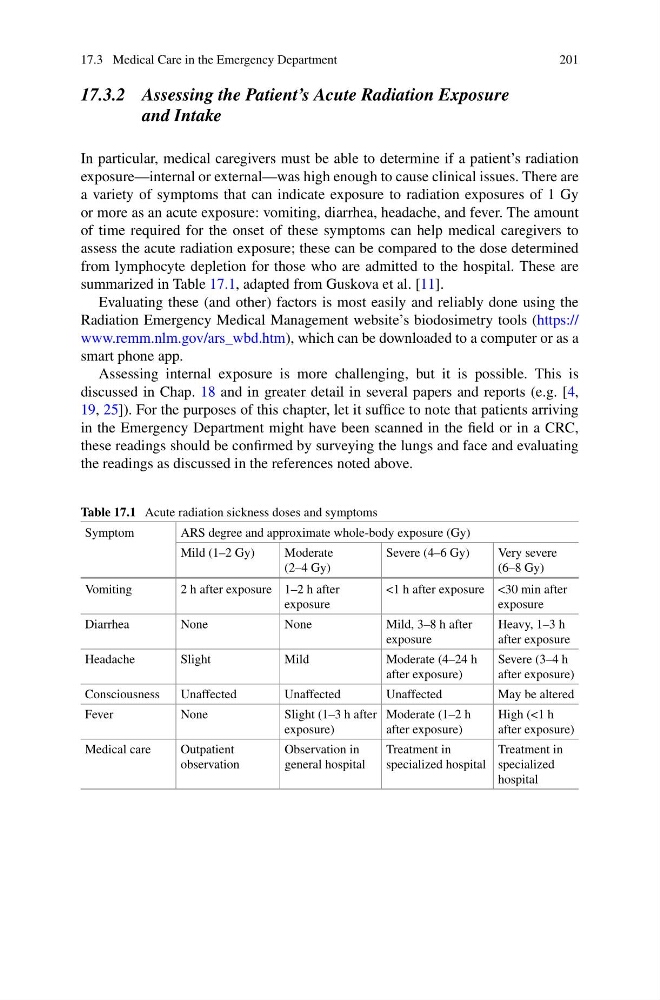
from lymphocyte depletion for those who are admitted to the hospital. These are
summarized in Table 17.1, adapted from Guskova et al. [11].
Evaluating these (and other) factors is most easily and reliably done using the
Radiation Emergency Medical Management website’s biodosimetry tools (https://
www.remm.nlm.gov/ars_wbd.htm), which can be downloaded to a computer or as a
smart phone app.
Assessing internal exposure is more challenging, but it is possible. This is
discussed in Chap. 18 and in greater detail in several papers and reports (e.g. [4,
19, 25]). For the purposes of this chapter, let it suffice to note that patients arriving
in the Emergency Department might have been scanned in the field or in a CRC,
these readings should be confirmed by surveying the lungs and face and evaluating
the readings as discussed in the references noted above.
Table 17.1 Acute radiation sickness doses and symptoms
Symptom
ARS degree and approximate whole-body exposure (Gy)
Mild (1–2 Gy)
Moderate
(2–4 Gy)
Severe (4–6 Gy)
Very severe
(6–8 Gy)
Vomiting
2 h after exposure 1–2 h after
exposure
<1 h after exposure <30 min after
exposure
Diarrhea
None
None
Mild, 3–8 h after
exposure
Heavy, 1–3 h
after exposure
Headache
Slight
Mild
Moderate (4–24 h
after exposure)
Severe (3–4 h
after exposure)
Consciousness
Unaffected
Unaffected
Unaffected
May be altered
Fever
None
Slight (1–3 h after
exposure)
Moderate (1–2 h
after exposure)
High (<1 h
after exposure)
Medical care
Outpatient
observation
Observation in
general hospital
Treatment in
specialized hospital
Treatment in
specialized
hospital
201
17.3.2 Assessing the Patient’s Acute Radiation Exposure
and Intake
In particular, medical caregivers must be able to determine if a patient’s radiation
exposure—internal or external—was high enough to cause clinical issues. There are
a variety of symptoms that can indicate exposure to radiation exposures of 1 Gy
or more as an acute exposure: vomiting, diarrhea, headache, and fever. The amount
of time required for the onset of these symptoms can help medical caregivers to
assess the acute radiation exposure; these can be compared to the dose determined
from lymphocyte depletion for those who are admitted to the hospital. These are
summarized in Table 17.1, adapted from Guskova et al. [11].
Evaluating these (and other) factors is most easily and reliably done using the
Radiation Emergency Medical Management website’s biodosimetry tools (https://
www.remm.nlm.gov/ars_wbd.htm), which can be downloaded to a computer or as a
smart phone app.
Assessing internal exposure is more challenging, but it is possible. This is
discussed in Chap. 18 and in greater detail in several papers and reports (e.g. [4,
19, 25]). For the purposes of this chapter, let it suffice to note that patients arriving
in the Emergency Department might have been scanned in the field or in a CRC,
these readings should be confirmed by surveying the lungs and face and evaluating
the readings as discussed in the references noted above.
Table 17.1 Acute radiation sickness doses and symptoms
Symptom
ARS degree and approximate whole-body exposure (Gy)
Mild (1–2 Gy)
Moderate
(2–4 Gy)
Severe (4–6 Gy)
Very severe
(6–8 Gy)
Vomiting
2 h after exposure 1–2 h after
exposure
<1 h after exposure <30 min after
exposure
Diarrhea
None
None
Mild, 3–8 h after
exposure
Heavy, 1–3 h
after exposure
Headache
Slight
Mild
Moderate (4–24 h
after exposure)
Severe (3–4 h
after exposure)
Consciousness
Unaffected
Unaffected
Unaffected
May be altered
Fever
None
Slight (1–3 h after
exposure)
Moderate (1–2 h
after exposure)
High (<1 h
after exposure)
Medical care
Outpatient
observation
Observation in
general hospital
Treatment in
specialized hospital
Treatment in
specialized
hospital