

184
16 Working Safely in a Radiological Area
• Distance—maintain the greatest distance possible from any identified radioactive
sources and areas with the highest radiation dose rates; even relatively small
changes in distance (e.g. working at arm’s length instead of standing directly
adjacent to a source) can reduce exposure considerably.
• Shielding—workers can install temporary shielding, which can be lead sheets,
soil, or even large water bladders such as those used as water supplies by fire
departments. Workers can also make use of existing structures (e.g. masonry
walls), vehicles, buildings, and terrain to reduce radiation exposure.
• PPE—wearing PPE can reduce skin dose by keeping contamination from direct
contact with the skin and can reduce internal exposure by protecting the mouth
and nose using a respirator. Covering open cuts, scrapes, and other injuries can
also help to reduce internal exposure.
• Dosimetry and radiation instruments—since radiation cannot be sensed, the
only way we have to know if it is present and in what levels is through our radiation
instruments. Responders should not enter a radiological area without dosimetry
and/or radiation detectors unless victims are going to die without immediate
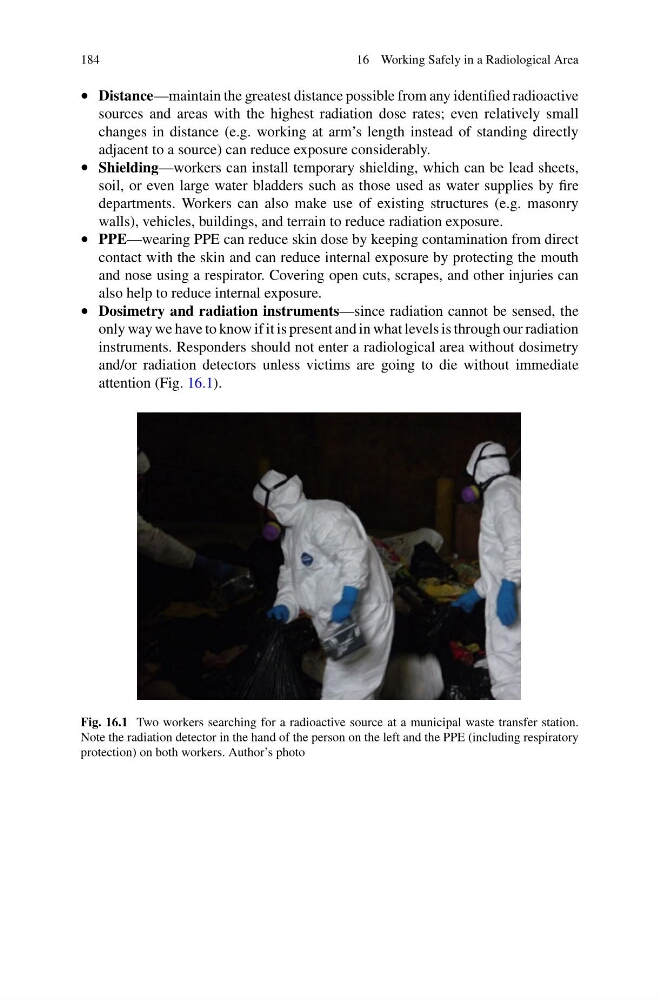
attention (Fig. 16.1).
Fig. 16.1 Two workers searching for a radioactive source at a municipal waste transfer station.
Note the radiation detector in the hand of the person on the left and the PPE (including respiratory
protection) on both workers. Author’s photo
16 Working Safely in a Radiological Area
• Distance—maintain the greatest distance possible from any identified radioactive
sources and areas with the highest radiation dose rates; even relatively small
changes in distance (e.g. working at arm’s length instead of standing directly
adjacent to a source) can reduce exposure considerably.
• Shielding—workers can install temporary shielding, which can be lead sheets,
soil, or even large water bladders such as those used as water supplies by fire
departments. Workers can also make use of existing structures (e.g. masonry
walls), vehicles, buildings, and terrain to reduce radiation exposure.
• PPE—wearing PPE can reduce skin dose by keeping contamination from direct
contact with the skin and can reduce internal exposure by protecting the mouth
and nose using a respirator. Covering open cuts, scrapes, and other injuries can
also help to reduce internal exposure.
• Dosimetry and radiation instruments—since radiation cannot be sensed, the
only way we have to know if it is present and in what levels is through our radiation
instruments. Responders should not enter a radiological area without dosimetry
and/or radiation detectors unless victims are going to die without immediate
attention (Fig. 16.1).
Fig. 16.1 Two workers searching for a radioactive source at a municipal waste transfer station.
Note the radiation detector in the hand of the person on the left and the PPE (including respiratory
protection) on both workers. Author’s photo