

166
15 Initial Emergency Response Efforts
Table 15.1 PRD alarm adjudication examples
Reading (µGy hr -1 )
Detector
Circumstances
Adjudication
11
CsI PRD
500 m from construction
site with industrial
radiography taking place
Innocent alarm
1.3
Energy-Comp. GM
Elevated dose rates are
distributed over an area
of about 2 ha
Covert attack
2.8
NaI PRD
In vicinity of nuclear
medicine clinic
Innocent alarm
5.7
Pressurized
ionization chamber
Near truck with soil
density gauge in bed
Innocent alarm
0.2
NaI PRD
At scene of pipe bomb
explosion
Possible attack,
possibly
non-radiological
0.5-1.8
Cs-137, I-133 nuclide
ID
NaI mobile system
with high-volume
detectors
Site area emergency at
nearby nuclear power
plant
Possible reactor
accident
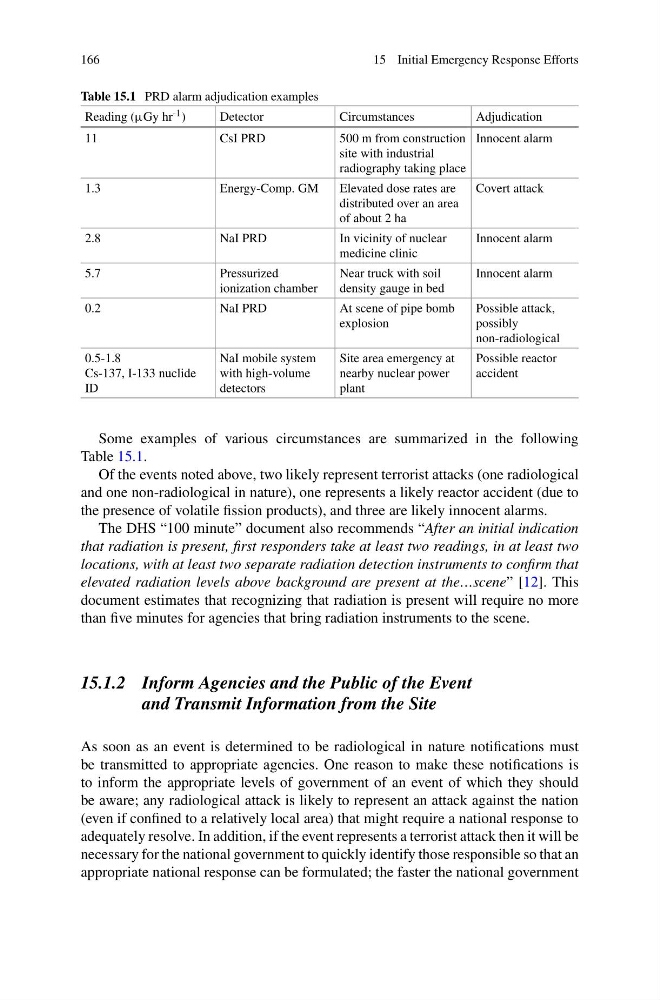
Some examples of various circumstances are summarized in the following
Table 15.1.
Of the events noted above, two likely represent terrorist attacks (one radiological
and one non-radiological in nature), one represents a likely reactor accident (due to
the presence of volatile fission products), and three are likely innocent alarms.
The DHS “100 minute” document also recommends “After an initial indication
that radiation is present, first responders take at least two readings, in at least two
locations, with at least two separate radiation detection instruments to confirm that
elevated radiation levels above background are present at the…scene” [12]. This
document estimates that recognizing that radiation is present will require no more
than five minutes for agencies that bring radiation instruments to the scene.
15.1.2 Inform Agencies and the Public of the Event
and Transmit Information from the Site
As soon as an event is determined to be radiological in nature notifications must
be transmitted to appropriate agencies. One reason to make these notifications is
to inform the appropriate levels of government of an event of which they should
be aware; any radiological attack is likely to represent an attack against the nation
(even if confined to a relatively local area) that might require a national response to
adequately resolve. In addition, if the event represents a terrorist attack then it will be
necessary for the national government to quickly identify those responsible so that an
appropriate national response can be formulated; the faster the national government
15 Initial Emergency Response Efforts
Table 15.1 PRD alarm adjudication examples
Reading (µGy hr -1 )
Detector
Circumstances
Adjudication
11
CsI PRD
500 m from construction
site with industrial
radiography taking place
Innocent alarm
1.3
Energy-Comp. GM
Elevated dose rates are
distributed over an area
of about 2 ha
Covert attack
2.8
NaI PRD
In vicinity of nuclear
medicine clinic
Innocent alarm
5.7
Pressurized
ionization chamber
Near truck with soil
density gauge in bed
Innocent alarm
0.2
NaI PRD
At scene of pipe bomb
explosion
Possible attack,
possibly
non-radiological
0.5-1.8
Cs-137, I-133 nuclide
ID
NaI mobile system
with high-volume
detectors
Site area emergency at
nearby nuclear power
plant
Possible reactor
accident
Some examples of various circumstances are summarized in the following
Table 15.1.
Of the events noted above, two likely represent terrorist attacks (one radiological
and one non-radiological in nature), one represents a likely reactor accident (due to
the presence of volatile fission products), and three are likely innocent alarms.
The DHS “100 minute” document also recommends “After an initial indication
that radiation is present, first responders take at least two readings, in at least two
locations, with at least two separate radiation detection instruments to confirm that
elevated radiation levels above background are present at the…scene” [12]. This
document estimates that recognizing that radiation is present will require no more
than five minutes for agencies that bring radiation instruments to the scene.
15.1.2 Inform Agencies and the Public of the Event
and Transmit Information from the Site
As soon as an event is determined to be radiological in nature notifications must
be transmitted to appropriate agencies. One reason to make these notifications is
to inform the appropriate levels of government of an event of which they should
be aware; any radiological attack is likely to represent an attack against the nation
(even if confined to a relatively local area) that might require a national response to
adequately resolve. In addition, if the event represents a terrorist attack then it will be
necessary for the national government to quickly identify those responsible so that an
appropriate national response can be formulated; the faster the national government