

14.1 Challenges to Radiological Interdiction
151
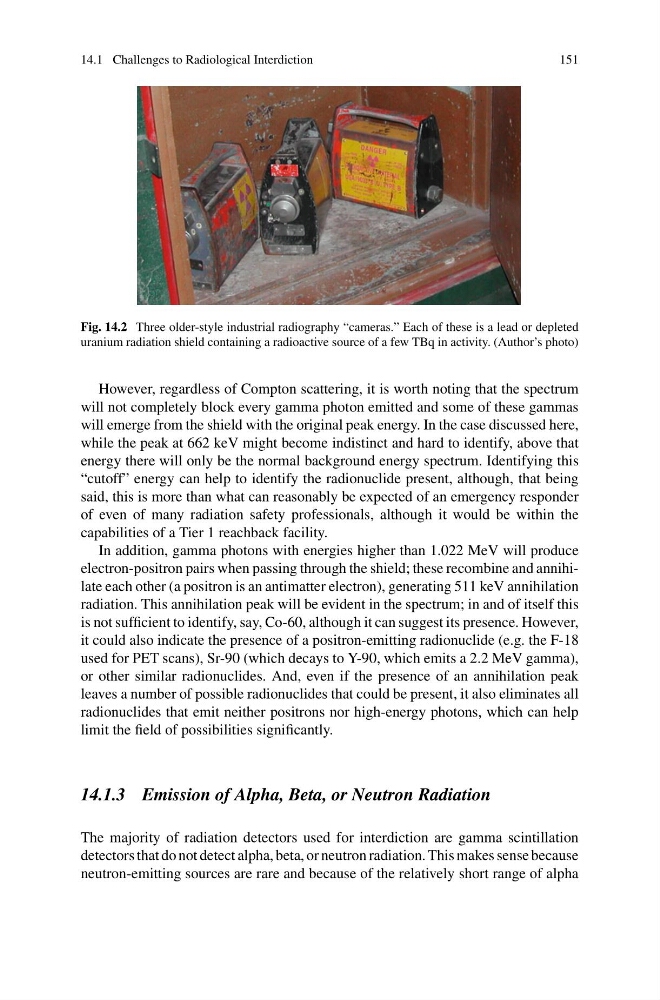
Fig. 14.2 Three older-style industrial radiography “cameras.” Each of these is a lead or depleted
uranium radiation shield containing a radioactive source of a few TBq in activity. (Author’s photo)
However, regardless of Compton scattering, it is worth noting that the spectrum
will not completely block every gamma photon emitted and some of these gammas
will emerge from the shield with the original peak energy. In the case discussed here,
while the peak at 662 keV might become indistinct and hard to identify, above that
energy there will only be the normal background energy spectrum. Identifying this
“cutoff” energy can help to identify the radionuclide present, although, that being
said, this is more than what can reasonably be expected of an emergency responder
of even of many radiation safety professionals, although it would be within the
capabilities of a Tier 1 reachback facility.
In addition, gamma photons with energies higher than 1.022 MeV will produce
electron-positron pairs when passing through the shield; these recombine and annihilate each other (a positron is an antimatter electron), generating 511 keV annihilation
radiation. This annihilation peak will be evident in the spectrum; in and of itself this
is not sufficient to identify, say, Co-60, although it can suggest its presence. However,
it could also indicate the presence of a positron-emitting radionuclide (e.g. the F-18
used for PET scans), Sr-90 (which decays to Y-90, which emits a 2.2 MeV gamma),
or other similar radionuclides. And, even if the presence of an annihilation peak
leaves a number of possible radionuclides that could be present, it also eliminates all
radionuclides that emit neither positrons nor high-energy photons, which can help
limit the field of possibilities significantly.
14.1.3 Emission of Alpha, Beta, or Neutron Radiation
The majority of radiation detectors used for interdiction are gamma scintillation
detectors that do not detect alpha, beta, or neutron radiation. This makes sense because
neutron-emitting sources are rare and because of the relatively short range of alpha
151
Fig. 14.2 Three older-style industrial radiography “cameras.” Each of these is a lead or depleted
uranium radiation shield containing a radioactive source of a few TBq in activity. (Author’s photo)
However, regardless of Compton scattering, it is worth noting that the spectrum
will not completely block every gamma photon emitted and some of these gammas
will emerge from the shield with the original peak energy. In the case discussed here,
while the peak at 662 keV might become indistinct and hard to identify, above that
energy there will only be the normal background energy spectrum. Identifying this
“cutoff” energy can help to identify the radionuclide present, although, that being
said, this is more than what can reasonably be expected of an emergency responder
of even of many radiation safety professionals, although it would be within the
capabilities of a Tier 1 reachback facility.
In addition, gamma photons with energies higher than 1.022 MeV will produce
electron-positron pairs when passing through the shield; these recombine and annihilate each other (a positron is an antimatter electron), generating 511 keV annihilation
radiation. This annihilation peak will be evident in the spectrum; in and of itself this
is not sufficient to identify, say, Co-60, although it can suggest its presence. However,
it could also indicate the presence of a positron-emitting radionuclide (e.g. the F-18
used for PET scans), Sr-90 (which decays to Y-90, which emits a 2.2 MeV gamma),
or other similar radionuclides. And, even if the presence of an annihilation peak
leaves a number of possible radionuclides that could be present, it also eliminates all
radionuclides that emit neither positrons nor high-energy photons, which can help
limit the field of possibilities significantly.
14.1.3 Emission of Alpha, Beta, or Neutron Radiation
The majority of radiation detectors used for interdiction are gamma scintillation
detectors that do not detect alpha, beta, or neutron radiation. This makes sense because
neutron-emitting sources are rare and because of the relatively short range of alpha