

100
10 Physical Effects of Nuclear Weapons
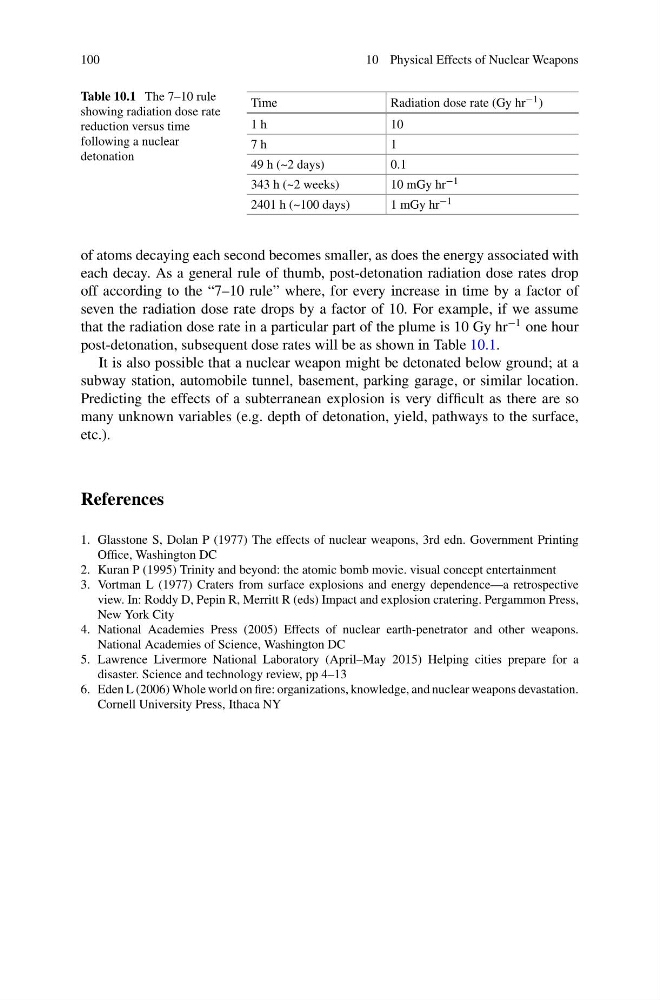
Table 10.1 The 7–10 rule
showing radiation dose rate
reduction versus time
following a nuclear
detonation
Time
Radiation dose rate (Gy hr −1 )
1 h
10
7 h
1
49 h (~2 days)
0.1
343 h (~2 weeks)
10 mGy hr −1
2401 h (~100 days)
1 mGy hr −1
of atoms decaying each second becomes smaller, as does the energy associated with
each decay. As a general rule of thumb, post-detonation radiation dose rates drop
off according to the “7–10 rule” where, for every increase in time by a factor of
seven the radiation dose rate drops by a factor of 10. For example, if we assume
that the radiation dose rate in a particular part of the plume is 10 Gy hr
−1 one hour
post-detonation, subsequent dose rates will be as shown in Table 10.1.
It is also possible that a nuclear weapon might be detonated below ground; at a
subway station, automobile tunnel, basement, parking garage, or similar location.
Predicting the effects of a subterranean explosion is very difficult as there are so
many unknown variables (e.g. depth of detonation, yield, pathways to the surface,
etc.).
References
1. Glasstone S, Dolan P (1977) The effects of nuclear weapons, 3rd edn. Government Printing
Office, Washington DC
2. Kuran P (1995) Trinity and beyond: the atomic bomb movie. visual concept entertainment
3. Vortman L (1977) Craters from surface explosions and energy dependence—a retrospective
view. In: Roddy D, Pepin R, Merritt R (eds) Impact and explosion cratering. Pergammon Press,
New York City
4. National Academies Press (2005) Effects of nuclear earth-penetrator and other weapons.
National Academies of Science, Washington DC
5. Lawrence Livermore National Laboratory (April–May 2015) Helping cities prepare for a
disaster. Science and technology review, pp 4–13
6. Eden L (2006) Whole world on fire: organizations, knowledge, and nuclear weapons devastation.
Cornell University Press, Ithaca NY
10 Physical Effects of Nuclear Weapons
Table 10.1 The 7–10 rule
showing radiation dose rate
reduction versus time
following a nuclear
detonation
Time
Radiation dose rate (Gy hr −1 )
1 h
10
7 h
1
49 h (~2 days)
0.1
343 h (~2 weeks)
10 mGy hr −1
2401 h (~100 days)
1 mGy hr −1
of atoms decaying each second becomes smaller, as does the energy associated with
each decay. As a general rule of thumb, post-detonation radiation dose rates drop
off according to the “7–10 rule” where, for every increase in time by a factor of
seven the radiation dose rate drops by a factor of 10. For example, if we assume
that the radiation dose rate in a particular part of the plume is 10 Gy hr
−1 one hour
post-detonation, subsequent dose rates will be as shown in Table 10.1.
It is also possible that a nuclear weapon might be detonated below ground; at a
subway station, automobile tunnel, basement, parking garage, or similar location.
Predicting the effects of a subterranean explosion is very difficult as there are so
many unknown variables (e.g. depth of detonation, yield, pathways to the surface,
etc.).
References
1. Glasstone S, Dolan P (1977) The effects of nuclear weapons, 3rd edn. Government Printing
Office, Washington DC
2. Kuran P (1995) Trinity and beyond: the atomic bomb movie. visual concept entertainment
3. Vortman L (1977) Craters from surface explosions and energy dependence—a retrospective
view. In: Roddy D, Pepin R, Merritt R (eds) Impact and explosion cratering. Pergammon Press,
New York City
4. National Academies Press (2005) Effects of nuclear earth-penetrator and other weapons.
National Academies of Science, Washington DC
5. Lawrence Livermore National Laboratory (April–May 2015) Helping cities prepare for a
disaster. Science and technology review, pp 4–13
6. Eden L (2006) Whole world on fire: organizations, knowledge, and nuclear weapons devastation.
Cornell University Press, Ithaca NY