

88
9 How Nuclear Weapons Work
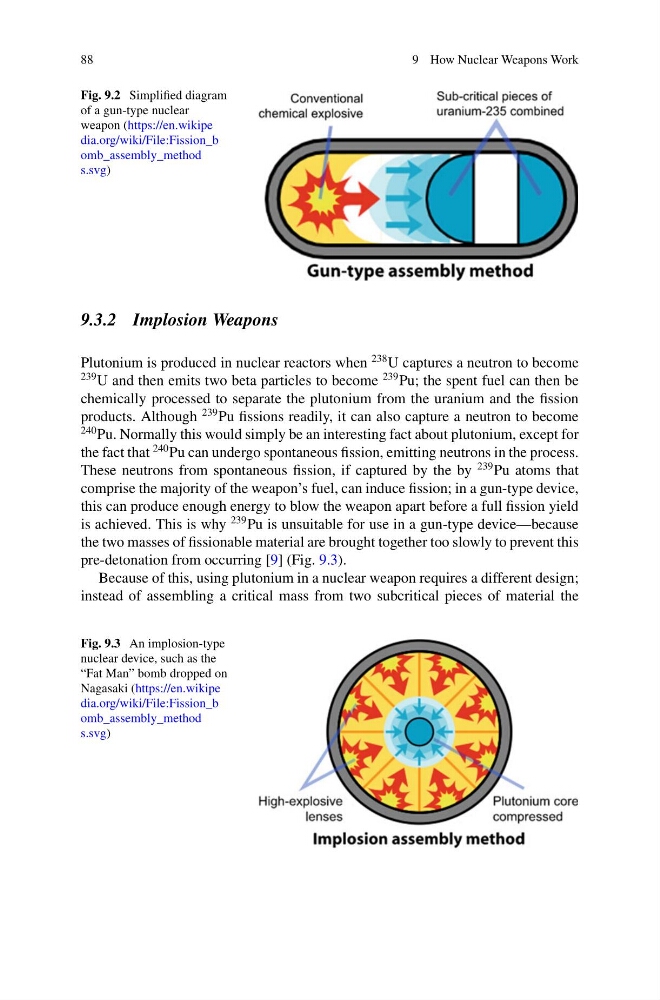
Fig. 9.2 Simplified diagram
of a gun-type nuclear
weapon (https://en.wikipe
dia.org/wiki/File:Fission_b
omb_assembly_method
s.svg)
9.3.2 Implosion Weapons
Plutonium is produced in nuclear reactors when
238 U captures a neutron to become
239 U and then emits two beta particles to become
239 Pu; the spent fuel can then be
chemically processed to separate the plutonium from the uranium and the fission
products. Although
239 Pu fissions readily, it can also capture a neutron to become
240 Pu. Normally this would simply be an interesting fact about plutonium, except for
the fact that
240 Pu can undergo spontaneous fission, emitting neutrons in the process.
These neutrons from spontaneous fission, if captured by the by
239 Pu atoms that
comprise the majority of the weapon’s fuel, can induce fission; in a gun-type device,
this can produce enough energy to blow the weapon apart before a full fission yield
is achieved. This is why
239 Pu is unsuitable for use in a gun-type device—because
the two masses of fissionable material are brought together too slowly to prevent this
pre-detonation from occurring [9] (Fig. 9.3).
Because of this, using plutonium in a nuclear weapon requires a different design;
instead of assembling a critical mass from two subcritical pieces of material the
Fig. 9.3 An implosion-type
nuclear device, such as the
“Fat Man” bomb dropped on
Nagasaki (https://en.wikipe
dia.org/wiki/File:Fission_b
omb_assembly_method
s.svg)
9 How Nuclear Weapons Work
Fig. 9.2 Simplified diagram
of a gun-type nuclear
weapon (https://en.wikipe
dia.org/wiki/File:Fission_b
omb_assembly_method
s.svg)
9.3.2 Implosion Weapons
Plutonium is produced in nuclear reactors when
238 U captures a neutron to become
239 U and then emits two beta particles to become
239 Pu; the spent fuel can then be
chemically processed to separate the plutonium from the uranium and the fission
products. Although
239 Pu fissions readily, it can also capture a neutron to become
240 Pu. Normally this would simply be an interesting fact about plutonium, except for
the fact that
240 Pu can undergo spontaneous fission, emitting neutrons in the process.
These neutrons from spontaneous fission, if captured by the by
239 Pu atoms that
comprise the majority of the weapon’s fuel, can induce fission; in a gun-type device,
this can produce enough energy to blow the weapon apart before a full fission yield
is achieved. This is why
239 Pu is unsuitable for use in a gun-type device—because
the two masses of fissionable material are brought together too slowly to prevent this
pre-detonation from occurring [9] (Fig. 9.3).
Because of this, using plutonium in a nuclear weapon requires a different design;
instead of assembling a critical mass from two subcritical pieces of material the
Fig. 9.3 An implosion-type
nuclear device, such as the
“Fat Man” bomb dropped on
Nagasaki (https://en.wikipe
dia.org/wiki/File:Fission_b
omb_assembly_method
s.svg)