

88
6 Beyond Point-to-Point Quantum Key Distribution
ρ
k d
AB =
p 1
p click
q
q + (1 − q)(1 −
√ η)
|ψ k d 1 ψ k d 1 | AB
+
(1 − q)(1 −
√
η)
q + (1 − q)(1 −
√
η)
|1111| AB
+
p 2
p click
|1111| AB ,
(6.7)
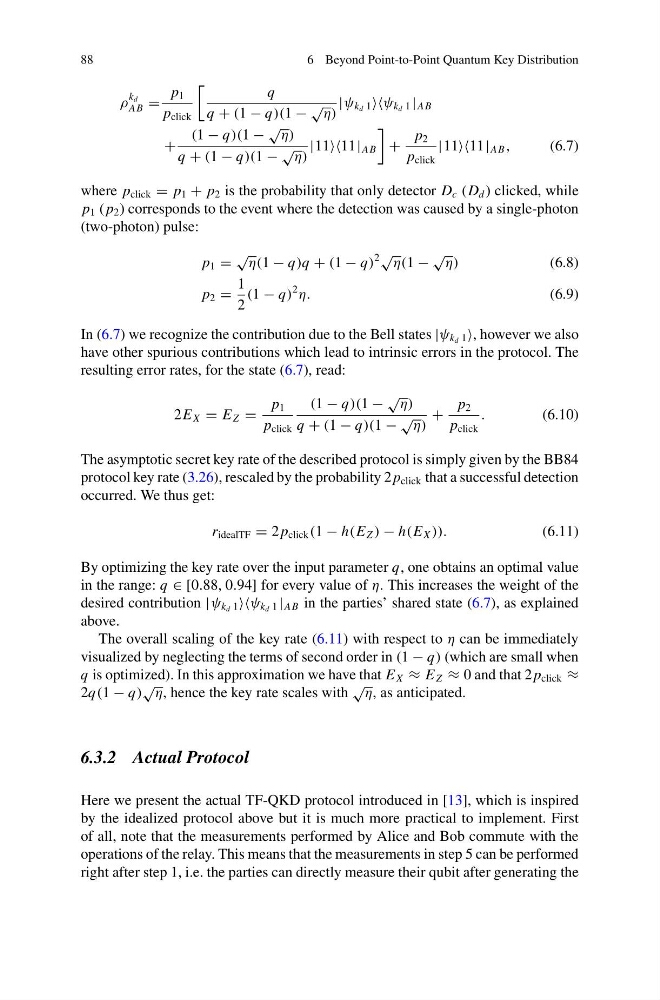
where p click = p 1 + p 2 is the probability that only detector D c (D d ) clicked, while
p 1 ( p 2 ) corresponds to the event where the detection was caused by a single-photon
(two-photon) pulse:
p 1 =
√
η(1 − q)q + (1 − q)
2 √ η(1 −
√ η)
(6.8)
p 2 =
1
2
(1 − q)
2
η.
(6.9)
In (6.7) we recognize the contribution due to the Bell states |ψ k d 1 , however we also
have other spurious contributions which lead to intrinsic errors in the protocol. The
resulting error rates, for the state (6.7), read:
2E X = E Z =
p 1
p click
(1 − q)(1 −
√
η)
q + (1 − q)(1 −
√ η)
+
p 2
p click
.
(6.10)
The asymptotic secret key rate of the described protocol is simply given by the BB84
protocol key rate (3.26), rescaled by the probability 2 p click that a successful detection
occurred. We thus get:
r idealTF = 2 p click (1 − h(E Z ) − h(E X )).
(6.11)
By optimizing the key rate over the input parameter q, one obtains an optimal value
in the range: q ∈ [0.88, 0.94] for every value of η. This increases the weight of the
desired contribution |ψ k d 1 ψ k d 1 | AB in the parties’ shared state (6.7), as explained
above.
The overall scaling of the key rate (6.11) with respect to η can be immediately
visualized by neglecting the terms of second order in (1 − q) (which are small when
q is optimized). In this approximation we have that E X ≈ E Z ≈ 0 and that 2 p click ≈
2q(1 − q)
√ η, hence the key rate scales with
√ η, as anticipated.
6.3.2 Actual Protocol
Here we present the actual TF-QKD protocol introduced in [13], which is inspired
by the idealized protocol above but it is much more practical to implement. First
of all, note that the measurements performed by Alice and Bob commute with the
operations of the relay. This means that the measurements in step 5 can be performed
right after step 1, i.e. the parties can directly measure their qubit after generating the
6 Beyond Point-to-Point Quantum Key Distribution
ρ
k d
AB =
p 1
p click
q
q + (1 − q)(1 −
√ η)
|ψ k d 1 ψ k d 1 | AB
+
(1 − q)(1 −
√
η)
q + (1 − q)(1 −
√
η)
|1111| AB
+
p 2
p click
|1111| AB ,
(6.7)
where p click = p 1 + p 2 is the probability that only detector D c (D d ) clicked, while
p 1 ( p 2 ) corresponds to the event where the detection was caused by a single-photon
(two-photon) pulse:
p 1 =
√
η(1 − q)q + (1 − q)
2 √ η(1 −
√ η)
(6.8)
p 2 =
1
2
(1 − q)
2
η.
(6.9)
In (6.7) we recognize the contribution due to the Bell states |ψ k d 1 , however we also
have other spurious contributions which lead to intrinsic errors in the protocol. The
resulting error rates, for the state (6.7), read:
2E X = E Z =
p 1
p click
(1 − q)(1 −
√
η)
q + (1 − q)(1 −
√ η)
+
p 2
p click
.
(6.10)
The asymptotic secret key rate of the described protocol is simply given by the BB84
protocol key rate (3.26), rescaled by the probability 2 p click that a successful detection
occurred. We thus get:
r idealTF = 2 p click (1 − h(E Z ) − h(E X )).
(6.11)
By optimizing the key rate over the input parameter q, one obtains an optimal value
in the range: q ∈ [0.88, 0.94] for every value of η. This increases the weight of the
desired contribution |ψ k d 1 ψ k d 1 | AB in the parties’ shared state (6.7), as explained
above.
The overall scaling of the key rate (6.11) with respect to η can be immediately
visualized by neglecting the terms of second order in (1 − q) (which are small when
q is optimized). In this approximation we have that E X ≈ E Z ≈ 0 and that 2 p click ≈
2q(1 − q)
√ η, hence the key rate scales with
√ η, as anticipated.
6.3.2 Actual Protocol
Here we present the actual TF-QKD protocol introduced in [13], which is inspired
by the idealized protocol above but it is much more practical to implement. First
of all, note that the measurements performed by Alice and Bob commute with the
operations of the relay. This means that the measurements in step 5 can be performed
right after step 1, i.e. the parties can directly measure their qubit after generating the