

86
6 Beyond Point-to-Point Quantum Key Distribution
The main challenge in implementing the TF-QKD protocol of [12] is controlling
the phase drifts of the twin fields. Indeed, the differential phase fluctuation between
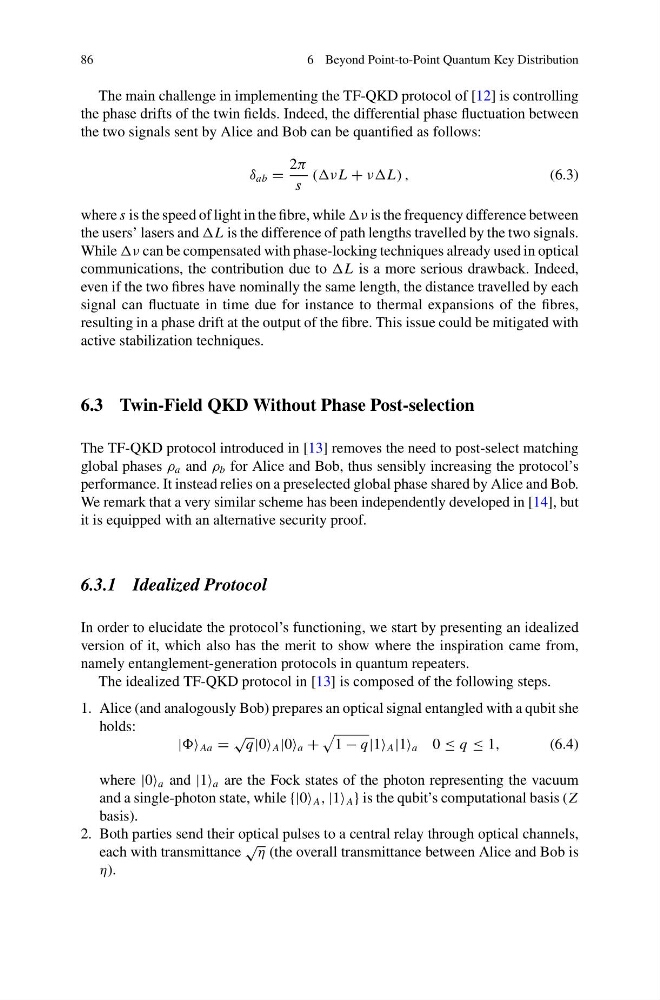
the two signals sent by Alice and Bob can be quantified as follows:
δ ab =
2π
s
(ν L + ννL) ,
(6.3)
where s is the speed of light in the fibre, while ν is the frequency difference between
the users’ lasers and L is the difference of path lengths travelled by the two signals.
While ν can be compensated with phase-locking techniques already used in optical
communications, the contribution due to L is a more serious drawback. Indeed,
even if the two fibres have nominally the same length, the distance travelled by each
signal can fluctuate in time due for instance to thermal expansions of the fibres,
resulting in a phase drift at the output of the fibre. This issue could be mitigated with
active stabilization techniques.
6.3 Twin-Field QKD Without Phase Post-selection
The TF-QKD protocol introduced in [13] removes the need to post-select matching
global phases ρ a and ρ b for Alice and Bob, thus sensibly increasing the protocol’s
performance. It instead relies on a preselected global phase shared by Alice and Bob.
We remark that a very similar scheme has been independently developed in [14], but
it is equipped with an alternative security proof.
6.3.1 Idealized Protocol
In order to elucidate the protocol’s functioning, we start by presenting an idealized
version of it, which also has the merit to show where the inspiration came from,
namely entanglement-generation protocols in quantum repeaters.
The idealized TF-QKD protocol in [13] is composed of the following steps.
1. Alice (and analogously Bob) prepares an optical signal entangled with a qubit she
holds:
| Aa =
√
q|0 A |0 a +
1 − q|1 A |1 a 0 ≤ q ≤ 1,
(6.4)
where |0 a and |1 a are the Fock states of the photon representing the vacuum
and a single-photon state, while {|0 A , |1 A } is the qubit’s computational basis (Z
basis).
2. Both parties send their optical pulses to a central relay through optical channels,
each with transmittance
√
η (the overall transmittance between Alice and Bob is
η).
6 Beyond Point-to-Point Quantum Key Distribution
The main challenge in implementing the TF-QKD protocol of [12] is controlling
the phase drifts of the twin fields. Indeed, the differential phase fluctuation between
the two signals sent by Alice and Bob can be quantified as follows:
δ ab =
2π
s
(ν L + ννL) ,
(6.3)
where s is the speed of light in the fibre, while ν is the frequency difference between
the users’ lasers and L is the difference of path lengths travelled by the two signals.
While ν can be compensated with phase-locking techniques already used in optical
communications, the contribution due to L is a more serious drawback. Indeed,
even if the two fibres have nominally the same length, the distance travelled by each
signal can fluctuate in time due for instance to thermal expansions of the fibres,
resulting in a phase drift at the output of the fibre. This issue could be mitigated with
active stabilization techniques.
6.3 Twin-Field QKD Without Phase Post-selection
The TF-QKD protocol introduced in [13] removes the need to post-select matching
global phases ρ a and ρ b for Alice and Bob, thus sensibly increasing the protocol’s
performance. It instead relies on a preselected global phase shared by Alice and Bob.
We remark that a very similar scheme has been independently developed in [14], but
it is equipped with an alternative security proof.
6.3.1 Idealized Protocol
In order to elucidate the protocol’s functioning, we start by presenting an idealized
version of it, which also has the merit to show where the inspiration came from,
namely entanglement-generation protocols in quantum repeaters.
The idealized TF-QKD protocol in [13] is composed of the following steps.
1. Alice (and analogously Bob) prepares an optical signal entangled with a qubit she
holds:
| Aa =
√
q|0 A |0 a +
1 − q|1 A |1 a 0 ≤ q ≤ 1,
(6.4)
where |0 a and |1 a are the Fock states of the photon representing the vacuum
and a single-photon state, while {|0 A , |1 A } is the qubit’s computational basis (Z
basis).
2. Both parties send their optical pulses to a central relay through optical channels,
each with transmittance
√
η (the overall transmittance between Alice and Bob is
η).