

64
4 Quantum Conference Key Agreement
The CKA experiment in [26] implements the multipartite BB84 protocol [13]
described in Sect 4.1, by distributing four-party GHZ states encoded in the polarization of single photons at telecom wavelength. In particular, the qubit computational
basis {|0 |1} is encoded in the horizontal/vertical polarization: {|H |V }. In each
round, the photons prepared in the GHZ state are distributed to the four parties over
up to a total of 50 km of optical fibres and are subsequently measured in the horizontal/vertical basis (Z basis) or in the diagonal/antidiagonal basis: {|++, |−−} (X basis),
where |±± = (|H ± |V )/
√
2. After completing the EC and PA steps, the parties
hold an ε tot -secure conference key of = 1.15 × 10
6 bits, with ε tot = 1.8 × 10
−8 .
The established key is then used to encrypt an image with one-time pad in order to
securely share it among the four parties.
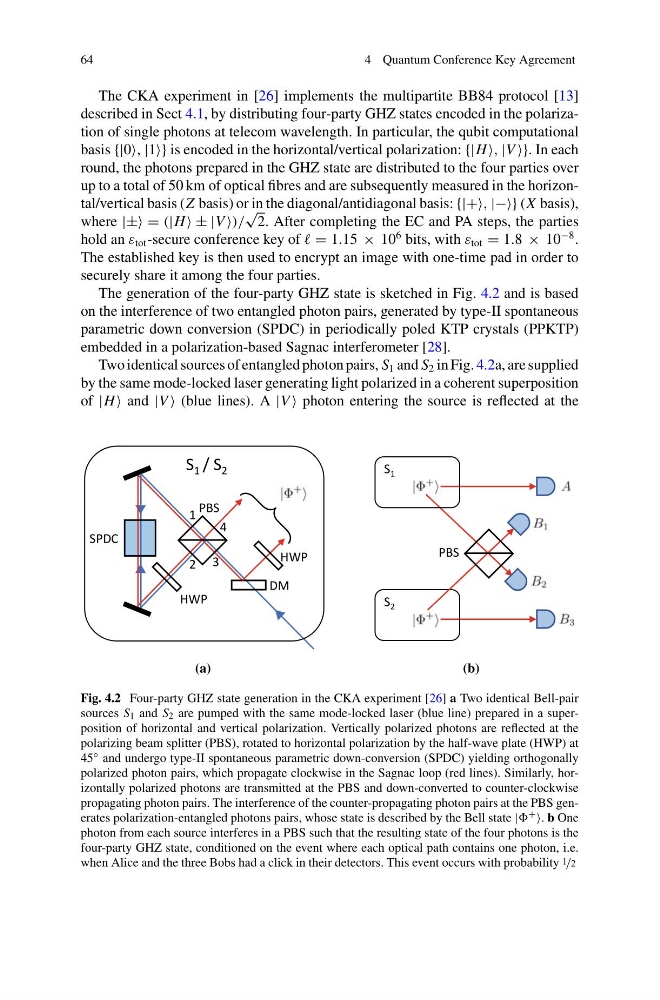
The generation of the four-party GHZ state is sketched in Fig. 4.2 and is based
on the interference of two entangled photon pairs, generated by type-II spontaneous
parametric down conversion (SPDC) in periodically poled KTP crystals (PPKTP)
embedded in a polarization-based Sagnac interferometer [28].
Two identical sources of entangled photon pairs, S 1 and S 2 in Fig. 4.2a, are supplied
by the same mode-locked laser generating light polarized in a coherent superposition
of |H and |V (blue lines). A |V photon entering the source is reflected at the
PBS
HWP
DM
SPDC
S 1 / S 2
1
2
4
3
HWP
(a)
S 1
S 2
PBS
(b)
Fig. 4.2 Four-party GHZ state generation in the CKA experiment [26] a Two identical Bell-pair
sources S 1 and S 2 are pumped with the same mode-locked laser (blue line) prepared in a superposition of horizontal and vertical polarization. Vertically polarized photons are reflected at the
polarizing beam splitter (PBS), rotated to horizontal polarization by the half-wave plate (HWP) at
45 ◦ and undergo type-II spontaneous parametric down-conversion (SPDC) yielding orthogonally
polarized photon pairs, which propagate clockwise in the Sagnac loop (red lines). Similarly, horizontally polarized photons are transmitted at the PBS and down-converted to counter-clockwise
propagating photon pairs. The interference of the counter-propagating photon pairs at the PBS generates polarization-entangled photons pairs, whose state is described by the Bell state | + . b One
photon from each source interferes in a PBS such that the resulting state of the four photons is the
four-party GHZ state, conditioned on the event where each optical path contains one photon, i.e.
when Alice and the three Bobs had a click in their detectors. This event occurs with probability 1 /2
4 Quantum Conference Key Agreement
The CKA experiment in [26] implements the multipartite BB84 protocol [13]
described in Sect 4.1, by distributing four-party GHZ states encoded in the polarization of single photons at telecom wavelength. In particular, the qubit computational
basis {|0 |1} is encoded in the horizontal/vertical polarization: {|H |V }. In each
round, the photons prepared in the GHZ state are distributed to the four parties over
up to a total of 50 km of optical fibres and are subsequently measured in the horizontal/vertical basis (Z basis) or in the diagonal/antidiagonal basis: {|++, |−−} (X basis),
where |±± = (|H ± |V )/
√
2. After completing the EC and PA steps, the parties
hold an ε tot -secure conference key of = 1.15 × 10
6 bits, with ε tot = 1.8 × 10
−8 .
The established key is then used to encrypt an image with one-time pad in order to
securely share it among the four parties.
The generation of the four-party GHZ state is sketched in Fig. 4.2 and is based
on the interference of two entangled photon pairs, generated by type-II spontaneous
parametric down conversion (SPDC) in periodically poled KTP crystals (PPKTP)
embedded in a polarization-based Sagnac interferometer [28].
Two identical sources of entangled photon pairs, S 1 and S 2 in Fig. 4.2a, are supplied
by the same mode-locked laser generating light polarized in a coherent superposition
of |H and |V (blue lines). A |V photon entering the source is reflected at the
PBS
HWP
DM
SPDC
S 1 / S 2
1
2
4
3
HWP
(a)
S 1
S 2
PBS
(b)
Fig. 4.2 Four-party GHZ state generation in the CKA experiment [26] a Two identical Bell-pair
sources S 1 and S 2 are pumped with the same mode-locked laser (blue line) prepared in a superposition of horizontal and vertical polarization. Vertically polarized photons are reflected at the
polarizing beam splitter (PBS), rotated to horizontal polarization by the half-wave plate (HWP) at
45 ◦ and undergo type-II spontaneous parametric down-conversion (SPDC) yielding orthogonally
polarized photon pairs, which propagate clockwise in the Sagnac loop (red lines). Similarly, horizontally polarized photons are transmitted at the PBS and down-converted to counter-clockwise
propagating photon pairs. The interference of the counter-propagating photon pairs at the PBS generates polarization-entangled photons pairs, whose state is described by the Bell state | + . b One
photon from each source interferes in a PBS such that the resulting state of the four photons is the
four-party GHZ state, conditioned on the event where each optical path contains one photon, i.e.
when Alice and the three Bobs had a click in their detectors. This event occurs with probability 1 /2