

42
3 Introducing Quantum Key Distribution
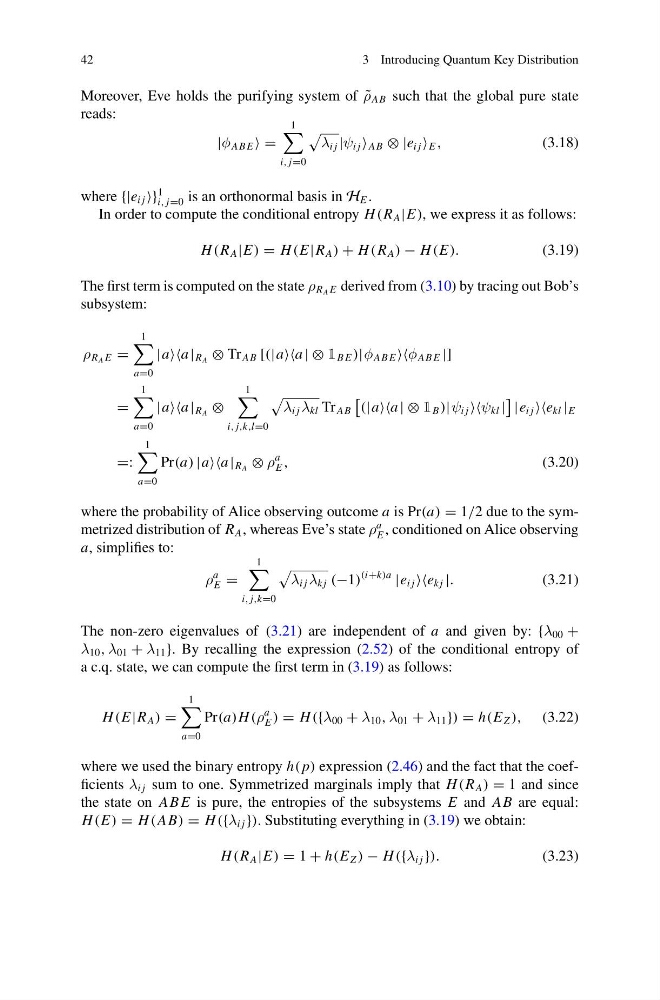
Moreover, Eve holds the purifying system of ˜
ρ AB such that the global pure state
reads:
|φ AB E =
1
i, j=0
λ i j |ψ i j AB ⊗ |e i j E ,
(3.18)
where {|e i j }
1
i, j=0 is an orthonormal basis in H E .
In order to compute the conditional entropy H (R A |E), we express it as follows:
H (R A |E) = H (E|R A ) + H (R A ) − H (E).
(3.19)
The first term is computed on the state ρ R A E derived from (3.10) by tracing out Bob’s
subsystem:
ρ R A E =
1
a=0
|aa | R A ⊗ Tr AB [(|aa | ⊗ 1 B E )|φ AB E φ AB E |]
=
1
a=0
|aa | R A ⊗
1
i, j,k,l=0
λ i j λ kl Tr AB
(|aa | ⊗ 1 B )|ψ i j ψ kl |
|e i j e kl | E
=:
1
a=0
Pr(a) |aa | R A ⊗ ρ
a
E ,
(3.20)
where the probability of Alice observing outcome a is Pr(a) = 1/2 due to the symmetrized distribution of R A , whereas Eve’s state ρ
a
E , conditioned on Alice observing
a, simplifies to:
ρ
a
E =
1
i, j,k=0
λ i j λ k j (−1)
(i+k)a
|e i j e k j |.
(3.21)
The non-zero eigenvalues of (3.21) are independent of a and given by: {λ 00 +
λ 10 , λ 01 + λ 11 }. By recalling the expression (2.52) of the conditional entropy of
a c.q. state, we can compute the first term in (3.19) as follows:
H (E|R A ) =
1
a=0
Pr(a)H (ρ
a
E ) = H ({λ 00 + λ 10 , λ 01 + λ 11 }) = h(E Z ), (3.22)
where we used the binary entropy h( p) expression (2.46) and the fact that the coefficients λ i j sum to one. Symmetrized marginals imply that H (R A ) = 1 and since
the state on AB E is pure, the entropies of the subsystems E and AB are equal:
H (E) = H (AB) = H ({λ i j }). Substituting everything in (3.19) we obtain:
H (R A |E) = 1 + h(E Z ) − H ({λ i j }).
(3.23)
3 Introducing Quantum Key Distribution
Moreover, Eve holds the purifying system of ˜
ρ AB such that the global pure state
reads:
|φ AB E =
1
i, j=0
λ i j |ψ i j AB ⊗ |e i j E ,
(3.18)
where {|e i j }
1
i, j=0 is an orthonormal basis in H E .
In order to compute the conditional entropy H (R A |E), we express it as follows:
H (R A |E) = H (E|R A ) + H (R A ) − H (E).
(3.19)
The first term is computed on the state ρ R A E derived from (3.10) by tracing out Bob’s
subsystem:
ρ R A E =
1
a=0
|aa | R A ⊗ Tr AB [(|aa | ⊗ 1 B E )|φ AB E φ AB E |]
=
1
a=0
|aa | R A ⊗
1
i, j,k,l=0
λ i j λ kl Tr AB
(|aa | ⊗ 1 B )|ψ i j ψ kl |
|e i j e kl | E
=:
1
a=0
Pr(a) |aa | R A ⊗ ρ
a
E ,
(3.20)
where the probability of Alice observing outcome a is Pr(a) = 1/2 due to the symmetrized distribution of R A , whereas Eve’s state ρ
a
E , conditioned on Alice observing
a, simplifies to:
ρ
a
E =
1
i, j,k=0
λ i j λ k j (−1)
(i+k)a
|e i j e k j |.
(3.21)
The non-zero eigenvalues of (3.21) are independent of a and given by: {λ 00 +
λ 10 , λ 01 + λ 11 }. By recalling the expression (2.52) of the conditional entropy of
a c.q. state, we can compute the first term in (3.19) as follows:
H (E|R A ) =
1
a=0
Pr(a)H (ρ
a
E ) = H ({λ 00 + λ 10 , λ 01 + λ 11 }) = h(E Z ), (3.22)
where we used the binary entropy h( p) expression (2.46) and the fact that the coefficients λ i j sum to one. Symmetrized marginals imply that H (R A ) = 1 and since
the state on AB E is pure, the entropies of the subsystems E and AB are equal:
H (E) = H (AB) = H ({λ i j }). Substituting everything in (3.19) we obtain:
H (R A |E) = 1 + h(E Z ) − H ({λ i j }).
(3.23)