

30
2 Elements of Quantum Information Theory
Appendix
In this Appendix we define two notions of distance between quantum states that
are often used in quantum cryptography. We also provide a definition of
ε-indistinguishability of two quantum states.
2.11 Distances and Distinguishability Between Quantum
States
We first define a commonly used norm for linear operators, the trace norm.
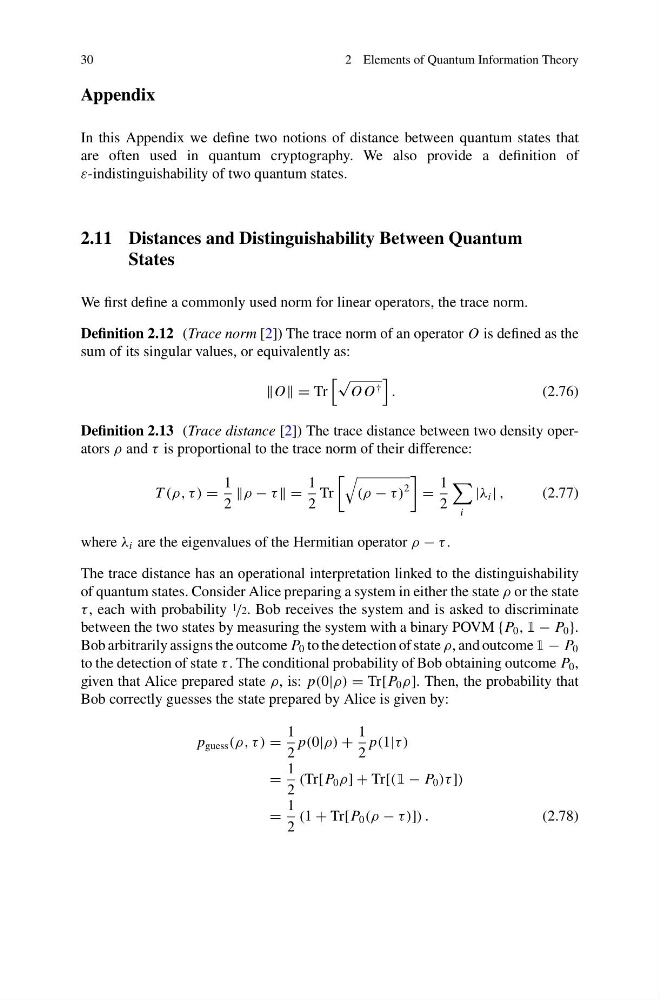
Definition 2.12 (Trace norm [2]) The trace norm of an operator O is defined as the
sum of its singular values, or equivalently as:
O = Tr
√
O O †
.
(2.76)
Definition 2.13 (Trace distance [2]) The trace distance between two density operators ρ and τ is proportional to the trace norm of their difference:
T (ρ, τ ) =
1
2
ρ − τ =
1
2
Tr
(ρ − τ )
2
=
1
2
i
|λ i | ,
(2.77)
where λ i are the eigenvalues of the Hermitian operator ρ − τ .
The trace distance has an operational interpretation linked to the distinguishability
of quantum states. Consider Alice preparing a system in either the state ρ or the state
τ , each with probability 1 /2. Bob receives the system and is asked to discriminate
between the two states by measuring the system with a binary POVM {P 0 , 1 − P 0 }.
Bob arbitrarily assigns the outcome P 0 to the detection of state ρ, and outcome 1 − P 0
to the detection of state τ . The conditional probability of Bob obtaining outcome P 0 ,
given that Alice prepared state ρ, is: p(0|ρ) = Tr[P 0 ρ]. Then, the probability that
Bob correctly guesses the state prepared by Alice is given by:
p guess (ρ, τ ) =
1
2
p(0|ρ) +
1
2
p(1|τ )
=
1
2
(Tr[P 0 ρ] + Tr[(1 − P 0 )τ ])
=
1
2
(1 + Tr[P 0 (ρ − τ )]) .
(2.78)
2 Elements of Quantum Information Theory
Appendix
In this Appendix we define two notions of distance between quantum states that
are often used in quantum cryptography. We also provide a definition of
ε-indistinguishability of two quantum states.
2.11 Distances and Distinguishability Between Quantum
States
We first define a commonly used norm for linear operators, the trace norm.
Definition 2.12 (Trace norm [2]) The trace norm of an operator O is defined as the
sum of its singular values, or equivalently as:
O = Tr
√
O O †
.
(2.76)
Definition 2.13 (Trace distance [2]) The trace distance between two density operators ρ and τ is proportional to the trace norm of their difference:
T (ρ, τ ) =
1
2
ρ − τ =
1
2
Tr
(ρ − τ )
2
=
1
2
i
|λ i | ,
(2.77)
where λ i are the eigenvalues of the Hermitian operator ρ − τ .
The trace distance has an operational interpretation linked to the distinguishability
of quantum states. Consider Alice preparing a system in either the state ρ or the state
τ , each with probability 1 /2. Bob receives the system and is asked to discriminate
between the two states by measuring the system with a binary POVM {P 0 , 1 − P 0 }.
Bob arbitrarily assigns the outcome P 0 to the detection of state ρ, and outcome 1 − P 0
to the detection of state τ . The conditional probability of Bob obtaining outcome P 0 ,
given that Alice prepared state ρ, is: p(0|ρ) = Tr[P 0 ρ]. Then, the probability that
Bob correctly guesses the state prepared by Alice is given by:
p guess (ρ, τ ) =
1
2
p(0|ρ) +
1
2
p(1|τ )
=
1
2
(Tr[P 0 ρ] + Tr[(1 − P 0 )τ ])
=
1
2
(1 + Tr[P 0 (ρ − τ )]) .
(2.78)