

7.8 State Reduction in the CHSH Scenario
141
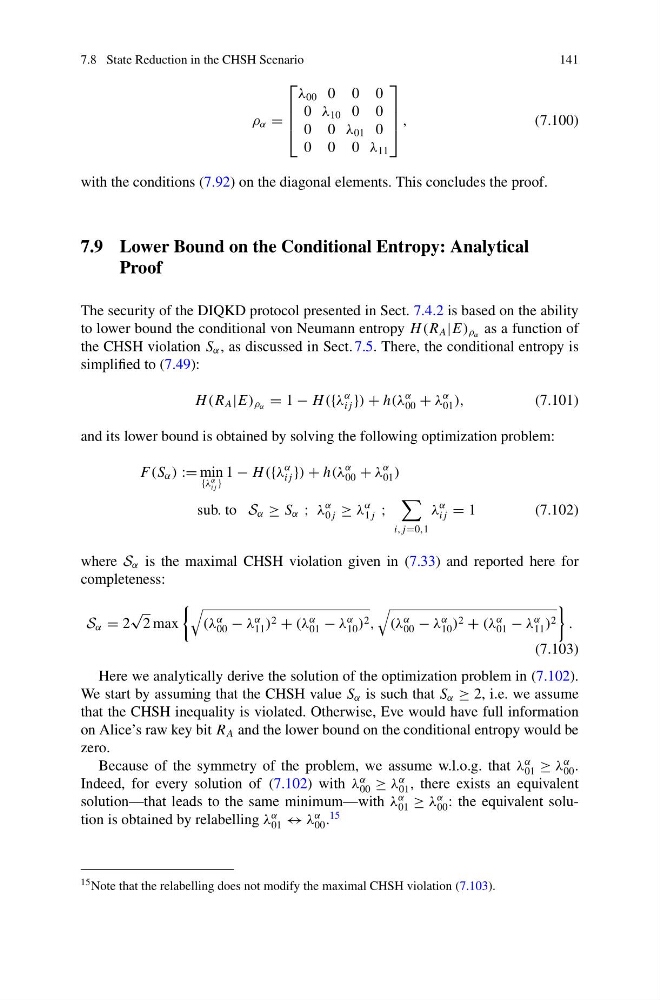
ρ α =
⎡
⎢
⎢
⎣
λ 00 0 0 0
0 λ 10 0 0
0 0 λ 01 0
0 0 0 λ 11
⎤
⎥
⎥
⎦ ,
(7.100)
with the conditions (7.92) on the diagonal elements. This concludes the proof.
7.9 Lower Bound on the Conditional Entropy: Analytical
Proof
The security of the DIQKD protocol presented in Sect. 7.4.2 is based on the ability
to lower bound the conditional von Neumann entropy H (R A |E) ρ α as a function of
the CHSH violation S α , as discussed in Sect. 7.5. There, the conditional entropy is
simplified to (7.49):
H (R A |E) ρ α = 1 − H ({λ
α
i j }) + h(λ
α
00 + λ
α
01 ),
(7.101)
and its lower bound is obtained by solving the following optimization problem:
F(S α ) := min
{λ
α
i j }
1 − H ({λ
α
i j }) + h(λ
α
00 + λ
α
01 )
sub. to S α ≥ S α ; λ
α
0 j ≥ λ
α
1 j ;
i, j=0,1
λ
α
i j = 1
(7.102)
where S α is the maximal CHSH violation given in (7.33) and reported here for
completeness:
S α = 2
√
2 max
(λ
α
00 − λ
α
11 ) 2 + (λ
α
01 − λ
α
10 ) 2 ,
(λ
α
00 − λ
α
10 ) 2 + (λ
α
01 − λ
α
11 ) 2
.
(7.103)
Here we analytically derive the solution of the optimization problem in (7.102).
We start by assuming that the CHSH value S α is such that S α ≥ 2, i.e. we assume
that the CHSH inequality is violated. Otherwise, Eve would have full information
on Alice’s raw key bit R A and the lower bound on the conditional entropy would be
zero.
Because of the symmetry of the problem, we assume w.l.o.g. that λ
α
01 ≥ λ
α
00 .
Indeed, for every solution of (7.102) with λ
α
00 ≥ λ
α
01 , there exists an equivalent
solution—that leads to the same minimum—with λ
α
01 ≥ λ
α
00 : the equivalent solution is obtained by relabelling λ
α
01 ↔ λ
α
00 .
15
15 Note that the relabelling does not modify the maximal CHSH violation (7.103).
141
ρ α =
⎡
⎢
⎢
⎣
λ 00 0 0 0
0 λ 10 0 0
0 0 λ 01 0
0 0 0 λ 11
⎤
⎥
⎥
⎦ ,
(7.100)
with the conditions (7.92) on the diagonal elements. This concludes the proof.
7.9 Lower Bound on the Conditional Entropy: Analytical
Proof
The security of the DIQKD protocol presented in Sect. 7.4.2 is based on the ability
to lower bound the conditional von Neumann entropy H (R A |E) ρ α as a function of
the CHSH violation S α , as discussed in Sect. 7.5. There, the conditional entropy is
simplified to (7.49):
H (R A |E) ρ α = 1 − H ({λ
α
i j }) + h(λ
α
00 + λ
α
01 ),
(7.101)
and its lower bound is obtained by solving the following optimization problem:
F(S α ) := min
{λ
α
i j }
1 − H ({λ
α
i j }) + h(λ
α
00 + λ
α
01 )
sub. to S α ≥ S α ; λ
α
0 j ≥ λ
α
1 j ;
i, j=0,1
λ
α
i j = 1
(7.102)
where S α is the maximal CHSH violation given in (7.33) and reported here for
completeness:
S α = 2
√
2 max
(λ
α
00 − λ
α
11 ) 2 + (λ
α
01 − λ
α
10 ) 2 ,
(λ
α
00 − λ
α
10 ) 2 + (λ
α
01 − λ
α
11 ) 2
.
(7.103)
Here we analytically derive the solution of the optimization problem in (7.102).
We start by assuming that the CHSH value S α is such that S α ≥ 2, i.e. we assume
that the CHSH inequality is violated. Otherwise, Eve would have full information
on Alice’s raw key bit R A and the lower bound on the conditional entropy would be
zero.
Because of the symmetry of the problem, we assume w.l.o.g. that λ
α
01 ≥ λ
α
00 .
Indeed, for every solution of (7.102) with λ
α
00 ≥ λ
α
01 , there exists an equivalent
solution—that leads to the same minimum—with λ
α
01 ≥ λ
α
00 : the equivalent solution is obtained by relabelling λ
α
01 ↔ λ
α
00 .
15
15 Note that the relabelling does not modify the maximal CHSH violation (7.103).