

7.6 Entropy Bounds for Multipartite Protocols
129
Alice
Eve
Bob
Charlie
Fig. 7.3 Alice, Bob and Charlie generate randomness with the outputs R A , R B and R C of their
unknown quantum devices, whose privacy is certified by testing the MABK inequality. Each device
is equipped with two inputs and two outputs. Eve might hold a quantum memory E entangled with
the parties’ devices and use it to guess the parties’ outcomes. We compute Eve’s uncertainty on
Alice’s outcome R A by deriving an analytical expression for the conditional von Neumann entropy
H (R A |E). We also assume that Alice and Bob are co-located and collaborate to generate global
randomness from their outcomes R A and R B . In this case, we quantify Eve’s uncertainty on their
outcomes by computing H (R A R B |E)
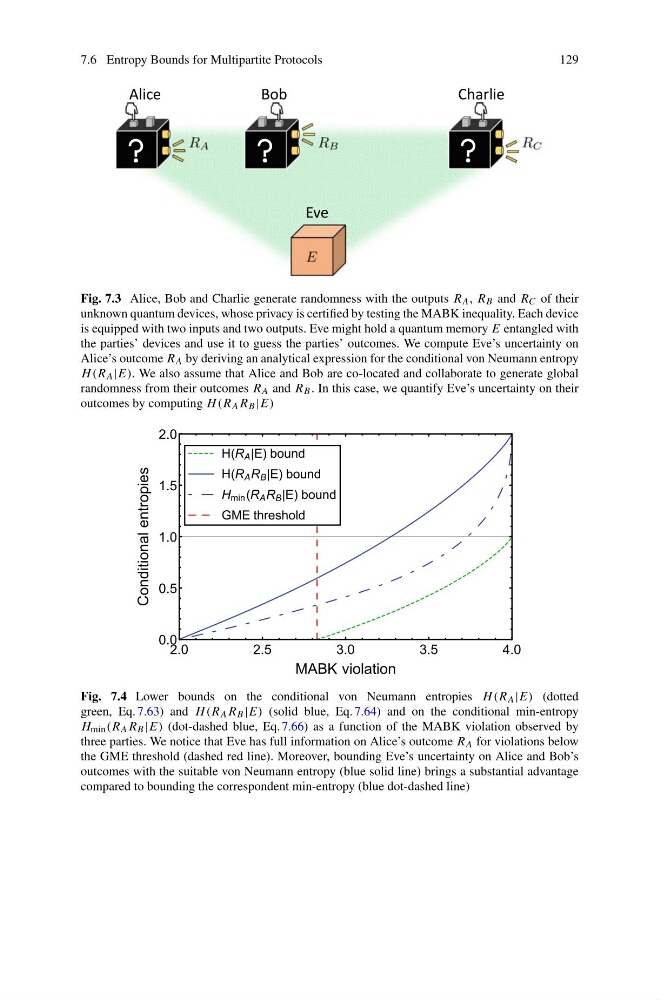
Fig. 7.4 Lower bounds on the conditional von Neumann entropies H (R A |E) (dotted
green, Eq. 7.63) and H (R A R B |E) (solid blue, Eq. 7.64) and on the conditional min-entropy
H min (R A R B |E) (dot-dashed blue, Eq. 7.66) as a function of the MABK violation observed by
three parties. We notice that Eve has full information on Alice’s outcome R A for violations below
the GME threshold (dashed red line). Moreover, bounding Eve’s uncertainty on Alice and Bob’s
outcomes with the suitable von Neumann entropy (blue solid line) brings a substantial advantage
compared to bounding the correspondent min-entropy (blue dot-dashed line)
129
Alice
Eve
Bob
Charlie
Fig. 7.3 Alice, Bob and Charlie generate randomness with the outputs R A , R B and R C of their
unknown quantum devices, whose privacy is certified by testing the MABK inequality. Each device
is equipped with two inputs and two outputs. Eve might hold a quantum memory E entangled with
the parties’ devices and use it to guess the parties’ outcomes. We compute Eve’s uncertainty on
Alice’s outcome R A by deriving an analytical expression for the conditional von Neumann entropy
H (R A |E). We also assume that Alice and Bob are co-located and collaborate to generate global
randomness from their outcomes R A and R B . In this case, we quantify Eve’s uncertainty on their
outcomes by computing H (R A R B |E)
Fig. 7.4 Lower bounds on the conditional von Neumann entropies H (R A |E) (dotted
green, Eq. 7.63) and H (R A R B |E) (solid blue, Eq. 7.64) and on the conditional min-entropy
H min (R A R B |E) (dot-dashed blue, Eq. 7.66) as a function of the MABK violation observed by
three parties. We notice that Eve has full information on Alice’s outcome R A for violations below
the GME threshold (dashed red line). Moreover, bounding Eve’s uncertainty on Alice and Bob’s
outcomes with the suitable von Neumann entropy (blue solid line) brings a substantial advantage
compared to bounding the correspondent min-entropy (blue dot-dashed line)