

7.6 Entropy Bounds for Multipartite Protocols
127
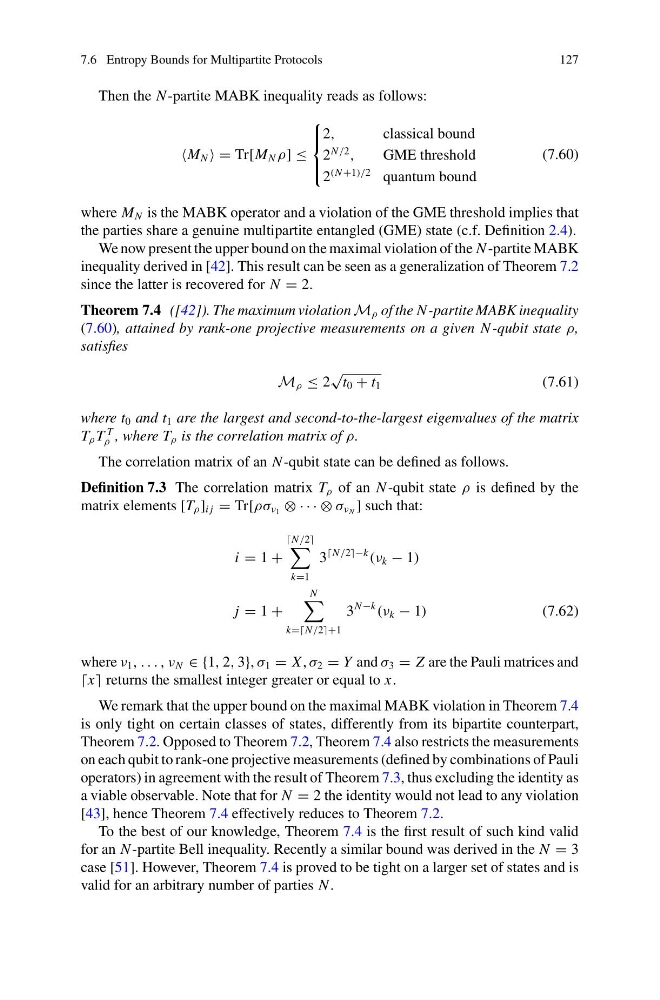
Then the N -partite MABK inequality reads as follows:
M N = Tr[M N ρ] ≤
⎧
⎪ ⎨
⎪ ⎩
2,
classical bound
2
N /2
,
GME threshold
2
(N +1)/2 quantum bound
(7.60)
where M N is the MABK operator and a violation of the GME threshold implies that
the parties share a genuine multipartite entangled (GME) state (c.f. Definition 2.4).
We now present the upper bound on the maximal violation of the N -partite MABK
inequality derived in [42]. This result can be seen as a generalization of Theorem 7.2
since the latter is recovered for N = 2.
Theorem 7.4 ([42]). The maximum violation M ρ of the N -partite MABK inequality
(7.60), attained by rank-one projective measurements on a given N -qubit state ρ,
satisfies
M ρ ≤ 2
√
t 0 + t 1
(7.61)
where t 0 and t 1 are the largest and second-to-the-largest eigenvalues of the matrix
T ρ T
T
ρ , where T ρ is the correlation matrix of ρ.
The correlation matrix of an N -qubit state can be defined as follows.
Definition 7.3 The correlation matrix T ρ of an N -qubit state ρ is defined by the
matrix elements [T ρ ] i j = Tr[ρσ ν 1 ⊗ · · · ⊗ σ ν N ] such that:
i = 1 +
N /2
k=1
3
N /2−k
(ν k − 1)
j = 1 +
N
k==N /2+1
3
N −k
(ν k − 1)
(7.62)
where ν 1 , . . . , ν N ∈ {1, 2, 3}, σ 1 = X , σ 2 = Y and σ 3 = Z are the Pauli matrices and
x returns the smallest integer greater or equal to x.
We remark that the upper bound on the maximal MABK violation in Theorem 7.4
is only tight on certain classes of states, differently from its bipartite counterpart,
Theorem 7.2. Opposed to Theorem 7.2, Theorem 7.4 also restricts the measurements
on each qubit to rank-one projective measurements (defined by combinations of Pauli
operators) in agreement with the result of Theorem 7.3, thus excluding the identity as
a viable observable. Note that for N = 2 the identity would not lead to any violation
[43], hence Theorem 7.4 effectively reduces to Theorem 7.2.
To the best of our knowledge, Theorem 7.4 is the first result of such kind valid
for an N -partite Bell inequality. Recently a similar bound was derived in the N = 3
case [51]. However, Theorem 7.4 is proved to be tight on a larger set of states and is
valid for an arbitrary number of parties N .
127
Then the N -partite MABK inequality reads as follows:
M N = Tr[M N ρ] ≤
⎧
⎪ ⎨
⎪ ⎩
2,
classical bound
2
N /2
,
GME threshold
2
(N +1)/2 quantum bound
(7.60)
where M N is the MABK operator and a violation of the GME threshold implies that
the parties share a genuine multipartite entangled (GME) state (c.f. Definition 2.4).
We now present the upper bound on the maximal violation of the N -partite MABK
inequality derived in [42]. This result can be seen as a generalization of Theorem 7.2
since the latter is recovered for N = 2.
Theorem 7.4 ([42]). The maximum violation M ρ of the N -partite MABK inequality
(7.60), attained by rank-one projective measurements on a given N -qubit state ρ,
satisfies
M ρ ≤ 2
√
t 0 + t 1
(7.61)
where t 0 and t 1 are the largest and second-to-the-largest eigenvalues of the matrix
T ρ T
T
ρ , where T ρ is the correlation matrix of ρ.
The correlation matrix of an N -qubit state can be defined as follows.
Definition 7.3 The correlation matrix T ρ of an N -qubit state ρ is defined by the
matrix elements [T ρ ] i j = Tr[ρσ ν 1 ⊗ · · · ⊗ σ ν N ] such that:
i = 1 +
N /2
k=1
3
N /2−k
(ν k − 1)
j = 1 +
N
k==N /2+1
3
N −k
(ν k − 1)
(7.62)
where ν 1 , . . . , ν N ∈ {1, 2, 3}, σ 1 = X , σ 2 = Y and σ 3 = Z are the Pauli matrices and
x returns the smallest integer greater or equal to x.
We remark that the upper bound on the maximal MABK violation in Theorem 7.4
is only tight on certain classes of states, differently from its bipartite counterpart,
Theorem 7.2. Opposed to Theorem 7.2, Theorem 7.4 also restricts the measurements
on each qubit to rank-one projective measurements (defined by combinations of Pauli
operators) in agreement with the result of Theorem 7.3, thus excluding the identity as
a viable observable. Note that for N = 2 the identity would not lead to any violation
[43], hence Theorem 7.4 effectively reduces to Theorem 7.2.
To the best of our knowledge, Theorem 7.4 is the first result of such kind valid
for an N -partite Bell inequality. Recently a similar bound was derived in the N = 3
case [51]. However, Theorem 7.4 is proved to be tight on a larger set of states and is
valid for an arbitrary number of parties N .