

7.6 Entropy Bounds for Multipartite Protocols
125
BB84 protocol
DIQKD protocol
CHSH violation
0.0
0.2
0.4
0.6
0.8
1.0
0.0
0.2
0.4
0.6
0.8
1.0
Conditional entropies
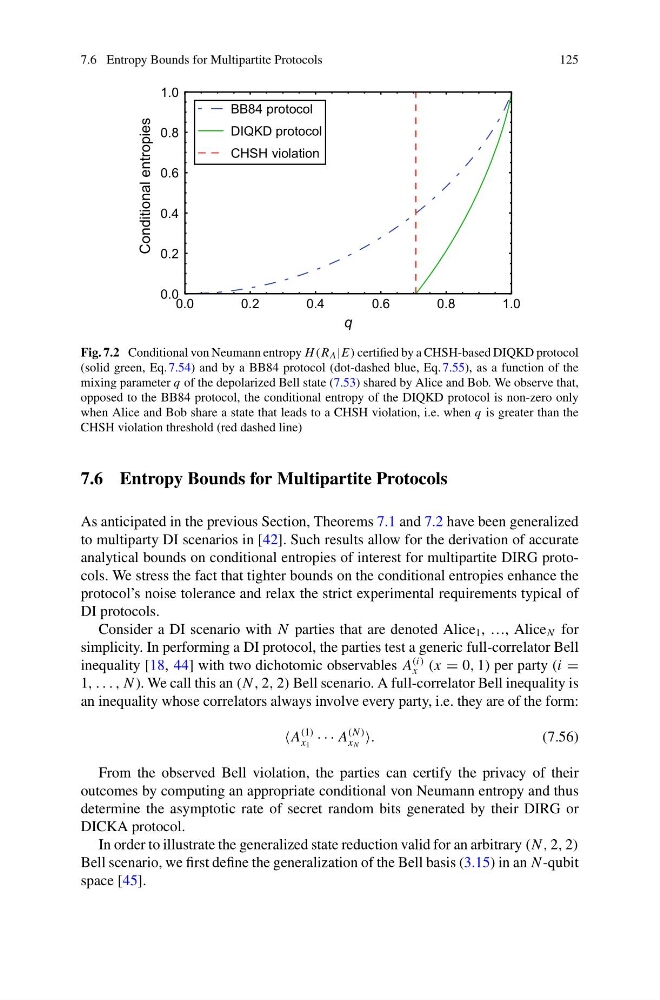
Fig. 7.2 Conditional von Neumann entropy H (R A |E) certified by a CHSH-based DIQKD protocol
(solid green, Eq. 7.54) and by a BB84 protocol (dot-dashed blue, Eq. 7.55), as a function of the
mixing parameter q of the depolarized Bell state (7.53) shared by Alice and Bob. We observe that,
opposed to the BB84 protocol, the conditional entropy of the DIQKD protocol is non-zero only
when Alice and Bob share a state that leads to a CHSH violation, i.e. when q is greater than the
CHSH violation threshold (red dashed line)
7.6 Entropy Bounds for Multipartite Protocols
As anticipated in the previous Section, Theorems 7.1 and 7.2 have been generalized
to multiparty DI scenarios in [42]. Such results allow for the derivation of accurate
analytical bounds on conditional entropies of interest for multipartite DIRG protocols. We stress the fact that tighter bounds on the conditional entropies enhance the
protocol’s noise tolerance and relax the strict experimental requirements typical of
DI protocols.
Consider a DI scenario with N parties that are denoted Alice 1 , …, Alice N for
simplicity. In performing a DI protocol, the parties test a generic full-correlator Bell
inequality [18, 44] with two dichotomic observables A
(i)
x (x = 0, 1) per party (i =
1, . . . , N ). We call this an (N , 2, 2) Bell scenario. A full-correlator Bell inequality is
an inequality whose correlators always involve every party, i.e. they are of the form:
(1)
x 1
· · · A
(N )
x N
(7.56)
From the observed Bell violation, the parties can certify the privacy of their
outcomes by computing an appropriate conditional von Neumann entropy and thus
determine the asymptotic rate of secret random bits generated by their DIRG or
DICKA protocol.
In order to illustrate the generalized state reduction valid for an arbitrary (N , 2, 2)
Bell scenario, we first define the generalization of the Bell basis (3.15) in an N -qubit
space [45].
125
BB84 protocol
DIQKD protocol
CHSH violation
0.0
0.2
0.4
0.6
0.8
1.0
0.0
0.2
0.4
0.6
0.8
1.0
Conditional entropies
Fig. 7.2 Conditional von Neumann entropy H (R A |E) certified by a CHSH-based DIQKD protocol
(solid green, Eq. 7.54) and by a BB84 protocol (dot-dashed blue, Eq. 7.55), as a function of the
mixing parameter q of the depolarized Bell state (7.53) shared by Alice and Bob. We observe that,
opposed to the BB84 protocol, the conditional entropy of the DIQKD protocol is non-zero only
when Alice and Bob share a state that leads to a CHSH violation, i.e. when q is greater than the
CHSH violation threshold (red dashed line)
7.6 Entropy Bounds for Multipartite Protocols
As anticipated in the previous Section, Theorems 7.1 and 7.2 have been generalized
to multiparty DI scenarios in [42]. Such results allow for the derivation of accurate
analytical bounds on conditional entropies of interest for multipartite DIRG protocols. We stress the fact that tighter bounds on the conditional entropies enhance the
protocol’s noise tolerance and relax the strict experimental requirements typical of
DI protocols.
Consider a DI scenario with N parties that are denoted Alice 1 , …, Alice N for
simplicity. In performing a DI protocol, the parties test a generic full-correlator Bell
inequality [18, 44] with two dichotomic observables A
(i)
x (x = 0, 1) per party (i =
1, . . . , N ). We call this an (N , 2, 2) Bell scenario. A full-correlator Bell inequality is
an inequality whose correlators always involve every party, i.e. they are of the form:
(1)
x 1
· · · A
(N )
x N
(7.56)
From the observed Bell violation, the parties can certify the privacy of their
outcomes by computing an appropriate conditional von Neumann entropy and thus
determine the asymptotic rate of secret random bits generated by their DIRG or
DICKA protocol.
In order to illustrate the generalized state reduction valid for an arbitrary (N , 2, 2)
Bell scenario, we first define the generalization of the Bell basis (3.15) in an N -qubit
space [45].