

7.1 Bell’s Theorem
107
Alice
Ɵme
Bob
space
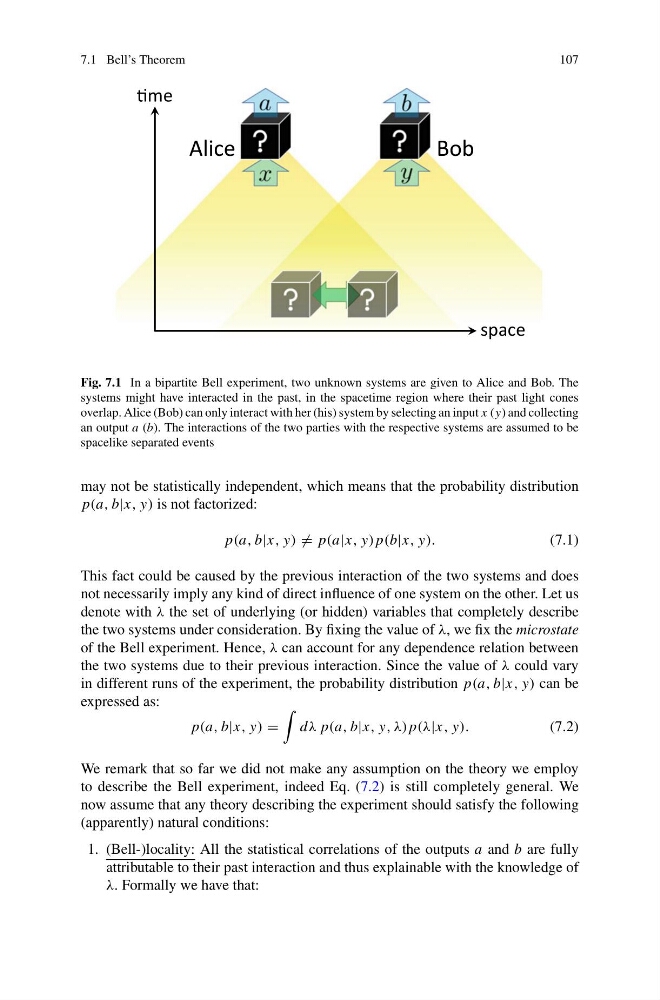
Fig. 7.1 In a bipartite Bell experiment, two unknown systems are given to Alice and Bob. The
systems might have interacted in the past, in the spacetime region where their past light cones
overlap. Alice (Bob) can only interact with her (his) system by selecting an input x (y) and collecting
an output a (b). The interactions of the two parties with the respective systems are assumed to be
spacelike separated events
may not be statistically independent, which means that the probability distribution
p(a, b|x, y) is not factorized:
p(a, b|x, y) = p(a|x, y) p(b|x, y).
(7.1)
This fact could be caused by the previous interaction of the two systems and does
not necessarily imply any kind of direct influence of one system on the other. Let us
denote with λ the set of underlying (or hidden) variables that completely describe
the two systems under consideration. By fixing the value of λ, we fix the microstate
of the Bell experiment. Hence, λ can account for any dependence relation between
the two systems due to their previous interaction. Since the value of λ could vary
in different runs of the experiment, the probability distribution p(a, b|x, y) can be
expressed as:
p(a, b|x, y) =
dλ p(a, b|x, y, λ)p(λ|x, y).
(7.2)
We remark that so far we did not make any assumption on the theory we employ
to describe the Bell experiment, indeed Eq. (7.2) is still completely general. We
now assume that any theory describing the experiment should satisfy the following
(apparently) natural conditions:
1. (Bell-)locality: All the statistical correlations of the outputs a and b are fully
attributable to their past interaction and thus explainable with the knowledge of
λ. Formally we have that:
107
Alice
Ɵme
Bob
space
Fig. 7.1 In a bipartite Bell experiment, two unknown systems are given to Alice and Bob. The
systems might have interacted in the past, in the spacetime region where their past light cones
overlap. Alice (Bob) can only interact with her (his) system by selecting an input x (y) and collecting
an output a (b). The interactions of the two parties with the respective systems are assumed to be
spacelike separated events
may not be statistically independent, which means that the probability distribution
p(a, b|x, y) is not factorized:
p(a, b|x, y) = p(a|x, y) p(b|x, y).
(7.1)
This fact could be caused by the previous interaction of the two systems and does
not necessarily imply any kind of direct influence of one system on the other. Let us
denote with λ the set of underlying (or hidden) variables that completely describe
the two systems under consideration. By fixing the value of λ, we fix the microstate
of the Bell experiment. Hence, λ can account for any dependence relation between
the two systems due to their previous interaction. Since the value of λ could vary
in different runs of the experiment, the probability distribution p(a, b|x, y) can be
expressed as:
p(a, b|x, y) =
dλ p(a, b|x, y, λ)p(λ|x, y).
(7.2)
We remark that so far we did not make any assumption on the theory we employ
to describe the Bell experiment, indeed Eq. (7.2) is still completely general. We
now assume that any theory describing the experiment should satisfy the following
(apparently) natural conditions:
1. (Bell-)locality: All the statistical correlations of the outputs a and b are fully
attributable to their past interaction and thus explainable with the knowledge of
λ. Formally we have that: