

3.2 Nonuniform Binding of Nucleotides to α 3 β 3 or α 3 β 3 γ Complex
35
ATP
>
ATP H 2 O
ADP
: β-subunit
AMP-PNP
With a nucleotide bound.
With no nucleotides bound.
Pi
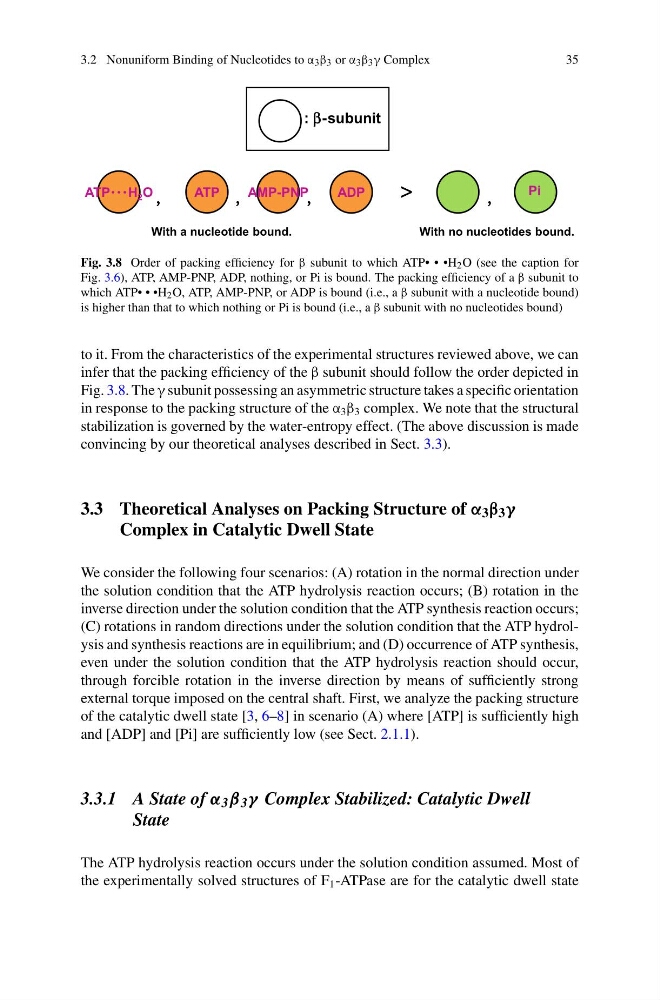
Fig. 3.8 Order of packing efficiency for β subunit to which ATP• • •H 2 O (see the caption for
Fig. 3.6), ATP, AMP-PNP, ADP, nothing, or Pi is bound. The packing efficiency of a β subunit to
which ATP• • •H 2 O, ATP, AMP-PNP, or ADP is bound (i.e., a β subunit with a nucleotide bound)
is higher than that to which nothing or Pi is bound (i.e., a β subunit with no nucleotides bound)
to it. From the characteristics of the experimental structures reviewed above, we can
infer that the packing efficiency of the β subunit should follow the order depicted in
Fig. 3.8. The γ subunit possessing an asymmetric structure takes a specific orientation
in response to the packing structure of the α 3 β 3 complex. We note that the structural
stabilization is governed by the water-entropy effect. (The above discussion is made
convincing by our theoretical analyses described in Sect. 3.3).
3.3 Theoretical Analyses on Packing Structure of α 3 β 3 γ
Complex in Catalytic Dwell State
We consider the following four scenarios: (A) rotation in the normal direction under
the solution condition that the ATP hydrolysis reaction occurs; (B) rotation in the
inverse direction under the solution condition that the ATP synthesis reaction occurs;
(C) rotations in random directions under the solution condition that the ATP hydrolysis and synthesis reactions are in equilibrium; and (D) occurrence of ATP synthesis,
even under the solution condition that the ATP hydrolysis reaction should occur,
through forcible rotation in the inverse direction by means of sufficiently strong
external torque imposed on the central shaft. First, we analyze the packing structure
of the catalytic dwell state [3, 6–8] in scenario (A) where [ATP] is sufficiently high
and [ADP] and [Pi] are sufficiently low (see Sect. 2.1.1).
3.3.1 A State of α 3 β 3 γ Complex Stabilized: Catalytic Dwell
State
The ATP hydrolysis reaction occurs under the solution condition assumed. Most of
the experimentally solved structures of F 1 -ATPase are for the catalytic dwell state
35
ATP
>
ATP H 2 O
ADP
: β-subunit
AMP-PNP
With a nucleotide bound.
With no nucleotides bound.
Pi
Fig. 3.8 Order of packing efficiency for β subunit to which ATP• • •H 2 O (see the caption for
Fig. 3.6), ATP, AMP-PNP, ADP, nothing, or Pi is bound. The packing efficiency of a β subunit to
which ATP• • •H 2 O, ATP, AMP-PNP, or ADP is bound (i.e., a β subunit with a nucleotide bound)
is higher than that to which nothing or Pi is bound (i.e., a β subunit with no nucleotides bound)
to it. From the characteristics of the experimental structures reviewed above, we can
infer that the packing efficiency of the β subunit should follow the order depicted in
Fig. 3.8. The γ subunit possessing an asymmetric structure takes a specific orientation
in response to the packing structure of the α 3 β 3 complex. We note that the structural
stabilization is governed by the water-entropy effect. (The above discussion is made
convincing by our theoretical analyses described in Sect. 3.3).
3.3 Theoretical Analyses on Packing Structure of α 3 β 3 γ
Complex in Catalytic Dwell State
We consider the following four scenarios: (A) rotation in the normal direction under
the solution condition that the ATP hydrolysis reaction occurs; (B) rotation in the
inverse direction under the solution condition that the ATP synthesis reaction occurs;
(C) rotations in random directions under the solution condition that the ATP hydrolysis and synthesis reactions are in equilibrium; and (D) occurrence of ATP synthesis,
even under the solution condition that the ATP hydrolysis reaction should occur,
through forcible rotation in the inverse direction by means of sufficiently strong
external torque imposed on the central shaft. First, we analyze the packing structure
of the catalytic dwell state [3, 6–8] in scenario (A) where [ATP] is sufficiently high
and [ADP] and [Pi] are sufficiently low (see Sect. 2.1.1).
3.3.1 A State of α 3 β 3 γ Complex Stabilized: Catalytic Dwell
State
The ATP hydrolysis reaction occurs under the solution condition assumed. Most of
the experimentally solved structures of F 1 -ATPase are for the catalytic dwell state