

3.2 Nonuniform Binding of Nucleotides to α 3 β 3 or α 3 β 3 γ Complex
33
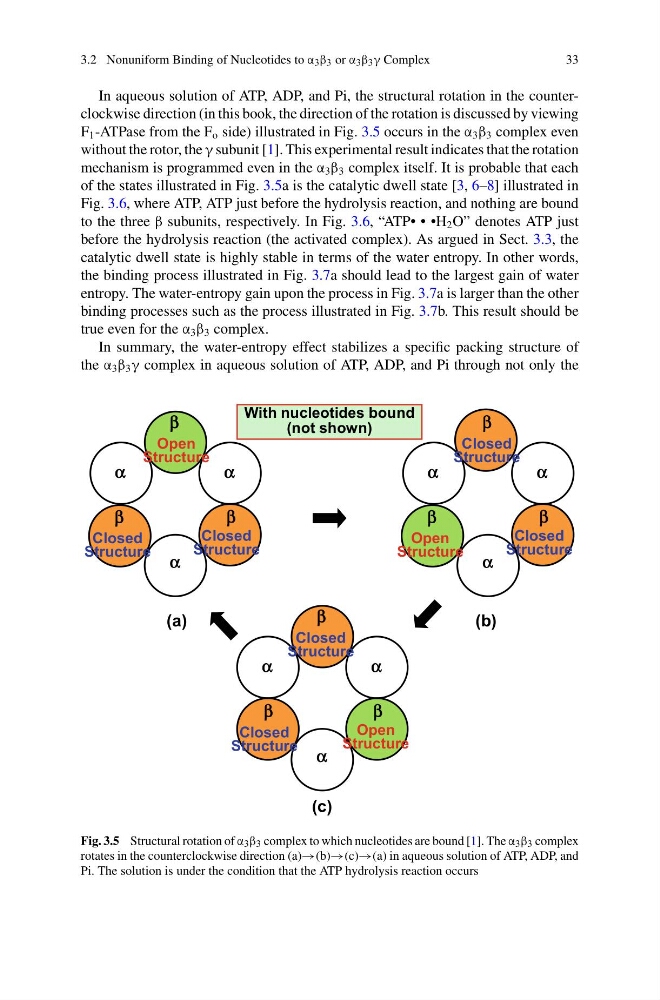
In aqueous solution of ATP, ADP, and Pi, the structural rotation in the counterclockwise direction (in this book, the direction of the rotation is discussed by viewing
F 1 -ATPase from the F o side) illustrated in Fig. 3.5 occurs in the α 3 β 3 complex even
without the rotor, the γ subunit [1]. This experimental result indicates that the rotation
mechanism is programmed even in the α 3 β 3 complex itself. It is probable that each
of the states illustrated in Fig. 3.5a is the catalytic dwell state [3, 6–8] illustrated in
Fig. 3.6, where ATP, ATP just before the hydrolysis reaction, and nothing are bound
to the three β subunits, respectively. In Fig. 3.6, “ATP• • •H 2 O” denotes ATP just
before the hydrolysis reaction (the activated complex). As argued in Sect. 3.3, the
catalytic dwell state is highly stable in terms of the water entropy. In other words,
the binding process illustrated in Fig. 3.7a should lead to the largest gain of water
entropy. The water-entropy gain upon the process in Fig. 3.7a is larger than the other
binding processes such as the process illustrated in Fig. 3.7b. This result should be
true even for the α 3 β 3 complex.
In summary, the water-entropy effect stabilizes a specific packing structure of
the α 3 β 3 γ complex in aqueous solution of ATP, ADP, and Pi through not only the
(a)
(b)
(c)
α
β
β
α
α
β
Open
Structure
Closed
Structure
Closed
Structure
α
β
β
α
α
β
Closed
Structure
Open
Structure
Closed
Structure
α
β
β
α
α
β
Closed
Structure
Closed
Structure
Open
Structure
With nucleotides bound
(not shown)
Fig. 3.5 Structural rotation of α 3 β 3 complex to which nucleotides are bound [1]. The α 3 β 3 complex
rotates in the counterclockwise direction (a)→(b)→(c)→(a) in aqueous solution of ATP, ADP, and
Pi. The solution is under the condition that the ATP hydrolysis reaction occurs
33
In aqueous solution of ATP, ADP, and Pi, the structural rotation in the counterclockwise direction (in this book, the direction of the rotation is discussed by viewing
F 1 -ATPase from the F o side) illustrated in Fig. 3.5 occurs in the α 3 β 3 complex even
without the rotor, the γ subunit [1]. This experimental result indicates that the rotation
mechanism is programmed even in the α 3 β 3 complex itself. It is probable that each
of the states illustrated in Fig. 3.5a is the catalytic dwell state [3, 6–8] illustrated in
Fig. 3.6, where ATP, ATP just before the hydrolysis reaction, and nothing are bound
to the three β subunits, respectively. In Fig. 3.6, “ATP• • •H 2 O” denotes ATP just
before the hydrolysis reaction (the activated complex). As argued in Sect. 3.3, the
catalytic dwell state is highly stable in terms of the water entropy. In other words,
the binding process illustrated in Fig. 3.7a should lead to the largest gain of water
entropy. The water-entropy gain upon the process in Fig. 3.7a is larger than the other
binding processes such as the process illustrated in Fig. 3.7b. This result should be
true even for the α 3 β 3 complex.
In summary, the water-entropy effect stabilizes a specific packing structure of
the α 3 β 3 γ complex in aqueous solution of ATP, ADP, and Pi through not only the
(a)
(b)
(c)
α
β
β
α
α
β
Open
Structure
Closed
Structure
Closed
Structure
α
β
β
α
α
β
Closed
Structure
Open
Structure
Closed
Structure
α
β
β
α
α
β
Closed
Structure
Closed
Structure
Open
Structure
With nucleotides bound
(not shown)
Fig. 3.5 Structural rotation of α 3 β 3 complex to which nucleotides are bound [1]. The α 3 β 3 complex
rotates in the counterclockwise direction (a)→(b)→(c)→(a) in aqueous solution of ATP, ADP, and
Pi. The solution is under the condition that the ATP hydrolysis reaction occurs