

26
2 A New View on Mechanism of Functional Expression …
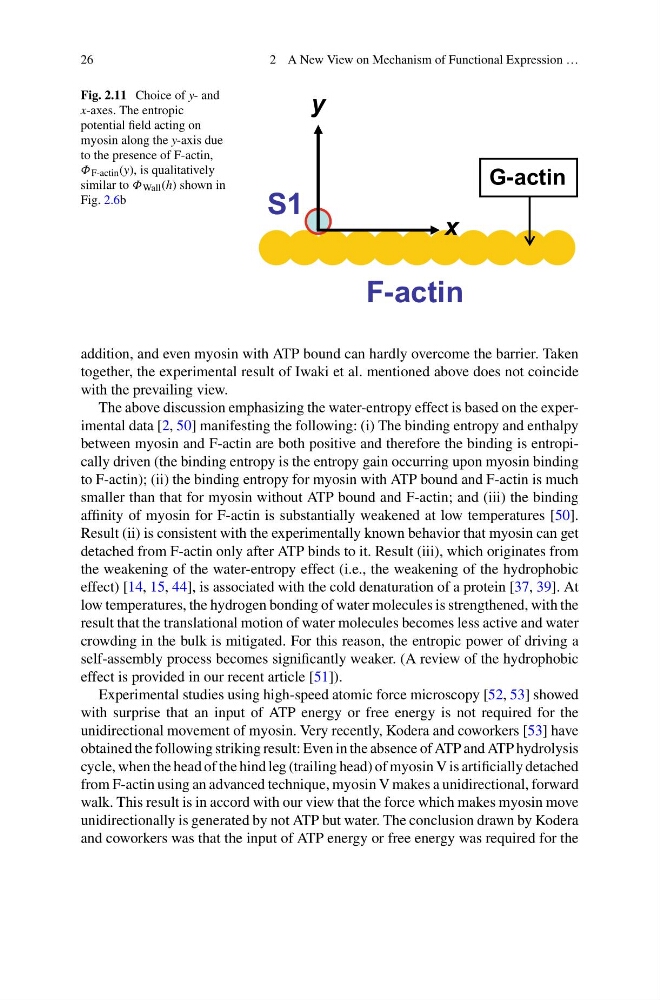
Fig. 2.11 Choice of y- and
x-axes. The entropic
potential field acting on
myosin along the y-axis due
to the presence of F-actin,
Φ F-actin (y), is qualitatively
similar to Φ Wall (h) shown in
Fig. 2.6b
y
F-actin
S1
x
G-actin
addition, and even myosin with ATP bound can hardly overcome the barrier. Taken
together, the experimental result of Iwaki et al. mentioned above does not coincide
with the prevailing view.
The above discussion emphasizing the water-entropy effect is based on the experimental data [2, 50] manifesting the following: (i) The binding entropy and enthalpy
between myosin and F-actin are both positive and therefore the binding is entropically driven (the binding entropy is the entropy gain occurring upon myosin binding
to F-actin); (ii) the binding entropy for myosin with ATP bound and F-actin is much
smaller than that for myosin without ATP bound and F-actin; and (iii) the binding
affinity of myosin for F-actin is substantially weakened at low temperatures [50].
Result (ii) is consistent with the experimentally known behavior that myosin can get
detached from F-actin only after ATP binds to it. Result (iii), which originates from
the weakening of the water-entropy effect (i.e., the weakening of the hydrophobic
effect) [14, 15, 44], is associated with the cold denaturation of a protein [37, 39]. At
low temperatures, the hydrogen bonding of water molecules is strengthened, with the
result that the translational motion of water molecules becomes less active and water
crowding in the bulk is mitigated. For this reason, the entropic power of driving a
self-assembly process becomes significantly weaker. (A review of the hydrophobic
effect is provided in our recent article [51]).
Experimental studies using high-speed atomic force microscopy [52, 53] showed
with surprise that an input of ATP energy or free energy is not required for the
unidirectional movement of myosin. Very recently, Kodera and coworkers [53] have
obtained the following striking result: Even in the absence of ATP and ATP hydrolysis
cycle, when the head of the hind leg (trailing head) of myosin V is artificially detached
from F-actin using an advanced technique, myosin V makes a unidirectional, forward
walk. This result is in accord with our view that the force which makes myosin move
unidirectionally is generated by not ATP but water. The conclusion drawn by Kodera
and coworkers was that the input of ATP energy or free energy was required for the
2 A New View on Mechanism of Functional Expression …
Fig. 2.11 Choice of y- and
x-axes. The entropic
potential field acting on
myosin along the y-axis due
to the presence of F-actin,
Φ F-actin (y), is qualitatively
similar to Φ Wall (h) shown in
Fig. 2.6b
y
F-actin
S1
x
G-actin
addition, and even myosin with ATP bound can hardly overcome the barrier. Taken
together, the experimental result of Iwaki et al. mentioned above does not coincide
with the prevailing view.
The above discussion emphasizing the water-entropy effect is based on the experimental data [2, 50] manifesting the following: (i) The binding entropy and enthalpy
between myosin and F-actin are both positive and therefore the binding is entropically driven (the binding entropy is the entropy gain occurring upon myosin binding
to F-actin); (ii) the binding entropy for myosin with ATP bound and F-actin is much
smaller than that for myosin without ATP bound and F-actin; and (iii) the binding
affinity of myosin for F-actin is substantially weakened at low temperatures [50].
Result (ii) is consistent with the experimentally known behavior that myosin can get
detached from F-actin only after ATP binds to it. Result (iii), which originates from
the weakening of the water-entropy effect (i.e., the weakening of the hydrophobic
effect) [14, 15, 44], is associated with the cold denaturation of a protein [37, 39]. At
low temperatures, the hydrogen bonding of water molecules is strengthened, with the
result that the translational motion of water molecules becomes less active and water
crowding in the bulk is mitigated. For this reason, the entropic power of driving a
self-assembly process becomes significantly weaker. (A review of the hydrophobic
effect is provided in our recent article [51]).
Experimental studies using high-speed atomic force microscopy [52, 53] showed
with surprise that an input of ATP energy or free energy is not required for the
unidirectional movement of myosin. Very recently, Kodera and coworkers [53] have
obtained the following striking result: Even in the absence of ATP and ATP hydrolysis
cycle, when the head of the hind leg (trailing head) of myosin V is artificially detached
from F-actin using an advanced technique, myosin V makes a unidirectional, forward
walk. This result is in accord with our view that the force which makes myosin move
unidirectionally is generated by not ATP but water. The conclusion drawn by Kodera
and coworkers was that the input of ATP energy or free energy was required for the