

2 Introduction to Imprecise Probabilities
77
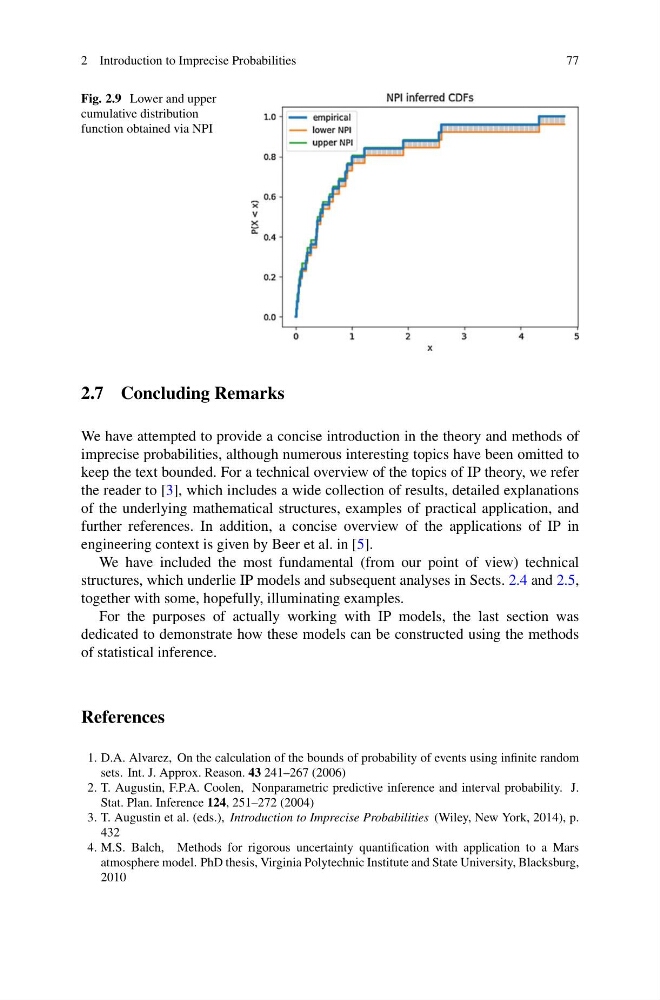
Fig. 2.9 Lower and upper
cumulative distribution
function obtained via NPI
2.7 Concluding Remarks
We have attempted to provide a concise introduction in the theory and methods of
imprecise probabilities, although numerous interesting topics have been omitted to
keep the text bounded. For a technical overview of the topics of IP theory, we refer
the reader to [3], which includes a wide collection of results, detailed explanations
of the underlying mathematical structures, examples of practical application, and
further references. In addition, a concise overview of the applications of IP in
engineering context is given by Beer et al. in [5].
We have included the most fundamental (from our point of view) technical
structures, which underlie IP models and subsequent analyses in Sects. 2.4 and 2.5,
together with some, hopefully, illuminating examples.
For the purposes of actually working with IP models, the last section was
dedicated to demonstrate how these models can be constructed using the methods
of statistical inference.
References
1. D.A. Alvarez, On the calculation of the bounds of probability of events using infinite random
sets. Int. J. Approx. Reason. 43 241–267 (2006)
2. T. Augustin, F.P.A. Coolen, Nonparametric predictive inference and interval probability. J.
Stat. Plan. Inference 124, 251–272 (2004)
3. T. Augustin et al. (eds.), Introduction to Imprecise Probabilities (Wiley, New York, 2014), p.
432
4. M.S. Balch, Methods for rigorous uncertainty quantification with application to a Mars
atmosphere model. PhD thesis, Virginia Polytechnic Institute and State University, Blacksburg,
2010
77
Fig. 2.9 Lower and upper
cumulative distribution
function obtained via NPI
2.7 Concluding Remarks
We have attempted to provide a concise introduction in the theory and methods of
imprecise probabilities, although numerous interesting topics have been omitted to
keep the text bounded. For a technical overview of the topics of IP theory, we refer
the reader to [3], which includes a wide collection of results, detailed explanations
of the underlying mathematical structures, examples of practical application, and
further references. In addition, a concise overview of the applications of IP in
engineering context is given by Beer et al. in [5].
We have included the most fundamental (from our point of view) technical
structures, which underlie IP models and subsequent analyses in Sects. 2.4 and 2.5,
together with some, hopefully, illuminating examples.
For the purposes of actually working with IP models, the last section was
dedicated to demonstrate how these models can be constructed using the methods
of statistical inference.
References
1. D.A. Alvarez, On the calculation of the bounds of probability of events using infinite random
sets. Int. J. Approx. Reason. 43 241–267 (2006)
2. T. Augustin, F.P.A. Coolen, Nonparametric predictive inference and interval probability. J.
Stat. Plan. Inference 124, 251–272 (2004)
3. T. Augustin et al. (eds.), Introduction to Imprecise Probabilities (Wiley, New York, 2014), p.
432
4. M.S. Balch, Methods for rigorous uncertainty quantification with application to a Mars
atmosphere model. PhD thesis, Virginia Polytechnic Institute and State University, Blacksburg,
2010