

2 Introduction to Imprecise Probabilities
75
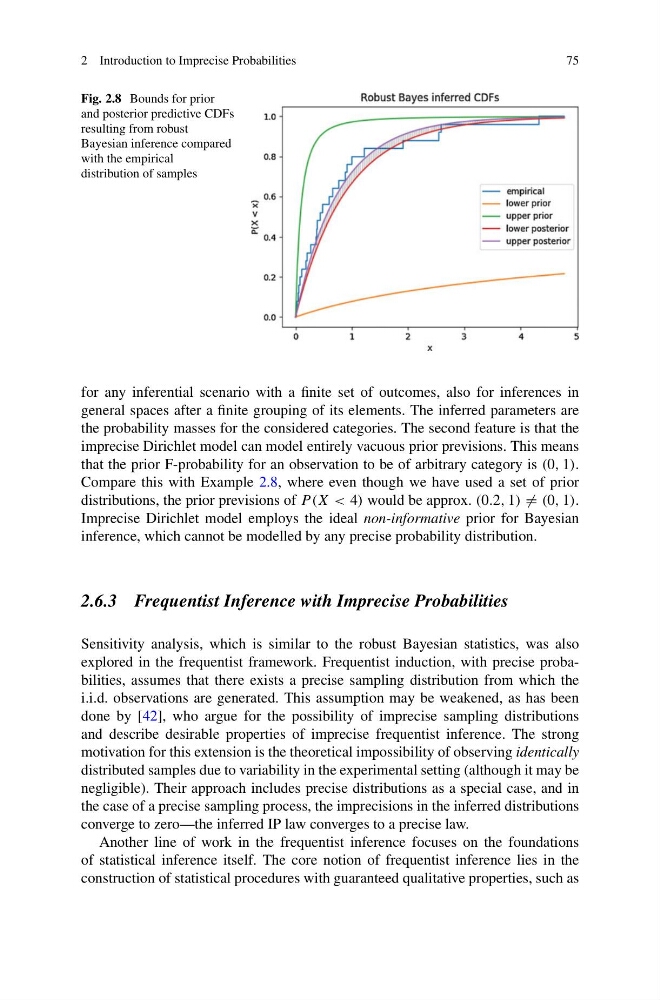
Fig. 2.8 Bounds for prior
and posterior predictive CDFs
resulting from robust
Bayesian inference compared
with the empirical
distribution of samples
for any inferential scenario with a finite set of outcomes, also for inferences in
general spaces after a finite grouping of its elements. The inferred parameters are
the probability masses for the considered categories. The second feature is that the
imprecise Dirichlet model can model entirely vacuous prior previsions. This means
that the prior F-probability for an observation to be of arbitrary category is (0, 1).
Compare this with Example 2.8, where even though we have used a set of prior
distributions, the prior previsions of P (X < 4) would be approx. (0.2, 1) = (0, 1).
Imprecise Dirichlet model employs the ideal non-informative prior for Bayesian
inference, which cannot be modelled by any precise probability distribution.
2.6.3 Frequentist Inference with Imprecise Probabilities
Sensitivity analysis, which is similar to the robust Bayesian statistics, was also
explored in the frequentist framework. Frequentist induction, with precise probabilities, assumes that there exists a precise sampling distribution from which the
i.i.d. observations are generated. This assumption may be weakened, as has been
done by [42], who argue for the possibility of imprecise sampling distributions
and describe desirable properties of imprecise frequentist inference. The strong
motivation for this extension is the theoretical impossibility of observing identically
distributed samples due to variability in the experimental setting (although it may be
negligible). Their approach includes precise distributions as a special case, and in
the case of a precise sampling process, the imprecisions in the inferred distributions
converge to zero—the inferred IP law converges to a precise law.
Another line of work in the frequentist inference focuses on the foundations
of statistical inference itself. The core notion of frequentist inference lies in the
construction of statistical procedures with guaranteed qualitative properties, such as
75
Fig. 2.8 Bounds for prior
and posterior predictive CDFs
resulting from robust
Bayesian inference compared
with the empirical
distribution of samples
for any inferential scenario with a finite set of outcomes, also for inferences in
general spaces after a finite grouping of its elements. The inferred parameters are
the probability masses for the considered categories. The second feature is that the
imprecise Dirichlet model can model entirely vacuous prior previsions. This means
that the prior F-probability for an observation to be of arbitrary category is (0, 1).
Compare this with Example 2.8, where even though we have used a set of prior
distributions, the prior previsions of P (X < 4) would be approx. (0.2, 1) = (0, 1).
Imprecise Dirichlet model employs the ideal non-informative prior for Bayesian
inference, which cannot be modelled by any precise probability distribution.
2.6.3 Frequentist Inference with Imprecise Probabilities
Sensitivity analysis, which is similar to the robust Bayesian statistics, was also
explored in the frequentist framework. Frequentist induction, with precise probabilities, assumes that there exists a precise sampling distribution from which the
i.i.d. observations are generated. This assumption may be weakened, as has been
done by [42], who argue for the possibility of imprecise sampling distributions
and describe desirable properties of imprecise frequentist inference. The strong
motivation for this extension is the theoretical impossibility of observing identically
distributed samples due to variability in the experimental setting (although it may be
negligible). Their approach includes precise distributions as a special case, and in
the case of a precise sampling process, the imprecisions in the inferred distributions
converge to zero—the inferred IP law converges to a precise law.
Another line of work in the frequentist inference focuses on the foundations
of statistical inference itself. The core notion of frequentist inference lies in the
construction of statistical procedures with guaranteed qualitative properties, such as