

70
D. Krpelík and T. Basu
Table 2.5 Revised betting
on g 1 and g 4
A B
C
Buy g 1 for 3 0 2
−4
Buy g 2 for 1 1 −2 4
Total reward 1 0
0
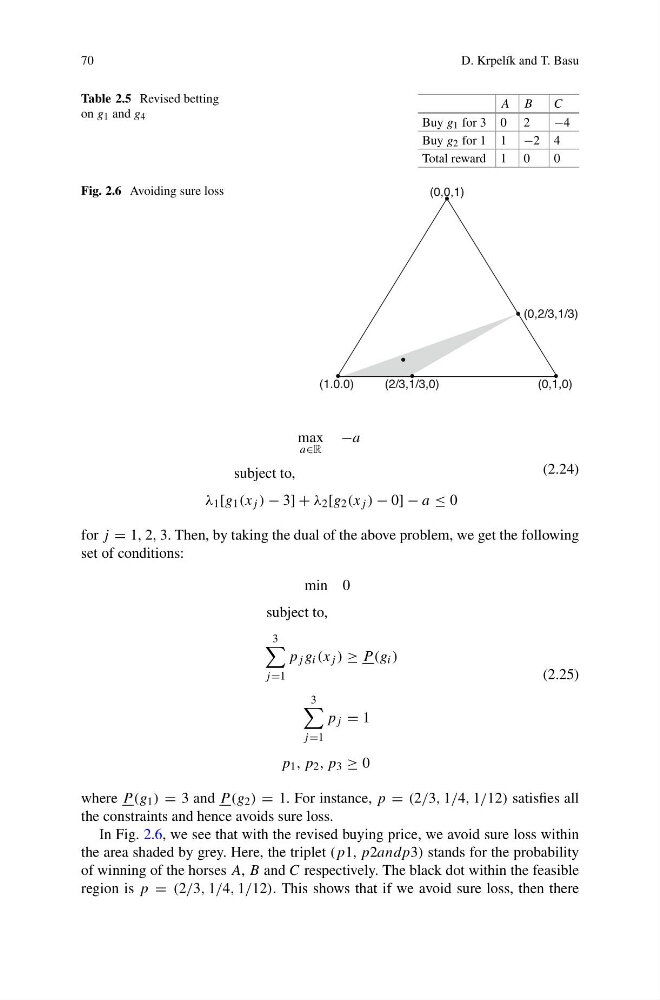
Fig. 2.6 Avoiding sure loss
(0,2/3,1/3)
(1.0.0)
(2/3,1/3,0)
(0,1,0)
(0,0,1)
max
a∈R
−a
subject to,
λ 1 [g 1 (x j ) − 3] + λ 2 [g 2 (x j ) − 0] − a ≤ 0
(2.24)
for j = 1, 2, 3. Then, by taking the dual of the above problem, we get the following
set of conditions:
min 0
subject to,
3
j =1
p j g i (x j ) ≥ P (g i )
3
j =1
p j = 1
p 1 , p 2 , p 3 ≥ 0
(2.25)
where P (g 1 ) = 3 and P (g 2 ) = 1. For instance, p = (2/3, 1/4, 1/12) satisfies all
the constraints and hence avoids sure loss.
In Fig. 2.6, we see that with the revised buying price, we avoid sure loss within
the area shaded by grey. Here, the triplet (p1, p2andp3) stands for the probability
of winning of the horses A, B and C respectively. The black dot within the feasible
region is p = (2/3, 1/4, 1/12). This shows that if we avoid sure loss, then there
D. Krpelík and T. Basu
Table 2.5 Revised betting
on g 1 and g 4
A B
C
Buy g 1 for 3 0 2
−4
Buy g 2 for 1 1 −2 4
Total reward 1 0
0
Fig. 2.6 Avoiding sure loss
(0,2/3,1/3)
(1.0.0)
(2/3,1/3,0)
(0,1,0)
(0,0,1)
max
a∈R
−a
subject to,
λ 1 [g 1 (x j ) − 3] + λ 2 [g 2 (x j ) − 0] − a ≤ 0
(2.24)
for j = 1, 2, 3. Then, by taking the dual of the above problem, we get the following
set of conditions:
min 0
subject to,
3
j =1
p j g i (x j ) ≥ P (g i )
3
j =1
p j = 1
p 1 , p 2 , p 3 ≥ 0
(2.25)
where P (g 1 ) = 3 and P (g 2 ) = 1. For instance, p = (2/3, 1/4, 1/12) satisfies all
the constraints and hence avoids sure loss.
In Fig. 2.6, we see that with the revised buying price, we avoid sure loss within
the area shaded by grey. Here, the triplet (p1, p2andp3) stands for the probability
of winning of the horses A, B and C respectively. The black dot within the feasible
region is p = (2/3, 1/4, 1/12). This shows that if we avoid sure loss, then there