

66
D. Krpelík and T. Basu
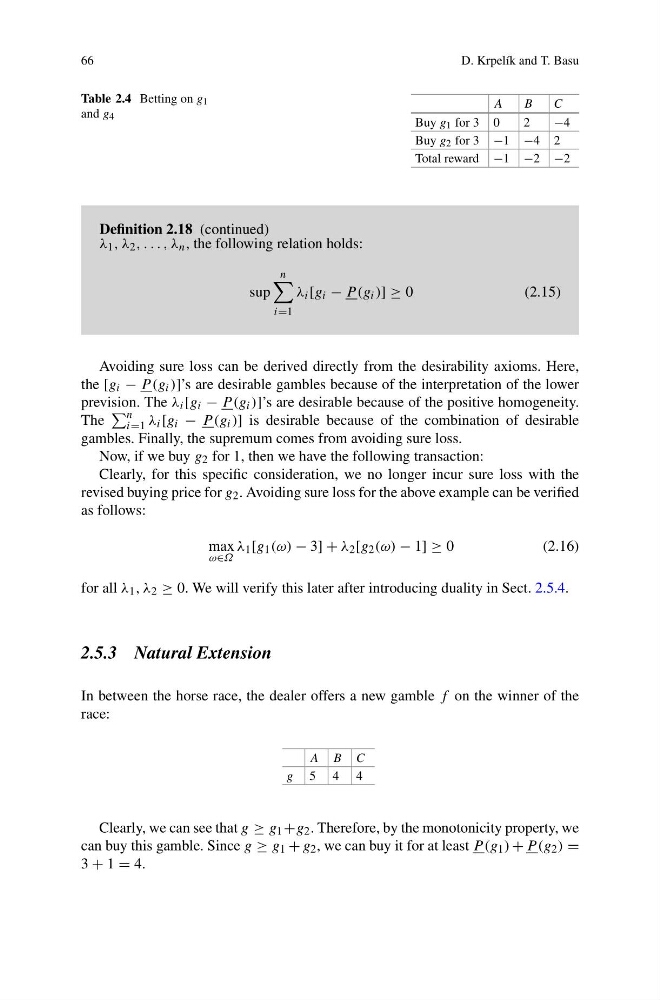
Table 2.4 Betting on g 1
and g 4
A
B
C
Buy g 1 for 3 0
2
−4
Buy g 2 for 3 −1 −4 2
Total reward −1 −2 −2
Definition 2.18 (continued)
λ 1 , λ 2 , . . . , λ n , the following relation holds:
sup
n
i=1
λ i [g i − P (g i )] ≥ 0
(2.15)
Avoiding sure loss can be derived directly from the desirability axioms. Here,
the [g i − P (g i )]’s are desirable gambles because of the interpretation of the lower
prevision. The λ i [g i − P (g i )]’s are desirable because of the positive homogeneity.
The
n
i=1 λ i [g i − P (g i )] is desirable because of the combination of desirable
gambles. Finally, the supremum comes from avoiding sure loss.
Now, if we buy g 2 for 1, then we have the following transaction:
Clearly, for this specific consideration, we no longer incur sure loss with the
revised buying price for g 2 . Avoiding sure loss for the above example can be verified
as follows:
max
ω∈Ω
λ 1 [g 1 (ω) − 3] + λ 2 [g 2 (ω) − 1] ≥ 0
(2.16)
for all λ 1 , λ 2 ≥ 0. We will verify this later after introducing duality in Sect. 2.5.4.
2.5.3 Natural Extension
In between the horse race, the dealer offers a new gamble f on the winner of the
race:
A B C
g 5 4 4
Clearly, we can see that g ≥ g 1 +g 2 . Therefore, by the monotonicity property, we
can buy this gamble. Since g ≥ g 1 + g 2 , we can buy it for at least P (g 1 ) + P (g 2 ) =
3 + 1 = 4.
D. Krpelík and T. Basu
Table 2.4 Betting on g 1
and g 4
A
B
C
Buy g 1 for 3 0
2
−4
Buy g 2 for 3 −1 −4 2
Total reward −1 −2 −2
Definition 2.18 (continued)
λ 1 , λ 2 , . . . , λ n , the following relation holds:
sup
n
i=1
λ i [g i − P (g i )] ≥ 0
(2.15)
Avoiding sure loss can be derived directly from the desirability axioms. Here,
the [g i − P (g i )]’s are desirable gambles because of the interpretation of the lower
prevision. The λ i [g i − P (g i )]’s are desirable because of the positive homogeneity.
The
n
i=1 λ i [g i − P (g i )] is desirable because of the combination of desirable
gambles. Finally, the supremum comes from avoiding sure loss.
Now, if we buy g 2 for 1, then we have the following transaction:
Clearly, for this specific consideration, we no longer incur sure loss with the
revised buying price for g 2 . Avoiding sure loss for the above example can be verified
as follows:
max
ω∈Ω
λ 1 [g 1 (ω) − 3] + λ 2 [g 2 (ω) − 1] ≥ 0
(2.16)
for all λ 1 , λ 2 ≥ 0. We will verify this later after introducing duality in Sect. 2.5.4.
2.5.3 Natural Extension
In between the horse race, the dealer offers a new gamble f on the winner of the
race:
A B C
g 5 4 4
Clearly, we can see that g ≥ g 1 +g 2 . Therefore, by the monotonicity property, we
can buy this gamble. Since g ≥ g 1 + g 2 , we can buy it for at least P (g 1 ) + P (g 2 ) =
3 + 1 = 4.