

2 Introduction to Imprecise Probabilities
63
2.5 Lower Previsions
The theory of previsions starts with the work of de Finetti [14, 15]. Later generalisation of prevision to lower prevision occurred in Williams’ work [45, 46] and in a
more developed form in Walley’s work [40]. This is another approach of IP. The theory of lower previsions has a unifying mathematical character that attracted considerable attention. There are several other concepts like probability charges (Bhaskara
Rao, Bhaskara Rao [7]), n-monotone set functions (Choquet [10]), belief functions
(Dempster [16], Shafer [37]), possibility measures (De Cooman [12]), and many
others (De Cooman [13], Denneberg [19], Troffaes [38]). They can also be regarded
as lower expectations with respect to closed convex sets of probability measures.
In this section, we will start with the notion of desirability and then derive
the main theory behind lower previsions. Finally, we will conclude this with a
discussion of duality between lower previsions and credal sets.
2.5.1 Desirability
Suppose we observe an experiment where we have different outcomes and we are
betting on these outcomes for some rewards. Gambles can be seen as these uncertain
rewards on the set of possible outcomes, say Ω. Mathematically, a gamble f is a
real-valued bounded function on Ω. The set of all gambles is denoted by B. We can
add or subtract two gambles as usual.
Example 2.5 Imagine, we are watching a horse race involving three horses:
A, B and C. Therefore, we have the set of outcomes Ω = {A, B, C}, where
the elements denote the events where the corresponding horse wins. The
dealer is offering several gambles on the race. For example, if we consider
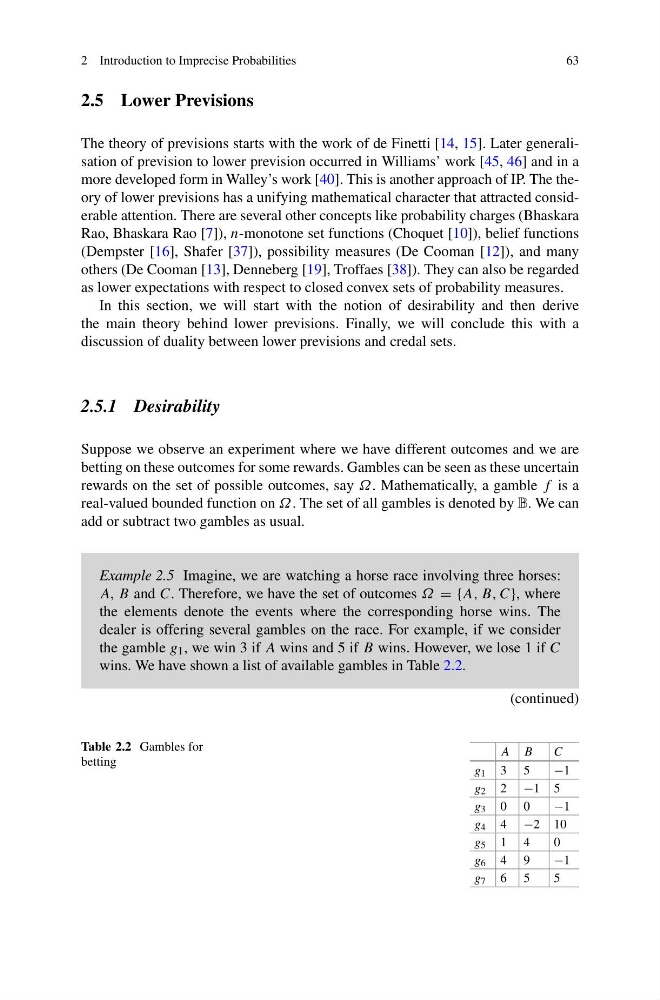
the gamble g 1 , we win 3 if A wins and 5 if B wins. However, we lose 1 if C
wins. We have shown a list of available gambles in Table 2.2.
(continued)
Table 2.2 Gambles for
betting
A B
C
g 1 3 5
−1
g 2 2 −1 5
g 3 0 0
−1
g 4 4 −2 10
g 5 1 4
0
g 6 4 9
−1
g 7 6 5
5
63
2.5 Lower Previsions
The theory of previsions starts with the work of de Finetti [14, 15]. Later generalisation of prevision to lower prevision occurred in Williams’ work [45, 46] and in a
more developed form in Walley’s work [40]. This is another approach of IP. The theory of lower previsions has a unifying mathematical character that attracted considerable attention. There are several other concepts like probability charges (Bhaskara
Rao, Bhaskara Rao [7]), n-monotone set functions (Choquet [10]), belief functions
(Dempster [16], Shafer [37]), possibility measures (De Cooman [12]), and many
others (De Cooman [13], Denneberg [19], Troffaes [38]). They can also be regarded
as lower expectations with respect to closed convex sets of probability measures.
In this section, we will start with the notion of desirability and then derive
the main theory behind lower previsions. Finally, we will conclude this with a
discussion of duality between lower previsions and credal sets.
2.5.1 Desirability
Suppose we observe an experiment where we have different outcomes and we are
betting on these outcomes for some rewards. Gambles can be seen as these uncertain
rewards on the set of possible outcomes, say Ω. Mathematically, a gamble f is a
real-valued bounded function on Ω. The set of all gambles is denoted by B. We can
add or subtract two gambles as usual.
Example 2.5 Imagine, we are watching a horse race involving three horses:
A, B and C. Therefore, we have the set of outcomes Ω = {A, B, C}, where
the elements denote the events where the corresponding horse wins. The
dealer is offering several gambles on the race. For example, if we consider
the gamble g 1 , we win 3 if A wins and 5 if B wins. However, we lose 1 if C
wins. We have shown a list of available gambles in Table 2.2.
(continued)
Table 2.2 Gambles for
betting
A B
C
g 1 3 5
−1
g 2 2 −1 5
g 3 0 0
−1
g 4 4 −2 10
g 5 1 4
0
g 6 4 9
−1
g 7 6 5
5