

564
G. Filippi and M. Vasile
17.4.4.3 Complexity Analysis
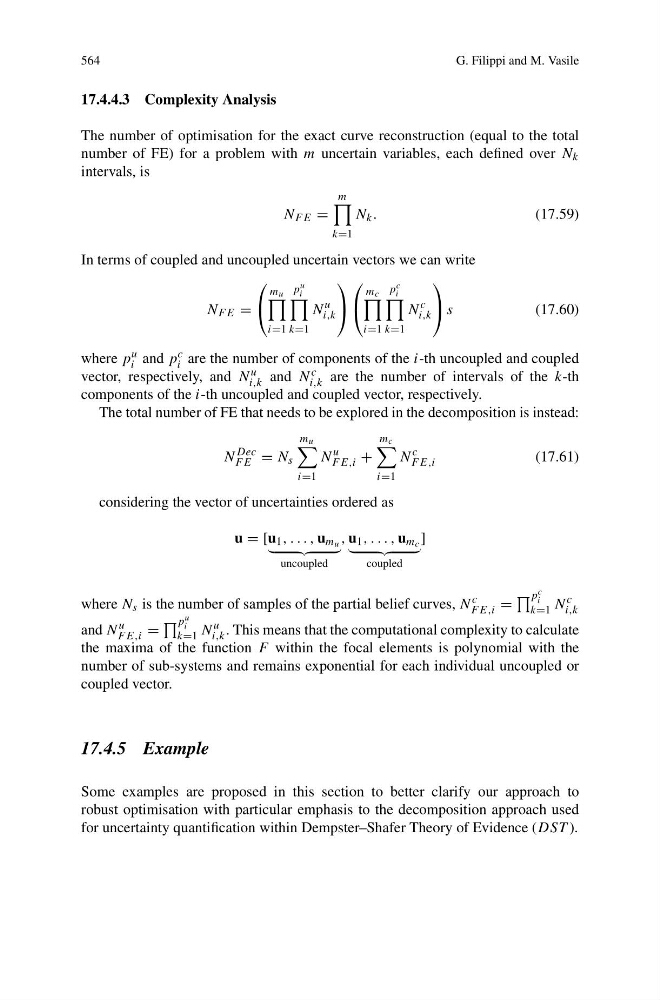
The number of optimisation for the exact curve reconstruction (equal to the total
number of FE) for a problem with m uncertain variables, each defined over N k
intervals, is
N F E =
m
k=1
N k .
(17.59)
In terms of coupled and uncoupled uncertain vectors we can write
N F E =
⎛
⎝
m u
i=1
p u
i
k=1
N
u
i,k
⎞
⎠
⎛
⎝
m c
i=1
p c
i
k=1
N
c
i,k
⎞
⎠ s
(17.60)
where p u
i and p c
i are the number of components of the i-th uncoupled and coupled
vector, respectively, and N u
i,k and N c
i,k are the number of intervals of the k-th
components of the i-th uncoupled and coupled vector, respectively.
The total number of FE that needs to be explored in the decomposition is instead:
N
Dec
F E = N s
m u
i=1
N
u
F E,i +
m c
i=1
N
c
F E,i
(17.61)
considering the vector of uncertainties ordered as
u = [u 1 , . . . , u m u
uncoupled
, u 1 , . . . , u m c
coupled
]
where N s is the number of samples of the partial belief curves, N c
F E,i =
p c
i
k=1 N c
i,k
and N u
F E,i =
p u
i
k=1 N u
i,k . This means that the computational complexity to calculate
the maxima of the function F within the focal elements is polynomial with the
number of sub-systems and remains exponential for each individual uncoupled or
coupled vector.
17.4.5 Example
Some examples are proposed in this section to better clarify our approach to
robust optimisation with particular emphasis to the decomposition approach used
for uncertainty quantification within Dempster–Shafer Theory of Evidence (DST ).