

16 Uncertainty Treatment Applications: High-Enthalpy Flow Ground Testing
527
s R i =
h R i
T
+
k B
m i
ln
T
σ i θ R i
(16.15)
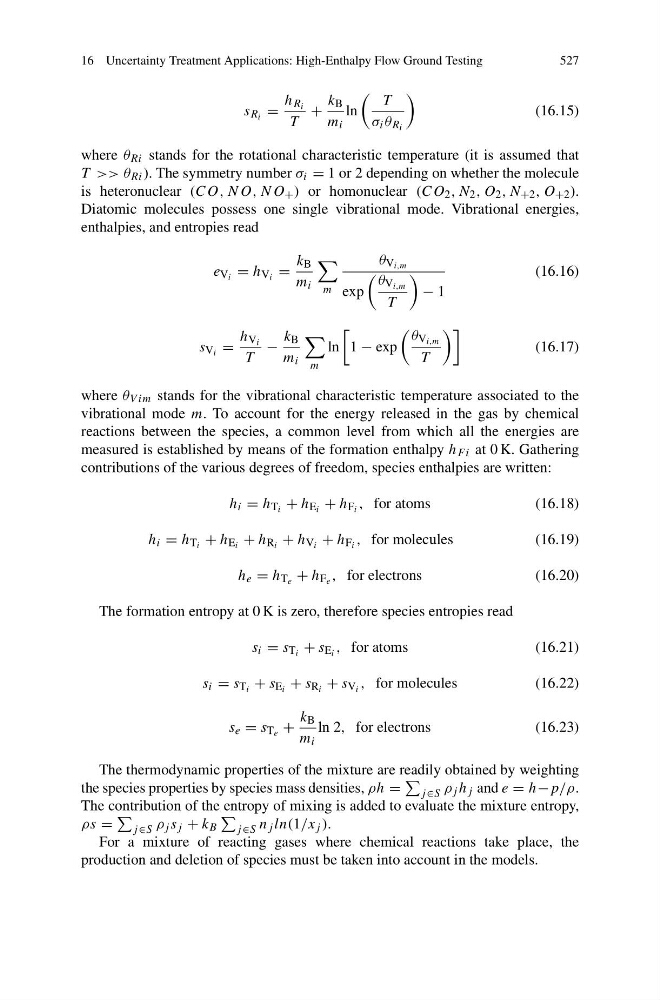
where θ Ri stands for the rotational characteristic temperature (it is assumed that
T >> θ Ri ). The symmetry number σ i = 1 or 2 depending on whether the molecule
is heteronuclear (CO, NO, NO + ) or homonuclear (CO 2 , N 2 , O 2 , N +2 , O +2 ).
Diatomic molecules possess one single vibrational mode. Vibrational energies,
enthalpies, and entropies read
e V i = h V i =
k B
m i
m
θ V i,m
exp
θ V i,m
T
− 1
(16.16)
s V i =
h V i
T
−
k B
m i
m
ln
1 − exp
θ V i,m
T
(16.17)
where θ V im stands for the vibrational characteristic temperature associated to the
vibrational mode m. To account for the energy released in the gas by chemical
reactions between the species, a common level from which all the energies are
measured is established by means of the formation enthalpy h F i at 0 K. Gathering
contributions of the various degrees of freedom, species enthalpies are written:
h i = h T i + h E i + h F i , for atoms
(16.18)
h i = h T i + h E i + h R i + h V i + h F i , for molecules
(16.19)
h e = h T e + h F e , for electrons
(16.20)
The formation entropy at 0 K is zero, therefore species entropies read
s i = s T i + s E i , for atoms
(16.21)
s i = s T i + s E i + s R i + s V i , for molecules
(16.22)
s e = s T e +
k B
m i
ln 2, for electrons
(16.23)
The thermodynamic properties of the mixture are readily obtained by weighting
the species properties by species mass densities, ρh =
j ∈S ρ j h j and e = h−p/ρ.
The contribution of the entropy of mixing is added to evaluate the mixture entropy,
ρs =
j ∈S ρ j s j + k B
j ∈S n j ln(1/x j ).
For a mixture of reacting gases where chemical reactions take place, the
production and deletion of species must be taken into account in the models.