

2 Introduction to Imprecise Probabilities
45
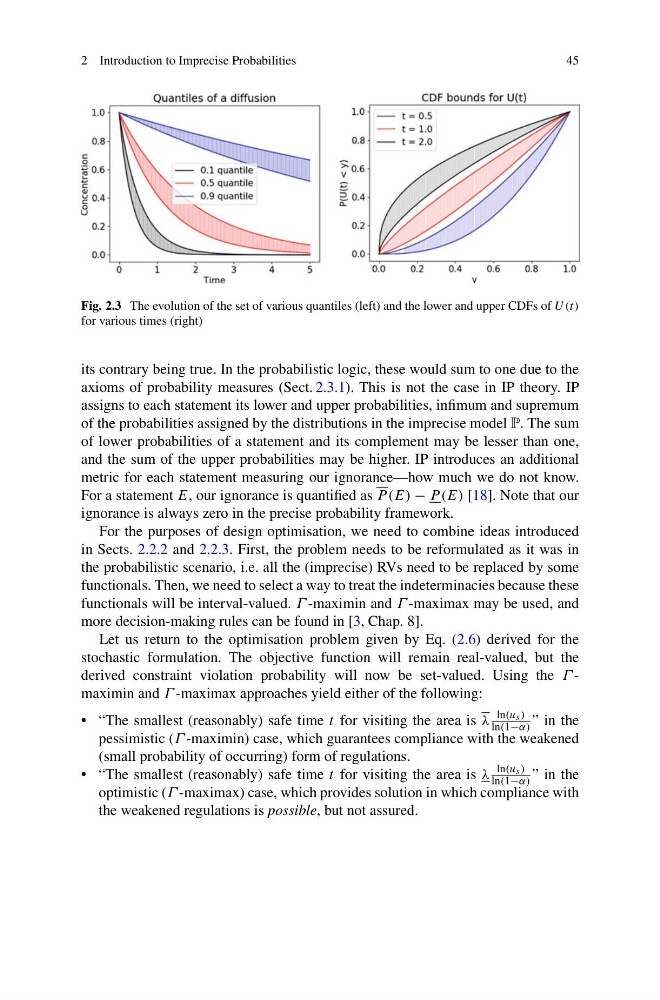
Fig. 2.3 The evolution of the set of various quantiles (left) and the lower and upper CDFs of U(t)
for various times (right)
its contrary being true. In the probabilistic logic, these would sum to one due to the
axioms of probability measures (Sect. 2.3.1). This is not the case in IP theory. IP
assigns to each statement its lower and upper probabilities, infimum and supremum
of the probabilities assigned by the distributions in the imprecise model P. The sum
of lower probabilities of a statement and its complement may be lesser than one,
and the sum of the upper probabilities may be higher. IP introduces an additional
metric for each statement measuring our ignorance—how much we do not know.
For a statement E, our ignorance is quantified as P (E) − P (E) [18]. Note that our
ignorance is always zero in the precise probability framework.
For the purposes of design optimisation, we need to combine ideas introduced
in Sects. 2.2.2 and 2.2.3. First, the problem needs to be reformulated as it was in
the probabilistic scenario, i.e. all the (imprecise) RVs need to be replaced by some
functionals. Then, we need to select a way to treat the indeterminacies because these
functionals will be interval-valued. Γ -maximin and Γ -maximax may be used, and
more decision-making rules can be found in [3, Chap. 8].
Let us return to the optimisation problem given by Eq. (2.6) derived for the
stochastic formulation. The objective function will remain real-valued, but the
derived constraint violation probability will now be set-valued. Using the Γ -
maximin and Γ -maximax approaches yield either of the following:
• “The smallest (reasonably) safe time t for visiting the area is λ
ln(u s )
ln(1−α) ” in the
pessimistic (Γ -maximin) case, which guarantees compliance with the weakened
(small probability of occurring) form of regulations.
• “The smallest (reasonably) safe time t for visiting the area is λ
ln(u s )
ln(1−α) ” in the
optimistic (Γ -maximax) case, which provides solution in which compliance with
the weakened regulations is possible, but not assured.
45
Fig. 2.3 The evolution of the set of various quantiles (left) and the lower and upper CDFs of U(t)
for various times (right)
its contrary being true. In the probabilistic logic, these would sum to one due to the
axioms of probability measures (Sect. 2.3.1). This is not the case in IP theory. IP
assigns to each statement its lower and upper probabilities, infimum and supremum
of the probabilities assigned by the distributions in the imprecise model P. The sum
of lower probabilities of a statement and its complement may be lesser than one,
and the sum of the upper probabilities may be higher. IP introduces an additional
metric for each statement measuring our ignorance—how much we do not know.
For a statement E, our ignorance is quantified as P (E) − P (E) [18]. Note that our
ignorance is always zero in the precise probability framework.
For the purposes of design optimisation, we need to combine ideas introduced
in Sects. 2.2.2 and 2.2.3. First, the problem needs to be reformulated as it was in
the probabilistic scenario, i.e. all the (imprecise) RVs need to be replaced by some
functionals. Then, we need to select a way to treat the indeterminacies because these
functionals will be interval-valued. Γ -maximin and Γ -maximax may be used, and
more decision-making rules can be found in [3, Chap. 8].
Let us return to the optimisation problem given by Eq. (2.6) derived for the
stochastic formulation. The objective function will remain real-valued, but the
derived constraint violation probability will now be set-valued. Using the Γ -
maximin and Γ -maximax approaches yield either of the following:
• “The smallest (reasonably) safe time t for visiting the area is λ
ln(u s )
ln(1−α) ” in the
pessimistic (Γ -maximin) case, which guarantees compliance with the weakened
(small probability of occurring) form of regulations.
• “The smallest (reasonably) safe time t for visiting the area is λ
ln(u s )
ln(1−α) ” in the
optimistic (Γ -maximax) case, which provides solution in which compliance with
the weakened regulations is possible, but not assured.