

15 In-flight Icing: Modeling, Prediction, and Uncertainty
497
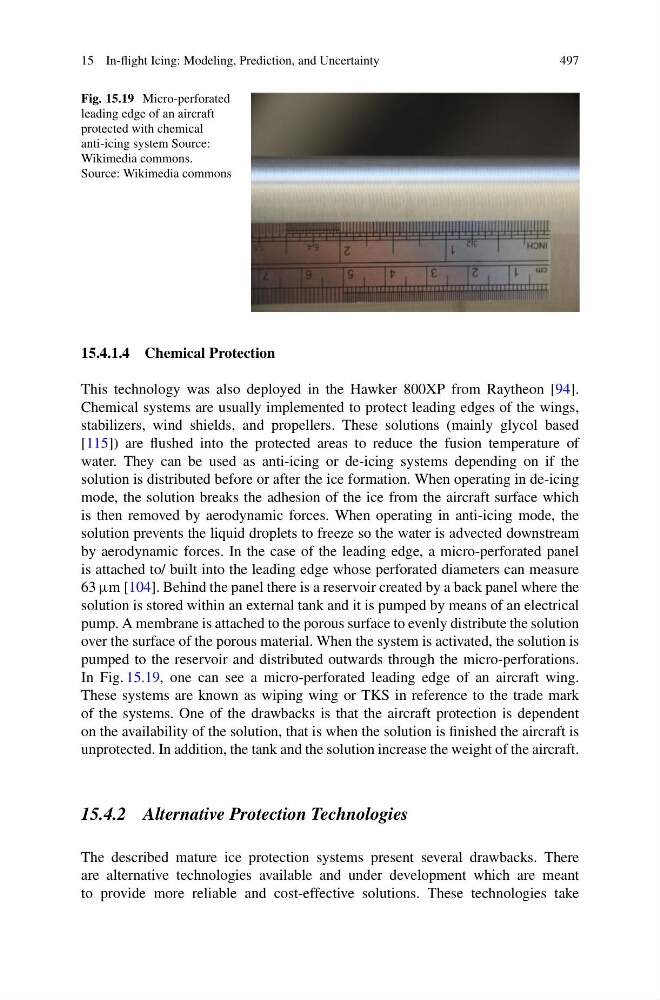
Fig. 15.19 Micro-perforated
leading edge of an aircraft
protected with chemical
anti-icing system Source:
Wikimedia commons.
Source: Wikimedia commons
15.4.1.4 Chemical Protection
This technology was also deployed in the Hawker 800XP from Raytheon [94].
Chemical systems are usually implemented to protect leading edges of the wings,
stabilizers, wind shields, and propellers. These solutions (mainly glycol based
[115]) are flushed into the protected areas to reduce the fusion temperature of
water. They can be used as anti-icing or de-icing systems depending on if the
solution is distributed before or after the ice formation. When operating in de-icing
mode, the solution breaks the adhesion of the ice from the aircraft surface which
is then removed by aerodynamic forces. When operating in anti-icing mode, the
solution prevents the liquid droplets to freeze so the water is advected downstream
by aerodynamic forces. In the case of the leading edge, a micro-perforated panel
is attached to/ built into the leading edge whose perforated diameters can measure
63 μm [104]. Behind the panel there is a reservoir created by a back panel where the
solution is stored within an external tank and it is pumped by means of an electrical
pump. A membrane is attached to the porous surface to evenly distribute the solution
over the surface of the porous material. When the system is activated, the solution is
pumped to the reservoir and distributed outwards through the micro-perforations.
In Fig. 15.19, one can see a micro-perforated leading edge of an aircraft wing.
These systems are known as wiping wing or TKS in reference to the trade mark
of the systems. One of the drawbacks is that the aircraft protection is dependent
on the availability of the solution, that is when the solution is finished the aircraft is
unprotected. In addition, the tank and the solution increase the weight of the aircraft.
15.4.2 Alternative Protection Technologies
The described mature ice protection systems present several drawbacks. There
are alternative technologies available and under development which are meant
to provide more reliable and cost-effective solutions. These technologies take
497
Fig. 15.19 Micro-perforated
leading edge of an aircraft
protected with chemical
anti-icing system Source:
Wikimedia commons.
Source: Wikimedia commons
15.4.1.4 Chemical Protection
This technology was also deployed in the Hawker 800XP from Raytheon [94].
Chemical systems are usually implemented to protect leading edges of the wings,
stabilizers, wind shields, and propellers. These solutions (mainly glycol based
[115]) are flushed into the protected areas to reduce the fusion temperature of
water. They can be used as anti-icing or de-icing systems depending on if the
solution is distributed before or after the ice formation. When operating in de-icing
mode, the solution breaks the adhesion of the ice from the aircraft surface which
is then removed by aerodynamic forces. When operating in anti-icing mode, the
solution prevents the liquid droplets to freeze so the water is advected downstream
by aerodynamic forces. In the case of the leading edge, a micro-perforated panel
is attached to/ built into the leading edge whose perforated diameters can measure
63 μm [104]. Behind the panel there is a reservoir created by a back panel where the
solution is stored within an external tank and it is pumped by means of an electrical
pump. A membrane is attached to the porous surface to evenly distribute the solution
over the surface of the porous material. When the system is activated, the solution is
pumped to the reservoir and distributed outwards through the micro-perforations.
In Fig. 15.19, one can see a micro-perforated leading edge of an aircraft wing.
These systems are known as wiping wing or TKS in reference to the trade mark
of the systems. One of the drawbacks is that the aircraft protection is dependent
on the availability of the solution, that is when the solution is finished the aircraft is
unprotected. In addition, the tank and the solution increase the weight of the aircraft.
15.4.2 Alternative Protection Technologies
The described mature ice protection systems present several drawbacks. There
are alternative technologies available and under development which are meant
to provide more reliable and cost-effective solutions. These technologies take