

15 In-flight Icing: Modeling, Prediction, and Uncertainty
469
15.2.4.3 Drop Impact
The research on the behavior of the impact of drops over solid surfaces or over fluid
films is a very active field. Although the first paper dates back to 1908, the process is
not fully understood [35]. Drop impact is very relevant on the field of ice accretion
study because it can describe in detail the interaction of the droplets with the aircraft
surfaces. In addition, it is key to the development of super-hydrophobic materials or
coatings that decrease the adhesion of the supercooled droplets on the surfaces of
the aircraft and thus the ice accreted. The characteristics of the impact are unique
for each fluid/gas/surface system [35]. Furthermore, the related parameters are the
density, viscosity, diameter, surface tension of the droplet, and impact velocity of the
droplet. The surface roughness and the wettability are also relevant to characterize
impact on solid surfaces [36]. The governing non-dimensional parameters are the
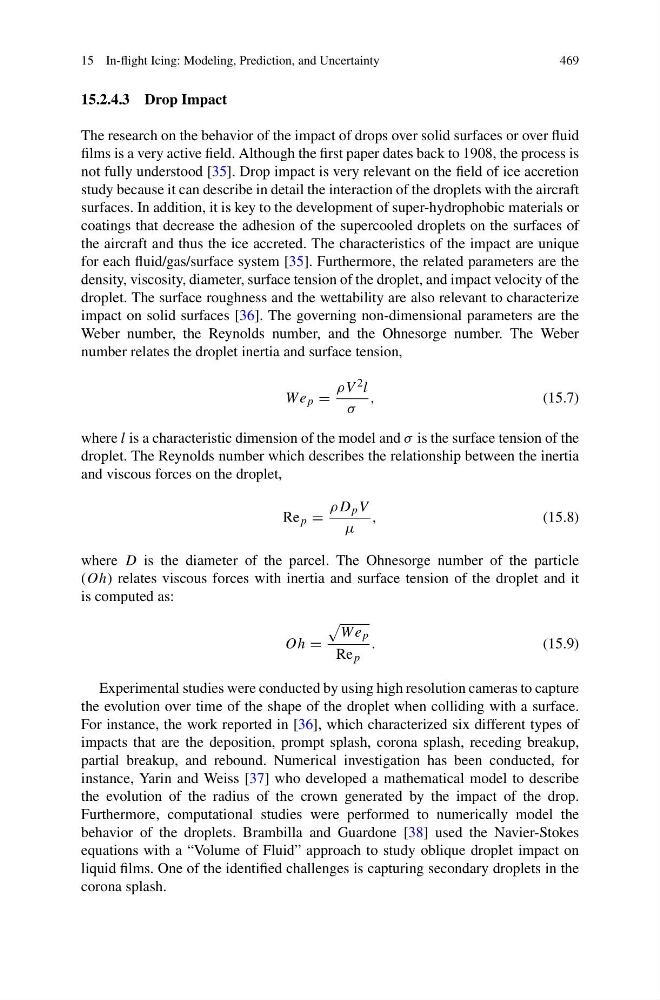
Weber number, the Reynolds number, and the Ohnesorge number. The Weber
number relates the droplet inertia and surface tension,
W e p =
ρV 2 l
σ
,
(15.7)
where l is a characteristic dimension of the model and σ is the surface tension of the
droplet. The Reynolds number which describes the relationship between the inertia
and viscous forces on the droplet,
Re p =
ρD p V
μ
,
(15.8)
where D is the diameter of the parcel. The Ohnesorge number of the particle
(Oh) relates viscous forces with inertia and surface tension of the droplet and it
is computed as:
Oh =
W e p
Re p
.
(15.9)
Experimental studies were conducted by using high resolution cameras to capture
the evolution over time of the shape of the droplet when colliding with a surface.
For instance, the work reported in [36], which characterized six different types of
impacts that are the deposition, prompt splash, corona splash, receding breakup,
partial breakup, and rebound. Numerical investigation has been conducted, for
instance, Yarin and Weiss [37] who developed a mathematical model to describe
the evolution of the radius of the crown generated by the impact of the drop.
Furthermore, computational studies were performed to numerically model the
behavior of the droplets. Brambilla and Guardone [38] used the Navier-Stokes
equations with a “Volume of Fluid” approach to study oblique droplet impact on
liquid films. One of the identified challenges is capturing secondary droplets in the
corona splash.
469
15.2.4.3 Drop Impact
The research on the behavior of the impact of drops over solid surfaces or over fluid
films is a very active field. Although the first paper dates back to 1908, the process is
not fully understood [35]. Drop impact is very relevant on the field of ice accretion
study because it can describe in detail the interaction of the droplets with the aircraft
surfaces. In addition, it is key to the development of super-hydrophobic materials or
coatings that decrease the adhesion of the supercooled droplets on the surfaces of
the aircraft and thus the ice accreted. The characteristics of the impact are unique
for each fluid/gas/surface system [35]. Furthermore, the related parameters are the
density, viscosity, diameter, surface tension of the droplet, and impact velocity of the
droplet. The surface roughness and the wettability are also relevant to characterize
impact on solid surfaces [36]. The governing non-dimensional parameters are the
Weber number, the Reynolds number, and the Ohnesorge number. The Weber
number relates the droplet inertia and surface tension,
W e p =
ρV 2 l
σ
,
(15.7)
where l is a characteristic dimension of the model and σ is the surface tension of the
droplet. The Reynolds number which describes the relationship between the inertia
and viscous forces on the droplet,
Re p =
ρD p V
μ
,
(15.8)
where D is the diameter of the parcel. The Ohnesorge number of the particle
(Oh) relates viscous forces with inertia and surface tension of the droplet and it
is computed as:
Oh =
W e p
Re p
.
(15.9)
Experimental studies were conducted by using high resolution cameras to capture
the evolution over time of the shape of the droplet when colliding with a surface.
For instance, the work reported in [36], which characterized six different types of
impacts that are the deposition, prompt splash, corona splash, receding breakup,
partial breakup, and rebound. Numerical investigation has been conducted, for
instance, Yarin and Weiss [37] who developed a mathematical model to describe
the evolution of the radius of the crown generated by the impact of the drop.
Furthermore, computational studies were performed to numerically model the
behavior of the droplets. Brambilla and Guardone [38] used the Navier-Stokes
equations with a “Volume of Fluid” approach to study oblique droplet impact on
liquid films. One of the identified challenges is capturing secondary droplets in the
corona splash.