

40
D. Krpelík and T. Basu
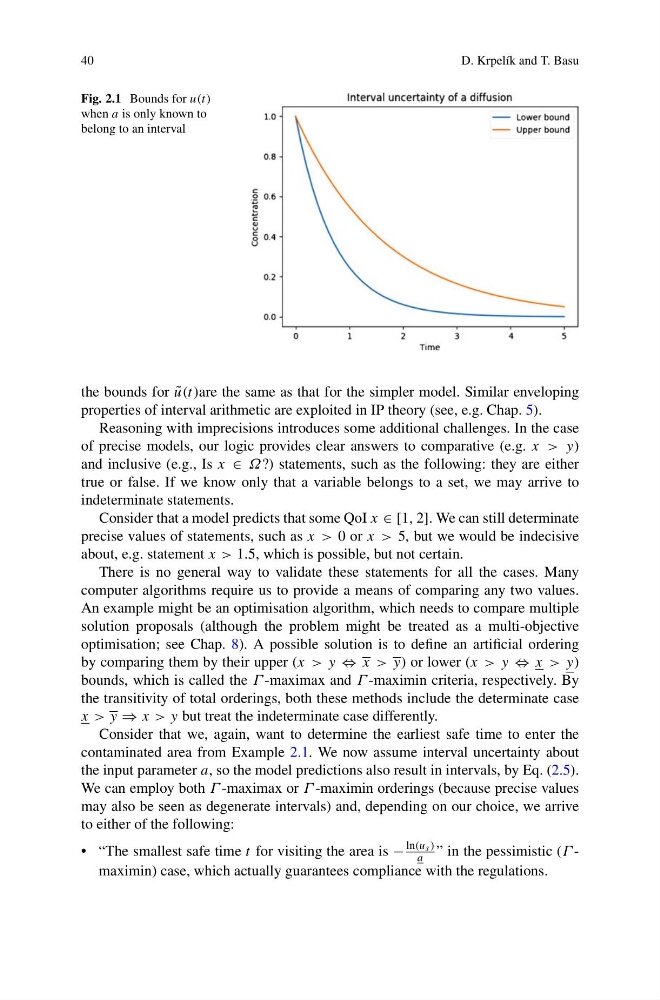
Fig. 2.1 Bounds for u(t)
when a is only known to
belong to an interval
the bounds for ˜
u(t)are the same as that for the simpler model. Similar enveloping
properties of interval arithmetic are exploited in IP theory (see, e.g. Chap. 5).
Reasoning with imprecisions introduces some additional challenges. In the case
of precise models, our logic provides clear answers to comparative (e.g. x > y)
and inclusive (e.g., Is x ∈ Ω?) statements, such as the following: they are either
true or false. If we know only that a variable belongs to a set, we may arrive to
indeterminate statements.
Consider that a model predicts that some QoI x ∈ [1, 2]. We can still determinate
precise values of statements, such as x > 0 or x > 5, but we would be indecisive
about, e.g. statement x > 1.5, which is possible, but not certain.
There is no general way to validate these statements for all the cases. Many
computer algorithms require us to provide a means of comparing any two values.
An example might be an optimisation algorithm, which needs to compare multiple
solution proposals (although the problem might be treated as a multi-objective
optimisation; see Chap. 8). A possible solution is to define an artificial ordering
by comparing them by their upper (x > y ⇔ x > y) or lower (x > y ⇔ x > y)
bounds, which is called the Γ -maximax and Γ -maximin criteria, respectively. By
the transitivity of total orderings, both these methods include the determinate case
x > y ⇒ x > y but treat the indeterminate case differently.
Consider that we, again, want to determine the earliest safe time to enter the
contaminated area from Example 2.1. We now assume interval uncertainty about
the input parameter a, so the model predictions also result in intervals, by Eq. (2.5).
We can employ both Γ -maximax or Γ -maximin orderings (because precise values
may also be seen as degenerate intervals) and, depending on our choice, we arrive
to either of the following:
• “The smallest safe time t for visiting the area is −
ln(u s )
a ” in the pessimistic (Γ -
maximin) case, which actually guarantees compliance with the regulations.
D. Krpelík and T. Basu
Fig. 2.1 Bounds for u(t)
when a is only known to
belong to an interval
the bounds for ˜
u(t)are the same as that for the simpler model. Similar enveloping
properties of interval arithmetic are exploited in IP theory (see, e.g. Chap. 5).
Reasoning with imprecisions introduces some additional challenges. In the case
of precise models, our logic provides clear answers to comparative (e.g. x > y)
and inclusive (e.g., Is x ∈ Ω?) statements, such as the following: they are either
true or false. If we know only that a variable belongs to a set, we may arrive to
indeterminate statements.
Consider that a model predicts that some QoI x ∈ [1, 2]. We can still determinate
precise values of statements, such as x > 0 or x > 5, but we would be indecisive
about, e.g. statement x > 1.5, which is possible, but not certain.
There is no general way to validate these statements for all the cases. Many
computer algorithms require us to provide a means of comparing any two values.
An example might be an optimisation algorithm, which needs to compare multiple
solution proposals (although the problem might be treated as a multi-objective
optimisation; see Chap. 8). A possible solution is to define an artificial ordering
by comparing them by their upper (x > y ⇔ x > y) or lower (x > y ⇔ x > y)
bounds, which is called the Γ -maximax and Γ -maximin criteria, respectively. By
the transitivity of total orderings, both these methods include the determinate case
x > y ⇒ x > y but treat the indeterminate case differently.
Consider that we, again, want to determine the earliest safe time to enter the
contaminated area from Example 2.1. We now assume interval uncertainty about
the input parameter a, so the model predictions also result in intervals, by Eq. (2.5).
We can employ both Γ -maximax or Γ -maximin orderings (because precise values
may also be seen as degenerate intervals) and, depending on our choice, we arrive
to either of the following:
• “The smallest safe time t for visiting the area is −
ln(u s )
a ” in the pessimistic (Γ -
maximin) case, which actually guarantees compliance with the regulations.