

412
E. M. Tirado and D. Quagliarella
indeterminacy invariably present in the initial and operating conditions [21] of the
system to be controlled.
Furthermore, in an industrial product, there are often manufacturing tolerances or
deviations from the nominal characteristics of the components that are not quickly
and economically eliminable. Therefore, an optimization process that allows taking
into account the sources of uncertainty and their effects on the performance to
be improved is often vital for many fields of human activities, from logistics to
economics to engineering and medicine. There are many approaches to robust
optimization, and some are well established. However, the focus of scientific
literature is often on improving the computational performance of the optimization
processes in conditions of uncertainty [10, 19]. Indeed, in this type of procedure, the
quantity of interest is a statistical measure that requires the evaluation of a sample
of the population elements, often quite large to reach acceptable reliability.
Here, instead, rather than on efficient sampling processes, the focus is on the
robust optimization problem definition itself. In particular, the primary theme is
the use of the so-called risk functions and their choice according to the robust
optimization problem at hand. In particular, the use of the Value-at-Risk (VaR)
and the Conditional Value-at-Risk (CVaR) is introduced. These risk functions were
introduced and are still widely used in financial engineering. However, as this
chapter illustrates, they are well suited to describe and formalize optimization
problems in different engineering sectors [13]. In particular, their versatility is here
demonstrated by applying CVaR to the performance improvement of a wing section.
13.2 Optimization Under Uncertainty
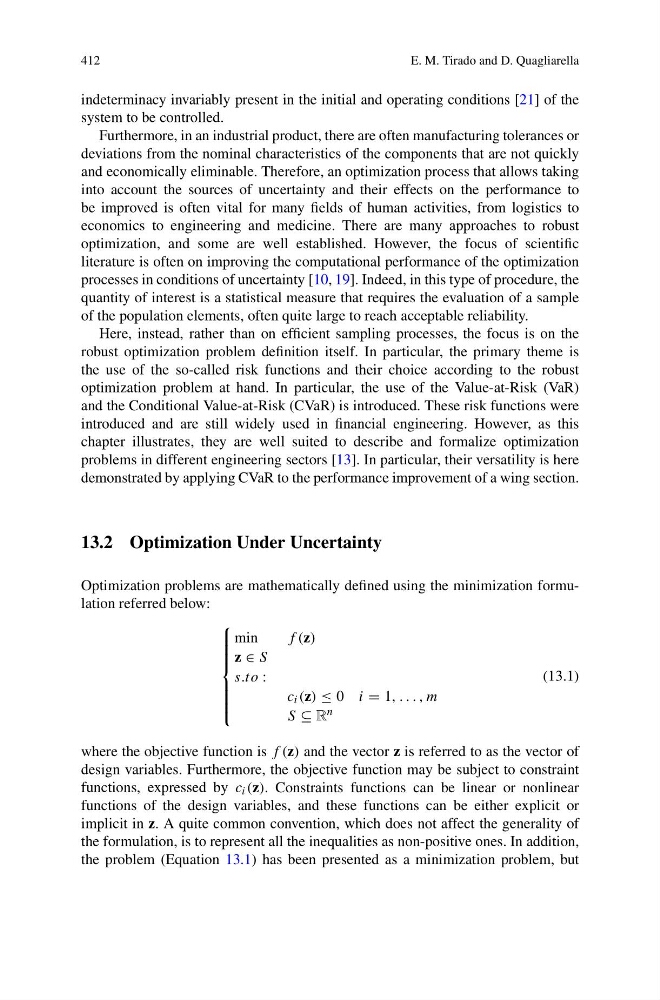
Optimization problems are mathematically defined using the minimization formulation referred below:
⎧
⎪ ⎪ ⎪ ⎪ ⎪ ⎨
⎪ ⎪ ⎪ ⎪ ⎪ ⎩
min
f (z)
z ∈ S
s.to :
c i (z) ≤ 0 i = 1, . . . , m
S ⊆ R n
(13.1)
where the objective function is f (z) and the vector z is referred to as the vector of
design variables. Furthermore, the objective function may be subject to constraint
functions, expressed by c i (z). Constraints functions can be linear or nonlinear
functions of the design variables, and these functions can be either explicit or
implicit in z. A quite common convention, which does not affect the generality of
the formulation, is to represent all the inequalities as non-positive ones. In addition,
the problem (Equation 13.1) has been presented as a minimization problem, but
E. M. Tirado and D. Quagliarella
indeterminacy invariably present in the initial and operating conditions [21] of the
system to be controlled.
Furthermore, in an industrial product, there are often manufacturing tolerances or
deviations from the nominal characteristics of the components that are not quickly
and economically eliminable. Therefore, an optimization process that allows taking
into account the sources of uncertainty and their effects on the performance to
be improved is often vital for many fields of human activities, from logistics to
economics to engineering and medicine. There are many approaches to robust
optimization, and some are well established. However, the focus of scientific
literature is often on improving the computational performance of the optimization
processes in conditions of uncertainty [10, 19]. Indeed, in this type of procedure, the
quantity of interest is a statistical measure that requires the evaluation of a sample
of the population elements, often quite large to reach acceptable reliability.
Here, instead, rather than on efficient sampling processes, the focus is on the
robust optimization problem definition itself. In particular, the primary theme is
the use of the so-called risk functions and their choice according to the robust
optimization problem at hand. In particular, the use of the Value-at-Risk (VaR)
and the Conditional Value-at-Risk (CVaR) is introduced. These risk functions were
introduced and are still widely used in financial engineering. However, as this
chapter illustrates, they are well suited to describe and formalize optimization
problems in different engineering sectors [13]. In particular, their versatility is here
demonstrated by applying CVaR to the performance improvement of a wing section.
13.2 Optimization Under Uncertainty
Optimization problems are mathematically defined using the minimization formulation referred below:
⎧
⎪ ⎪ ⎪ ⎪ ⎪ ⎨
⎪ ⎪ ⎪ ⎪ ⎪ ⎩
min
f (z)
z ∈ S
s.to :
c i (z) ≤ 0 i = 1, . . . , m
S ⊆ R n
(13.1)
where the objective function is f (z) and the vector z is referred to as the vector of
design variables. Furthermore, the objective function may be subject to constraint
functions, expressed by c i (z). Constraints functions can be linear or nonlinear
functions of the design variables, and these functions can be either explicit or
implicit in z. A quite common convention, which does not affect the generality of
the formulation, is to represent all the inequalities as non-positive ones. In addition,
the problem (Equation 13.1) has been presented as a minimization problem, but