

374
M. Antoniou et al.
decision space that the population occupies. In that regard, this control adjusts the
control parameters that are suitable for the current landscape. Consequently, this
makes such an optimisation dynamic (see Sect. 11.5.2), and the optimal values of
control parameters change during optimisation process.
The following list presents some of the self-adaptive implementations:
• Self-adaptation mechanism of mutation rates in GA [51]
• jDE—self-adaptive control parameter settings of differential evolution (DE)
algorithm [26, 52]
• Self-adaptive refinement of mutation rates in EA [10]
• Self-adaptive mutation rate in the (1,λ) EA [53]
11.4.4 Tuning vs. Control
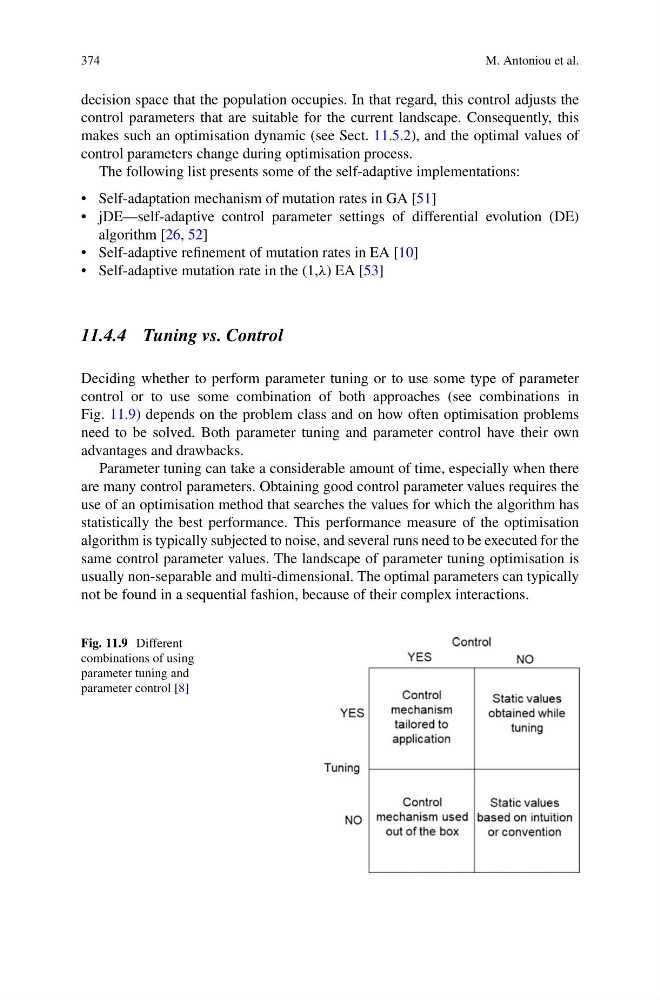
Deciding whether to perform parameter tuning or to use some type of parameter
control or to use some combination of both approaches (see combinations in
Fig. 11.9) depends on the problem class and on how often optimisation problems
need to be solved. Both parameter tuning and parameter control have their own
advantages and drawbacks.
Parameter tuning can take a considerable amount of time, especially when there
are many control parameters. Obtaining good control parameter values requires the
use of an optimisation method that searches the values for which the algorithm has
statistically the best performance. This performance measure of the optimisation
algorithm is typically subjected to noise, and several runs need to be executed for the
same control parameter values. The landscape of parameter tuning optimisation is
usually non-separable and multi-dimensional. The optimal parameters can typically
not be found in a sequential fashion, because of their complex interactions.
Fig. 11.9 Different
combinations of using
parameter tuning and
parameter control [8]
M. Antoniou et al.
decision space that the population occupies. In that regard, this control adjusts the
control parameters that are suitable for the current landscape. Consequently, this
makes such an optimisation dynamic (see Sect. 11.5.2), and the optimal values of
control parameters change during optimisation process.
The following list presents some of the self-adaptive implementations:
• Self-adaptation mechanism of mutation rates in GA [51]
• jDE—self-adaptive control parameter settings of differential evolution (DE)
algorithm [26, 52]
• Self-adaptive refinement of mutation rates in EA [10]
• Self-adaptive mutation rate in the (1,λ) EA [53]
11.4.4 Tuning vs. Control
Deciding whether to perform parameter tuning or to use some type of parameter
control or to use some combination of both approaches (see combinations in
Fig. 11.9) depends on the problem class and on how often optimisation problems
need to be solved. Both parameter tuning and parameter control have their own
advantages and drawbacks.
Parameter tuning can take a considerable amount of time, especially when there
are many control parameters. Obtaining good control parameter values requires the
use of an optimisation method that searches the values for which the algorithm has
statistically the best performance. This performance measure of the optimisation
algorithm is typically subjected to noise, and several runs need to be executed for the
same control parameter values. The landscape of parameter tuning optimisation is
usually non-separable and multi-dimensional. The optimal parameters can typically
not be found in a sequential fashion, because of their complex interactions.
Fig. 11.9 Different
combinations of using
parameter tuning and
parameter control [8]