

366
M. Antoniou et al.
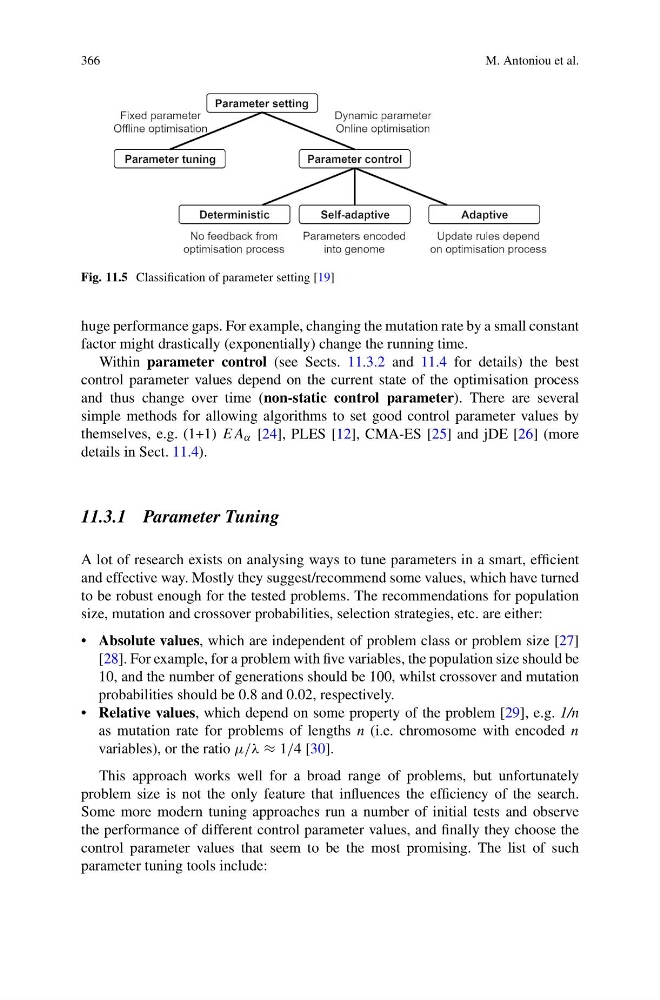
Fig. 11.5 Classification of parameter setting [19]
huge performance gaps. For example, changing the mutation rate by a small constant
factor might drastically (exponentially) change the running time.
Within parameter control (see Sects. 11.3.2 and 11.4 for details) the best
control parameter values depend on the current state of the optimisation process
and thus change over time (non-static control parameter). There are several
simple methods for allowing algorithms to set good control parameter values by
themselves, e.g. (1+1) EA α [24], PLES [12], CMA-ES [25] and jDE [26] (more
details in Sect. 11.4).
11.3.1 Parameter Tuning
A lot of research exists on analysing ways to tune parameters in a smart, efficient
and effective way. Mostly they suggest/recommend some values, which have turned
to be robust enough for the tested problems. The recommendations for population
size, mutation and crossover probabilities, selection strategies, etc. are either:
• Absolute values, which are independent of problem class or problem size [27]
[28]. For example, for a problem with five variables, the population size should be
10, and the number of generations should be 100, whilst crossover and mutation
probabilities should be 0.8 and 0.02, respectively.
• Relative values, which depend on some property of the problem [29], e.g. 1/n
as mutation rate for problems of lengths n (i.e. chromosome with encoded n
variables), or the ratio μ/λ ≈ 1/4 [30].
This approach works well for a broad range of problems, but unfortunately
problem size is not the only feature that influences the efficiency of the search.
Some more modern tuning approaches run a number of initial tests and observe
the performance of different control parameter values, and finally they choose the
control parameter values that seem to be the most promising. The list of such
parameter tuning tools include:
M. Antoniou et al.
Fig. 11.5 Classification of parameter setting [19]
huge performance gaps. For example, changing the mutation rate by a small constant
factor might drastically (exponentially) change the running time.
Within parameter control (see Sects. 11.3.2 and 11.4 for details) the best
control parameter values depend on the current state of the optimisation process
and thus change over time (non-static control parameter). There are several
simple methods for allowing algorithms to set good control parameter values by
themselves, e.g. (1+1) EA α [24], PLES [12], CMA-ES [25] and jDE [26] (more
details in Sect. 11.4).
11.3.1 Parameter Tuning
A lot of research exists on analysing ways to tune parameters in a smart, efficient
and effective way. Mostly they suggest/recommend some values, which have turned
to be robust enough for the tested problems. The recommendations for population
size, mutation and crossover probabilities, selection strategies, etc. are either:
• Absolute values, which are independent of problem class or problem size [27]
[28]. For example, for a problem with five variables, the population size should be
10, and the number of generations should be 100, whilst crossover and mutation
probabilities should be 0.8 and 0.02, respectively.
• Relative values, which depend on some property of the problem [29], e.g. 1/n
as mutation rate for problems of lengths n (i.e. chromosome with encoded n
variables), or the ratio μ/λ ≈ 1/4 [30].
This approach works well for a broad range of problems, but unfortunately
problem size is not the only feature that influences the efficiency of the search.
Some more modern tuning approaches run a number of initial tests and observe
the performance of different control parameter values, and finally they choose the
control parameter values that seem to be the most promising. The list of such
parameter tuning tools include: