

364
M. Antoniou et al.
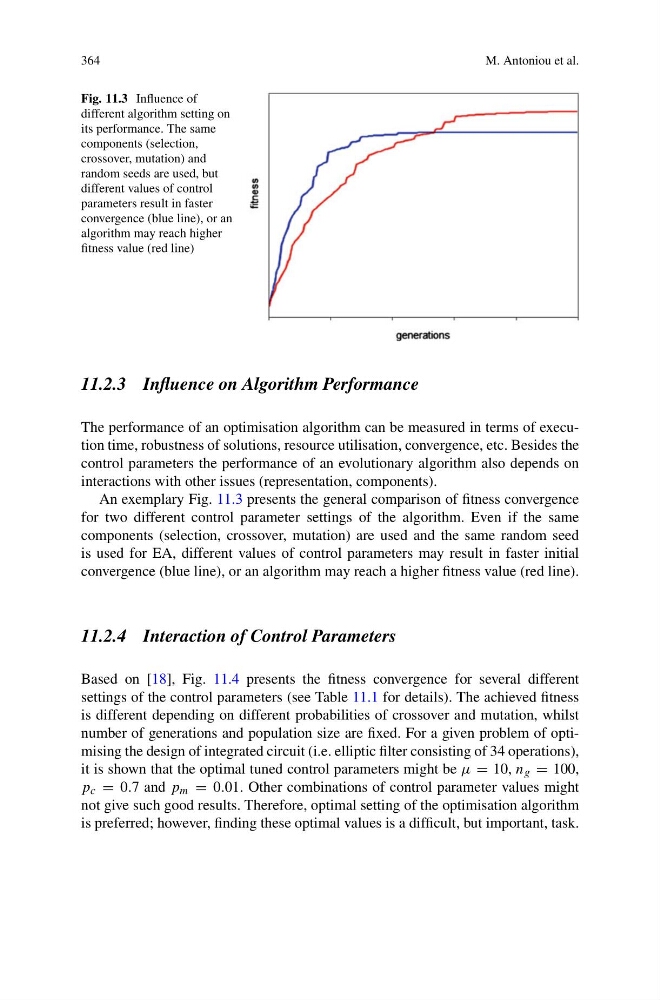
Fig. 11.3 Influence of
different algorithm setting on
its performance. The same
components (selection,
crossover, mutation) and
random seeds are used, but
different values of control
parameters result in faster
convergence (blue line), or an
algorithm may reach higher
fitness value (red line)
11.2.3 Influence on Algorithm Performance
The performance of an optimisation algorithm can be measured in terms of execution time, robustness of solutions, resource utilisation, convergence, etc. Besides the
control parameters the performance of an evolutionary algorithm also depends on
interactions with other issues (representation, components).
An exemplary Fig. 11.3 presents the general comparison of fitness convergence
for two different control parameter settings of the algorithm. Even if the same
components (selection, crossover, mutation) are used and the same random seed
is used for EA, different values of control parameters may result in faster initial
convergence (blue line), or an algorithm may reach a higher fitness value (red line).
11.2.4 Interaction of Control Parameters
Based on [18], Fig. 11.4 presents the fitness convergence for several different
settings of the control parameters (see Table 11.1 for details). The achieved fitness
is different depending on different probabilities of crossover and mutation, whilst
number of generations and population size are fixed. For a given problem of optimising the design of integrated circuit (i.e. elliptic filter consisting of 34 operations),
it is shown that the optimal tuned control parameters might be μ = 10, n g = 100,
p c = 0.7 and p m = 0.01. Other combinations of control parameter values might
not give such good results. Therefore, optimal setting of the optimisation algorithm
is preferred; however, finding these optimal values is a difficult, but important, task.
M. Antoniou et al.
Fig. 11.3 Influence of
different algorithm setting on
its performance. The same
components (selection,
crossover, mutation) and
random seeds are used, but
different values of control
parameters result in faster
convergence (blue line), or an
algorithm may reach higher
fitness value (red line)
11.2.3 Influence on Algorithm Performance
The performance of an optimisation algorithm can be measured in terms of execution time, robustness of solutions, resource utilisation, convergence, etc. Besides the
control parameters the performance of an evolutionary algorithm also depends on
interactions with other issues (representation, components).
An exemplary Fig. 11.3 presents the general comparison of fitness convergence
for two different control parameter settings of the algorithm. Even if the same
components (selection, crossover, mutation) are used and the same random seed
is used for EA, different values of control parameters may result in faster initial
convergence (blue line), or an algorithm may reach a higher fitness value (red line).
11.2.4 Interaction of Control Parameters
Based on [18], Fig. 11.4 presents the fitness convergence for several different
settings of the control parameters (see Table 11.1 for details). The achieved fitness
is different depending on different probabilities of crossover and mutation, whilst
number of generations and population size are fixed. For a given problem of optimising the design of integrated circuit (i.e. elliptic filter consisting of 34 operations),
it is shown that the optimal tuned control parameters might be μ = 10, n g = 100,
p c = 0.7 and p m = 0.01. Other combinations of control parameter values might
not give such good results. Therefore, optimal setting of the optimisation algorithm
is preferred; however, finding these optimal values is a difficult, but important, task.